Hanuman Chalisa Verses 11–20: Strength, Devotion, and Divine Grace in Daily Life ✨🙏
The Hanuman Chalisa is one of the most beloved devotional hymns in the spiritual tradition of bhakti. Composed by Goswami Tulsidas, it presents not only praise of Hanuman but also a roadmap for inner transformation. Each verse carries symbolic meaning that guides the devotee toward courage, humility, discipline, and unwavering devotion. While the earlier verses describe Hanuman’s strength, wisdom, and divine qualities, verses 11 to 20 move deeper into his actions and their spiritual implications. These verses illustrate how devotion expresses itself in service, how faith overcomes impossible obstacles, and how divine grace flows through selfless action.
This section of the Hanuman Chalisa shifts the focus from description to demonstration. Hanuman is no longer only praised. He is shown actively helping, guiding, protecting, and transforming situations. These verses highlight moments from the Ramayana that reveal his character. He revives Lakshman, receives Lord Ram’s embrace, is honored by sages, guides Sugriva and Vibhishan, leaps toward the sun, crosses the ocean, and makes difficult tasks easy through divine grace. Each event carries deep symbolic meaning for spiritual growth.
Verses 11 to 20 also emphasize the relationship between effort and grace. Hanuman represents the ideal devotee who acts with total sincerity. He does not hesitate, calculate personal benefit, or seek recognition. His actions flow naturally from devotion. Because of this purity, divine grace supports him. These verses teach that when action is aligned with truth and compassion, even the most difficult tasks become possible. The devotee learns that faith is not passive. Faith is expressed through courageous action.
By studying verses 11 to 20, the devotee learns practical spirituality. Instead of abstract philosophy, these verses provide examples. Help others, remain humble, act courageously, follow conscience, trust grace, and remember the divine. These principles create balance in life.
This section of the Hanuman Chalisa is especially powerful for those facing challenges. It inspires resilience. It encourages action. It removes fear. It strengthens faith. It reminds the devotee that inner strength is always available.
As we explore each verse in detail, we will examine its spiritual symbolism, reflect on its deeper meaning, and apply its wisdom to daily life. These verses are not only stories from the Ramayana. They are mirrors reflecting our own journey. Through contemplation, the devotee gradually embodies Hanuman’s qualities.
In this way, verses 11 to 20 become a guide for living with courage, devotion, humility, and compassion. They remind us that divine grace supports sincere effort, that service is the highest form of devotion, and that remembering Hanuman awakens inner strength.
Chaupai # 11
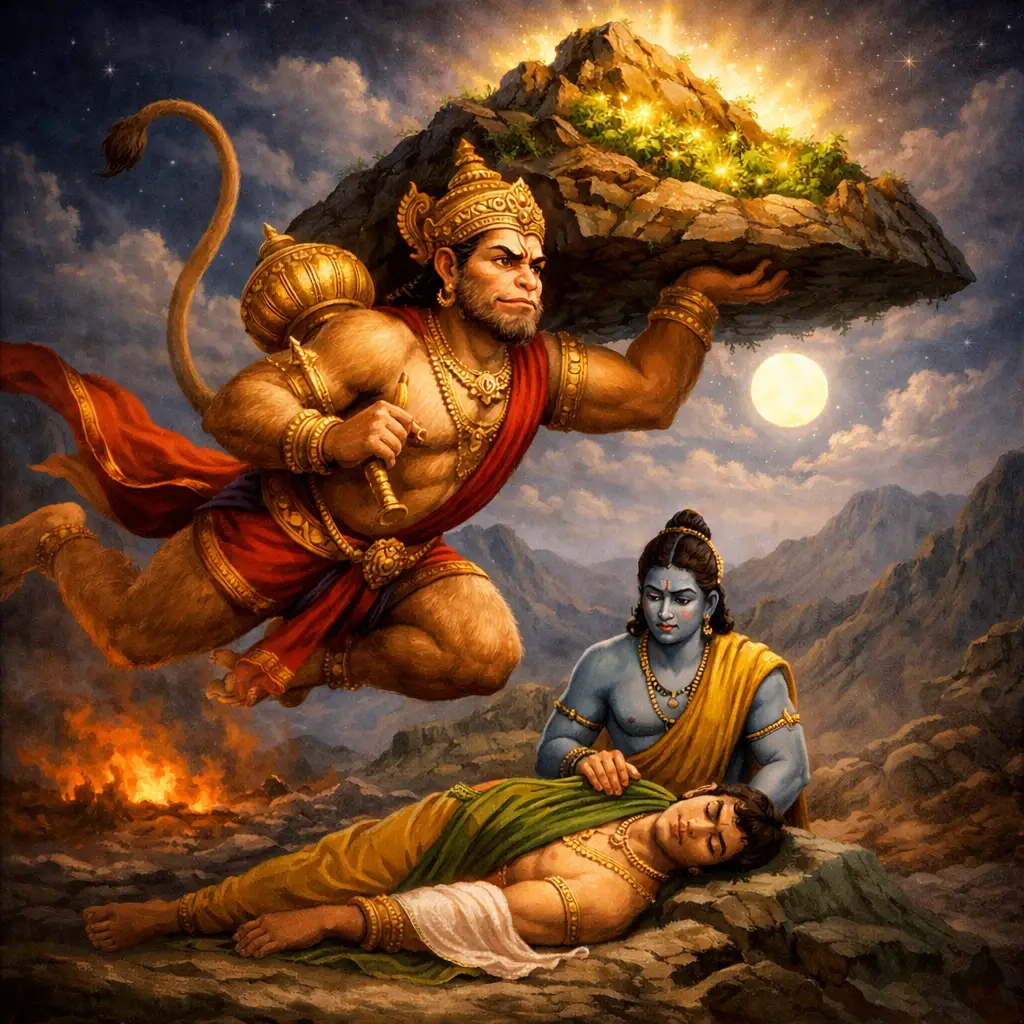
लाय सजीवन लखन जियाए, श्री रघुबीर हरषि उर लाए॥११॥
Laaye sanjeevan lakhana jiyaaye, Shree Raghuveer harashi urr laaye (11).
Meaning: Bringing the magic-herb Sanjivani, you revived Shree Lakshman and Lord Rama joyfully embraced you.
Spiritual Significance
This verse recalls the moment when Hanuman brought the Sanjeevani herb to revive Lakshman. Lakshman represents the disciplined mind that supports righteousness. When Lakshman falls unconscious, it symbolizes the weakening of spiritual resolve. Hanuman’s journey to bring the life restoring herb represents devotion overcoming all obstacles.
Hanuman did not stop to calculate difficulty. He did not question his capacity. He acted with urgency and faith. When he could not identify the herb, he lifted the entire mountain. This reflects a deeper spiritual truth. When clarity is absent, devotion still finds a way. Instead of hesitation, Hanuman chose decisive action.
Shri Ram embracing Hanuman afterward symbolizes divine grace responding to selfless service. The embrace represents the highest reward, union with the divine.
Reflection
This verse teaches that true devotion is not passive. It is active compassion. When someone is suffering, the devotee does not delay. Hanuman shows that service done without ego draws divine love.
Lakshman’s revival also suggests that faith revives inner strength. When life feels exhausting, when clarity is lost, remembering Hanuman helps restore courage and determination.
This verse encourages us to move beyond doubt. Instead of asking whether we can help, we act with sincerity. Devotion gives strength beyond calculation.
Daily Application
In daily life, this verse teaches us to help others immediately. When a friend is struggling, offer support. When family members need encouragement, give time. When someone is in distress, respond with compassion.
It also applies to personal struggles. When motivation fades, instead of waiting for inspiration, take action. Even small steps revive energy.
This verse can be remembered when facing urgency. Say mentally, "Hanuman gives strength to revive my inner discipline." Acting with faith becomes the Sanjeevani for the modern mind.
Chaupai # 12
रघुपति कीन्ही बहुत बड़ाई, तुम मम प्रिय भरत-हि सम भाई॥१२॥
Raghupati keenhi bahut badai, tum mum priya, Bhartahi sum bhai (12).
Meaning: Raghupati or Lord Ram praised you immensely and overflowing with gratitude, He said that you are His dear brother in the same way as Bharat.
Spiritual Significance
Lord Ram praises Hanuman and declares him as dear as Bharat. Bharat represents pure devotion without desire for power. Comparing Hanuman to Bharat places him among the highest devotees.
This verse shows that the divine values devotion over achievement. Hanuman’s greatness lies not in power alone but in humility and love. Despite immense strength, he remained a servant.
Ram’s praise also reveals that selfless service never goes unnoticed. The divine recognizes sincerity, even if the world does not.
Reflection
This verse invites us to reflect on the nature of love and devotion. Hanuman never sought recognition. He worked silently. Yet divine grace elevated him.
It reminds us that spiritual growth is not measured by knowledge or status. It is measured by sincerity. The heart that serves without ego becomes beloved to the divine.
Another reflection is about humility. Hanuman did not change after praise. He remained grounded. Praise did not inflate his ego.
Daily Application
In modern life, this verse encourages working without seeking validation. Help others without expecting appreciation. Serve your family quietly. Do your work sincerely.
When praised, remain humble. When ignored, remain steady. True reward is inner peace.
This verse also encourages seeing service as sacred. Helping parents, guiding children, supporting colleagues, all become acts of devotion.
Chaupai # 13

सहस बदन तुम्हरो जस गावै, अस कहि श्रीपति कंठ लगावै॥१३॥
Sahas badan tumharo yash gaave, Asa kahi Shripati kanth lagaave (13).
Rama said that even a thousand mouths cannot fully describe your glory and embraced you.
Spiritual Significance
This verse describes Ram saying that even a thousand mouths cannot fully sing Hanuman’s glory. The divine acknowledging the devotee’s greatness is profound. It reveals that devotion elevates a person beyond ordinary limitations.
The thousand mouths symbolize infinite praise. It suggests that Hanuman’s qualities are endless. Strength, humility, wisdom, compassion, loyalty, and courage all combine in him.
Ram embracing Hanuman again symbolizes union. When ego dissolves, closeness with the divine naturally arises.
Reflection
This verse inspires us to reflect on inner virtues. Glory does not come from external achievements but from character. Hanuman’s greatness comes from purity of intention.
It also teaches that divine love is intimate. The embrace symbolizes closeness between devotee and divine. Devotion is not distant worship. It is relationship.
This verse also encourages gratitude. Ram publicly honors Hanuman. The divine appreciates even small acts done with sincerity.
Daily Application
Practice appreciating others. Acknowledge good qualities in people. Encourage sincerity.
Also cultivate virtues silently. Build integrity, patience, courage, and compassion. Over time, these qualities create inner strength.
Remember this verse when feeling unrecognized. Divine awareness is always present. No sincere effort is lost.
Chaupai # 14
सनकादिक ब्रह्मादि मुनीसा, नारद सारद सहित अहीसा॥१४॥
Sankaadik brahmadi munisa, Narad sarad sahit aheesa (14).
Meaning: All the saints like Sanak, Sanandan etc., gods like Brahma, Saraswati, sages like Narad, and the king of serpents, sing your glory.
Spiritual Significance
This verse lists divine sages and celestial beings who praise Hanuman. Sanak, Brahma, Narad, Saraswati, and Shesh all symbolize wisdom and cosmic knowledge. Their praise indicates that Hanuman embodies wisdom as well as devotion.
Hanuman is not only strong but deeply enlightened. He represents union of knowledge and devotion.
This verse also teaches that divine qualities are recognized across all levels of existence. Spiritual greatness transcends status.
Reflection
This verse invites reflection on balanced spirituality. Hanuman combines intellect with devotion. He is wise yet humble.
Often knowledge leads to ego. Hanuman shows knowledge leading to surrender. This is true wisdom.
Another reflection is that devotion is universal. All paths ultimately honor sincerity and selfless service.
Daily Application
Seek balance between learning and devotion. Study spiritual teachings. Reflect on values. Practice kindness.
Do not allow knowledge to create superiority. Let wisdom create humility.
Respect different paths. Whether someone follows devotion, knowledge, or service, all sincere seekers are on the same journey.
Chaupai # 15
जम कुबेर दिगपाल जहाँ ते, कवि कोविद कहि सके कहाँ ते॥१५॥
Jam kuber digpal jahan te, kavi kovid kahi sake kahan te (15).
Meaning: Celestial gods like Yama, Kuber and the guardians of the four quarters, as well as poets and scholars do not have enough words to describe your glory.
Spiritual Significance
This verse states that even powerful deities like Yam and Kuber cannot fully describe Hanuman’s glory. Poets and scholars also cannot express his greatness.
This suggests that divine qualities transcend language. Hanuman represents limitless devotion.
The verse also emphasizes that spiritual greatness cannot be measured. It is experienced.
Reflection
This verse teaches that the highest truths are beyond words. Devotion is felt, not defined.
It also reminds us that intellectual understanding alone is insufficient. One must live devotion.
Hanuman’s greatness lies in action, not description. He serves without display.
Daily Application
Practice devotion through action. Help someone. Speak kindly. Act honestly. These become living prayers.
Avoid excessive debate. Instead of discussing spirituality endlessly, practice it.
Also respect silence. Sometimes inner peace grows when words reduce.
Chaupai # 16

तुम उपकार सुग्रीवहि कीन्हा, राम मिलाय राज पद दीन्हा॥१६॥
Tum upkaar Sugreev hi keenha, Ram milaaye raj-pad deenha (16).
Meaning: You helped Sugreev by introducing him to Lord Ram who reinstituted his crown. Therefore, you gave him the kingship (i.e., the dignity of being called a king).
Spiritual Significance
Hanuman helped Sugriva meet Ram and regain his kingdom. Sugriva represents the confused mind lost in fear. Hanuman acts as the guide connecting the seeker with divine truth.
Hanuman becomes the bridge between suffering and grace. Through him, Sugriva finds protection and purpose.
This verse highlights Hanuman as spiritual mediator. He connects devotee and divine.
Reflection
This verse teaches the value of guidance. Everyone needs a mentor or inner guidance. Hanuman represents the guiding force.
It also shows compassion. Hanuman did not judge Sugriva. He helped him regain dignity.
The verse also suggests that divine connection restores rightful balance. Sugriva regained his kingdom, symbolizing restoration of inner order.
Daily Application
Help others find clarity. Offer guidance without control. Encourage people toward truth.
Seek wise company. Read uplifting teachings. Spend time in reflection.
Remember Hanuman when feeling lost. Ask for clarity and courage.
Chaupai # 17
तुम्हरो मंत्र बिभीषण माना, लंकेश्वर भये सब जग जाना॥१७॥
Tumharo mantra Vibhishan maana, Lankeshwar bhaye sab jag jaana (17).
Meaning: Likewise, complying with your teachings, even Vibhishan became the king of Lanka.
Spiritual Significance
Vibhishan followed Hanuman’s advice and became king of Lanka. Vibhishan symbolizes righteousness in hostile surroundings. Hanuman’s guidance helps him choose truth.
This verse shows that following wisdom leads to success aligned with dharma. Vibhishan chose integrity over loyalty to wrongdoing.
Hanuman becomes the voice of conscience.
Reflection
This verse encourages choosing truth even when difficult. Vibhishan risked rejection but followed righteousness.
Hanuman represents inner wisdom guiding moral decisions. Listening to that voice leads to growth.
It also teaches that spiritual guidance leads to rightful leadership.
Daily Application
Follow conscience. Even when pressured, choose honesty.
Encourage ethical decisions. Support fairness.
Listen to inner clarity. When confused, pause and reflect before acting.
Chaupai # 18
युग सहस्त्र जोजन पर भानू, लिल्यो ताहि मधुर फ़ल जानू॥१८॥
Yug sahastra jojan par Bhanu, leelyo taahi madhur phal jaanu (18).
Meaning: You swallowed the sun that was located thousands of miles away, mistaking it to be a sweet and delicious red fruit!
Spiritual Significance
As a child, Hanuman leaped toward the sun thinking it was a fruit. This story symbolizes fearless aspiration. The sun represents knowledge and divine light.
Hanuman’s leap shows innocence, courage, and limitless potential. He did not perceive distance as limitation.
Spiritually, this verse represents reaching for enlightenment with enthusiasm.
Reflection
This verse encourages bold aspiration. Spiritual growth requires courage.
Childlike innocence allows fearless exploration. Hanuman’s purity allowed him to attempt the impossible.
It also reminds us that enthusiasm is powerful. Passion fuels growth.
Daily Application
Aim high. Set meaningful goals. Do not limit yourself.
Approach learning with curiosity. Try new things.
Maintain childlike joy. Let enthusiasm drive effort.
Chaupai # 19
प्रभु मुद्रिका मेलि मुख माही, जलधि लाँघि गए अचरज नाही॥१९॥
Prabhu mudrika meli mukh maahi, jaladhi laandhi gaye achraj naahi (19).
Meaning: Keeping Lord Ram’s ring in your mouth, you crossed over the ocean, but to no one’s astonishment

Spiritual Significance
Hanuman crossed the ocean carrying Ram’s ring. The ring symbolizes divine remembrance. Holding the ring, Hanuman performs the impossible.
This verse teaches that remembering the divine removes obstacles. Faith transforms difficulty into possibility.
The ocean represents life’s challenges. Devotion becomes the bridge.
Reflection
This verse reminds us that faith strengthens courage. When Hanuman remembered Ram, fear vanished.
It also shows that identity rooted in devotion brings strength.
Another reflection is that mission guided by devotion becomes effortless.
Daily Application
Carry remembrance in daily life. Repeat a mantra. Stay connected to values.
When facing challenges, recall purpose. Confidence increases.
Trust that sincere effort with faith leads to success.
Chaupai # 20
दुर्गम काज जगत के जेते, सुगम अनुग्रह तुम्हरे तेते॥२०॥
Durgam kaaj jagat ke jete, sugam anugrah tumhare tete (20).
Meaning: All difficult tasks of this world become easy, with your grace.
Spiritual Significance
This verse declares that difficult tasks become easy through Hanuman’s grace. Hanuman represents strength, clarity, and devotion combined.
The verse emphasizes that divine assistance transforms struggle.
It also highlights faith in support beyond personal effort.
Reflection
This verse encourages surrender. Effort matters, but grace completes.
It reminds us that we are not alone. Inner strength is always available.
Faith reduces anxiety. Trust replaces fear.
Daily Application
When tasks seem overwhelming, break them into steps. Remember Hanuman.
Pray before starting work. Invite clarity.
Act with confidence. Difficulties gradually reduce.
Concluding Reflection
Verses 11 to 20 of the Hanuman Chalisa describe Hanuman as healer, beloved devotee, guide, bridge, and remover of obstacles. These verses show devotion expressed through action, humility, courage, and wisdom.
Hanuman revives Lakshman, receives divine embrace, earns praise from sages, guides Sugriva and Vibhishan, leaps toward the sun, crosses the ocean, and makes the impossible possible. Each episode reflects inner spiritual growth.
The central message is that devotion combined with courage transforms life. Hanuman represents the ideal balance of strength and humility. He teaches us to serve selflessly, act fearlessly, remain humble, and trust divine guidance.
Daily remembrance of these verses encourages compassion, integrity, discipline, and confidence. When we act with sincerity, help others, follow conscience, aim high, and remember the divine, life’s difficulties become manageable.
Hanuman’s presence symbolizes the awakening of inner strength. By reflecting on these verses, we cultivate resilience, devotion, and clarity. Through these qualities, we move closer to peace, purpose, and spiritual fulfillment.
Call to Action ✨
Reflect on Hanuman Chalisa verses 11 to 20 and bring their wisdom into your daily life. Practice courage, serve selflessly, and trust that faith makes difficult tasks easier. Take a moment each day to read one verse and apply its meaning with intention and devotion.
📖 For deeper understanding, let’s explore Study Guide Part 4, where we continue with the next verses, their spiritual significance, reflections, and practical daily applications.
Frequently Asked Questions
1. What is the main theme of Hanuman Chalisa verses 11 to 20
These verses focus on Hanuman’s role as protector, guide, and remover of obstacles. They highlight his devotion, courage, humility, and service. The section shows how faith combined with action helps overcome challenges and brings divine grace into daily life.
2. Why is the Sanjeevani episode spiritually important
The Sanjeevani episode symbolizes revival of inner strength and faith. When Lakshman is revived, it represents restoring discipline and clarity. Spiritually, it teaches that devotion and timely action can heal emotional, mental, and spiritual exhaustion.
3. What does Hanuman crossing the ocean represent
Crossing the ocean represents overcoming fear, doubt, and life’s difficulties. Carrying Lord Ram’s ring symbolizes remembering divine purpose. The message is that faith and focus make even impossible tasks achievable.
4. How do these verses relate to daily life
These verses encourage helping others, acting with courage, staying humble, and trusting divine guidance. They teach practical values like compassion, discipline, ethical decision making, and resilience in difficult situations.
5. What is the significance of Lord Ram praising Hanuman
Lord Ram’s praise shows that selfless service is always recognized. It teaches that humility and devotion matter more than status or power. The divine values sincerity, dedication, and love.
6. Why are Sugriva and Vibhishan mentioned in these verses
Sugriva and Vibhishan represent individuals facing confusion and moral dilemmas. Hanuman guides them toward truth and success. This teaches that wise guidance and following righteousness lead to transformation and clarity.
7. How can chanting or reflecting on these verses help spiritually
Reflecting on these verses builds courage, reduces fear, and strengthens faith. It encourages positive thinking, service, and humility. Regular contemplation helps develop inner resilience and a deeper connect
Practice appreciating others. Acknowledge good qualities in people. Encourage sincerity.
Also cultivate virtues silently. Build integrity, patience, courage, and compassion. Over time, these qualities create inner strength.
Remember this verse when feeling unrecognized. Divine awareness is always present. No sincere effort is lost.