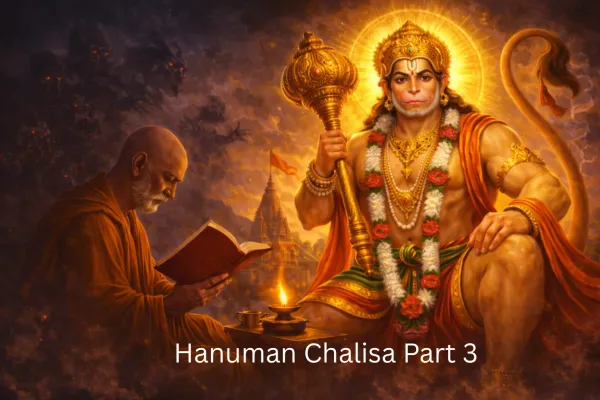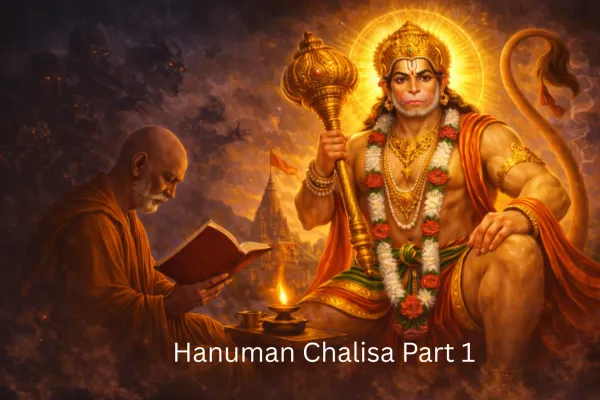
Part 1 of this blog series examined the author, structure and significance of the Hanuman Chalisa. The Hanuman Chalisa is not just a prayer; it is a manual for mastering the mind, cultivating strength, and deepening devotion.
In this Part 2 of the Study Guide series, we explore Chaupais 1 to 10, uncovering their meaning, spiritual depth, and practical application in daily life.

Chaupai #1
जय हनुमान ज्ञान गुन सागर, जय कपीस तिहुँ लोक उजागर॥१॥
Jai Hanuman gyan gunn sagar, jai kapish tihun lok ujaagar (1).
Meaning: Victory to Lord Hanuman, the ocean of wisdom and virtue. Victory to the Lord who is the supreme among the monkeys and illuminator of the three worlds.
Spiritual Significance
This opening verse establishes the fundamental nature of Hanuman as an embodiment of wisdom, virtue, and divine brilliance. By describing him as an “ocean of knowledge and virtues,” the verse suggests that true spiritual greatness lies not only in strength but in wisdom, humility, and righteous conduct. The reference to illuminating the three worlds symbolizes Hanuman’s ability to remove ignorance and bring spiritual awareness to all beings. In a deeper sense, Hanuman represents the enlightened mind that dispels darkness through knowledge and devotion.
Reflection and Application in Daily Life
This verse encourages individuals to pursue knowledge and cultivate noble qualities such as honesty, humility, and compassion. Rather than seeking recognition through external achievements alone, a person should strive to become a source of wisdom and positivity in the lives of others. In everyday life, this can mean making thoughtful decisions, offering guidance when others are confused, and maintaining moral clarity even in difficult situations. Hanuman himself exhibited a great thirst and enthusiasm for gaining knowledge from his Guru, Surya (the Sun God).
Chaupai #2
राम दूत अतुलित बल धामा, अंजनि पुत्र पवनसुत नामा॥२॥
Ramdoot atulit bal dhama, Anjani-putra pawansut naama (2).
Meaning: You are the emissary (messenger) of Lord Ram, the abode of matchless power, the son of Mother Anjani, and also the son of the Wind-god.
Spiritual Significance
This verse highlights Hanuman’s divine identity and his role as the devoted messenger of Rama. Being a messenger symbolizes the bridge between the human and the divine. Hanuman’s immense strength is not portrayed as personal power but as energy dedicated to serving a higher purpose. His connection to the wind god also symbolizes vitality, movement, and the life force that animates all beings.
Reflection and Application in Daily Life
The verse teaches that abilities and talents should be used in service of meaningful goals rather than for personal pride. Just as Hanuman used his strength to fulfill Rama’s mission, individuals can use their skills and knowledge to help others, contribute to society, and uphold moral values. This verse reminds us that purpose gives true meaning to strength and capability. Ultimately, as Hanuman did, we must recognise our position as an eternal relative and servitor of God.

Chaupai #3
महावीर बिक्रम बजरंगी, कुमति निवार सुमति के संगी॥३॥
Mahaveer vikram bajrangi, kumati nivaar sumati ke sangi (3).
Meaning: You are the most courageous of all and as mighty as a thunderbolt. You are the destroyer of malevolent intellect, and supporter of those with an altruistic intellect.
Spiritual Significance
Hanuman is depicted as Mahavir, a warrior who not only defeats external enemies but also destroys ignorance and misguided thinking. It takes great courage and resolve to exhibit bravery in the battle of life, and this verse serves as a powerful reminder and inspiration.
The thunderbolt represents the strength of Hanuman's body and also symbolizes powerful determination and clarity of purpose. Spiritually, this verse emphasizes that the greatest battle a person faces is often within the mind: overcoming confusion, doubt, and negativity.
Reflection and Application in Daily Life
In modern life, individuals frequently struggle with stress, fear, and negative thoughts. This verse encourages developing mental strength and surrounding oneself with wisdom and positivity. Practicing self-awareness, seeking good guidance, and maintaining a disciplined mind can help replace negative patterns with constructive thinking, and give us the strength to be brave in the battlefield of life.
Chaupai #4
कंचन बरन बिराज सुबेसा, कानन कुंडल कुँचित केसा॥४॥
Kanchan baran biraj subesa, kaanan kundal kunchit kesa (4).
Meaning: Your skin is golden in color and you are adorned with beautiful clothes. You have adorned yourself with earrings in your ears and your hair is curly and thick.
Spiritual Significance
The description of Hanuman’s radiant appearance symbolizes spiritual purity and divine energy. The golden color, akin to the sun's glow, represents illumination, truth, and spiritual brilliance. This verse reminds devotees that divine qualities shine outwardly through inner purity and devotion.
Reflection and Application in Daily Life
Although the verse describes physical features, its deeper message emphasizes inner beauty. A person who cultivates honesty, kindness, and integrity develops a natural radiance that others notice. In daily life, maintaining positive intentions and ethical behavior allows one's character to shine.
Chaupai #5
हाथ बज्र अरु ध्वजा बिराजे, काँधे मूँज जनेऊ साजे॥५॥
Haath vajra au dhwaja biraaje, kaandhe moonj janeu saaje (5).
Meaning: A mace and a flag of righteousness adorn your hands and a sacred thread adorns your shoulder.
Spiritual Significance
The mace symbolizes strength and decisive action, while the flag represents victory, courage, and righteousness. The sacred thread represents spiritual discipline, learning, and commitment to duty. Together, these symbols portray Hanuman as a balanced figure combining power, wisdom, and spiritual responsibility. Janeu is a sacred thread and when worn is an indicator of being a student of the Vedic scriptures.
Reflection and Application in Daily Life
This verse reminds individuals that strength should be guided by discipline and responsibility. Courage without wisdom can be destructive, but courage guided by moral values leads to positive outcomes. This verse also reminds us that Hanuman considered himself an eternal student. In everyday life, this can mean maintaining one's humility always and considering oneself always a student.

Chaupai #6
शंकर सुवन केसरी नंदन, तेज प्रताप महा जगवंदन॥६॥
Shankar suvan kesarinandan, tej prataap maha jag bandan (6).
Meaning: You are the embodiment of Lord Shiva and vanar-raj Kesari’s son. There is no limit or end to your glory or your magnificence. The whole universe worships you.
Spiritual Significance
This verse emphasizes Hanuman’s divine origin and spiritual power. His connection with Shiva represents strength combined with deep spiritual awareness. The verse also highlights how virtuous actions bring universal respect and admiration.
Reflection and Application in Daily Life
This verse encourages individuals to live in a way that earns genuine respect through good character and honorable actions. People who act with integrity, humility, and dedication naturally gain admiration and trust from others.
Chaupai #7
विद्यावान गुनी अति चातुर, राम काज करिबे को आतुर॥७॥
Vidyavaan guni ati chaatur, Ram kaaj karibe ko aatur (7).
Meaning: You are the wisest of the wise, most virtuous and very astute. You are always eager to do whatever you can in the service of Lord Ram.
Spiritual Significance
Hanuman is presented as a perfect combination of knowledge, virtue, and readiness for action. His eagerness to serve Rama reflects the principle that wisdom must be accompanied by service and devotion.
Reflection and Application in Daily Life
Knowledge alone is not enough; it must be applied in constructive ways. This verse encourages individuals to use their skills and intelligence for positive purposes and to contribute actively to the welfare of others. The highest and best use of our skills and talents are to use them in the service of God, just as Hanuman did with devotion and enthusiasm.
Chaupai #8
प्रभु चरित्र सुनिबे को रसिया, राम लखन सीता मनबसिया॥८॥
Prabhu charitra sunibe ko Rasiya, Ram Lakhan Sita mana basiya (8).
Meaning: You savor the bliss of listening to Lord Ram's noble character and his actions. Lord Ram, Mother Sita, and Shree Lakshman dwell forever in your heart.
Spiritual Significance
This verse highlights Hanuman’s deep devotion. He finds joy in hearing and remembering the divine qualities and actions of Lord Rama. Because his heart is filled with love and devotion, Rama, Sita, and Lakshman naturally dwell within him. It teaches that a heart absorbed in divine remembrance becomes a place where God resides. Hanuman’s love for the stories and virtues of Rama represents deep devotion and spiritual joy.
Rama represents truth and righteousness, Sita symbolizes love and purity, and Lakshman reflects discipline and service. When these qualities live in the heart, the mind becomes steady and spiritually aligned. Hanuman’s devotion shows the ideal state where divine values shape one’s inner life.
Reflection and Application in Daily Life
What we repeatedly think about shapes our character. By engaging with uplifting ideas, positive teachings, and inspiring stories, individuals can cultivate inner peace and moral clarity.
Reflect on what fills your mind each day. When the mind regularly turns toward uplifting stories and divine qualities, the heart becomes peaceful and receptive to spiritual growth.
Spend a little time each day reading or listening to spiritual teachings and remembering divine qualities such as truth, compassion, and service. As these values guide your actions, your heart gradually becomes a place where divine presence is felt.

Chaupai #9
सूक्ष्म रूप धरि सियहि दिखावा, विकट रूप धरि लंक जरावा॥९॥
Sukshma roop dhari siyanhi dikhawa, vikat roop dhari Lanka jarawa (9).
Meaning: You assumed a subtle form when you appeared in front of Mother Sita but a huge and formidable form when you burnt Ravan’s kingdom Lanka.
Spiritual Significance
This verse shows Hanuman’s wisdom and strength. He uses humility and gentleness when comforting Sita, yet displays immense power when confronting evil in Lanka. Spiritually, it teaches that true strength includes the ability to be both compassionate and courageous, responding appropriately to each situation.
Hanuman’s subtle form represents humility, sensitivity, and self-control, while his powerful form symbolizes courage and righteous action. His humility before Sita and courage against injustice symbolize wisdom in action. The verse reminds us that spiritual maturity includes knowing when to act with softness and when to stand firmly for truth.
Reflection and Application in Daily Life
Reflect on how you respond to different situations. Spiritual growth involves balancing kindness with strength, ensuring that both compassion and courage guide your actions.
Practice gentleness in moments that require understanding and care, and show courage when facing injustice or negativity. Like Hanuman, adapting your strength and humility wisely allows you to act with balance and righteousness in everyday life.
Different situations require different responses. Sometimes patience and gentleness are necessary, while other situations demand strength and firmness. Learning when to apply each approach is an important life skill.
Chaupai #10
भीम रूप धरि असुर सँहारे, रामचंद्र के काज सवाँरे॥१०॥
Bheem roop dhari asura sanghare, Ramchandra ke kaaj sanware (10).
Meaning: You slaughtered the demons by taking a massive form like that of Bheem, and successfully completed all the tasks in service of Lord Ram.
Spiritual Significance
This verse highlights Hanuman’s immense strength used in the service of righteousness. His power was not driven by ego or personal gain but by devotion and dedication to Lord Rama’s mission. Spiritually, it reminds us that true strength is sacred when it is used to remove negativity and support a higher purpose.
Reflection and Application in Daily Life
This verse invites us to reflect on how we use our abilities and energy. Like Hanuman, we can dedicate our strengths, whether physical, mental, or emotional, to serving a noble purpose. By overcoming inner “demons” such as fear, anger, and selfishness, and by acting with sincerity and devotion, we help bring goodness and harmony into our daily lives.
Conclusion
The first ten chaupais of the Hanuman Chalisa lay a powerful foundation for both spiritual growth and mental discipline. They reveal that true strength is not just physical power, but a harmonious blend of wisdom, humility, devotion, and purposeful action.
Through Hanuman’s example, we learn how to:
- Transform knowledge into wisdom
- Channel strength into service
- Replace fear with faith
- Balance compassion with courage
These verses are not merely meant to be recited—they are meant to be lived. When applied consistently, they can reshape the way we think, act, and respond to life’s challenges.
Call to Action
If this guide helped deepen your understanding:
👉 Start today: Read one chaupai daily and reflect on its meaning
👉 Apply one lesson from each verse in your daily routine
👉 Bookmark or share this guide with friends and family
👉 Explore more on RKT Blog for deeper spiritual insights
💬 Which chaupai resonated with you the most? Reflect on it—and try applying it today.
Frequently Asked Questions (FAQs)
1. What is the purpose of studying the Hanuman Chalisa in detail?
Studying the Hanuman Chalisa in depth helps go beyond simple recitation. It allows you to understand its psychological, spiritual, and practical teachings, making it more impactful in daily life.
2. Can beginners start with this study guide?
Yes, this guide is designed for beginners as well as regular readers. Each chaupai is explained in a simple way with practical applications.
3. How often should I read or reflect on these chaupais?
You can read one chaupai daily or revisit all ten regularly. Consistency is more important than quantity.
4. What are the benefits of chanting Hanuman Chalisa daily?
Daily chanting is believed to:
- Reduce fear and anxiety
- Improve focus and mental clarity
- Build inner strength and confidence
- Encourage positive thinking and discipline
5. Do I need to understand Sanskrit or Hindi to benefit from it?
No. Even reading the transliteration and meaning is enough to gain spiritual and practical benefits.
6. When is the best time to read Hanuman Chalisa?
Traditionally, Tuesdays and Saturdays are considered auspicious, but it can be read any time with sincerity and focus.
7. Can Hanuman Chalisa help with stress and anxiety?
Yes. Its teachings promote mental discipline, faith, and detachment from negative thoughts, which naturally helps reduce stress.
8. Is it necessary to follow any rules while reading?
While there are traditional practices, the most important aspects are devotion, sincerity, and consistency.
9. How can I apply these teachings in modern life?
By:
- Practicing mindfulness
- Acting with integrity
- Staying focused on purpose
- Managing emotions wisely
10. What should I read next after Part 2?
You can continue with Part 3 (Chaupais 11–20) to deepen your understanding and maintain continuity in your spiritual journey.