
Imagine if Ayodhya was not only a sacred city in India but a state of peace within your own heart.
For centuries, the story of Lord Ram has inspired humanity with the ideals of righteousness, compassion, and unwavering devotion to truth. Yet the true purpose of this sacred story is not merely to admire Ram from a distance but to allow his virtues to transform our own lives.
In the Ramcharitmanas, Goswami Tulsidas reminds us that Ram is not limited to temples, scriptures, or history. He lives wherever there is sincerity, devotion, and dharma.
Spiritual teacher Swami Mukundananda often explains in his discourses that the journey of Ramayana mirrors the journey of every soul. Just as Ram returned to Ayodhya after conquering obstacles, every seeker must return to the inner kingdom of peace and divine connection.
The real question, therefore, is not simply where Ayodhya is located on a map.
The deeper question is:
Can we create an Ayodhya within our own hearts?
Introduction
Across centuries, the story of Lord Ram has inspired millions of people to live with integrity, devotion, and compassion. His life, beautifully narrated in the sacred Ramcharitmanas by Goswami Tulsidas, presents a timeless guide for righteous living. Lord Ram is not only worshiped as a divine incarnation but also revered as the ideal human being whose conduct provides direction for every aspect of life.
Spiritual teacher Swami Mukundananda frequently explains in his discourses that the purpose of studying the life of Lord Ram is transformation. The scriptures are not merely stories meant for admiration. They are blueprints for personal growth and spiritual evolution.
He often says that when we contemplate the qualities of Ram, we begin to reshape our own character. The values of patience, truthfulness, humility, and devotion slowly take root in our lives.
In the modern world filled with constant distractions and inner conflicts, the message of Ram is more relevant than ever. His life teaches us how to maintain righteousness even in difficult circumstances and how to remain anchored in dharma despite challenges.
This article explores how we can bring the spirit of Ram into our lives. By understanding his virtues, practicing devotion, and nurturing the divine presence within, we can transform our homes, communities, and inner world into a reflection of Ram's ideals.
Example:
“Lord Ram did not come merely to be worshiped. He came to demonstrate how a human being can live with perfect dignity, responsibility, and devotion to dharma.”
— Swami Mukundananda
This strengthens the transition into the sections explaining Ram’s ideals.
Ayodhya in our Hearts: Beyond the Temple Structure
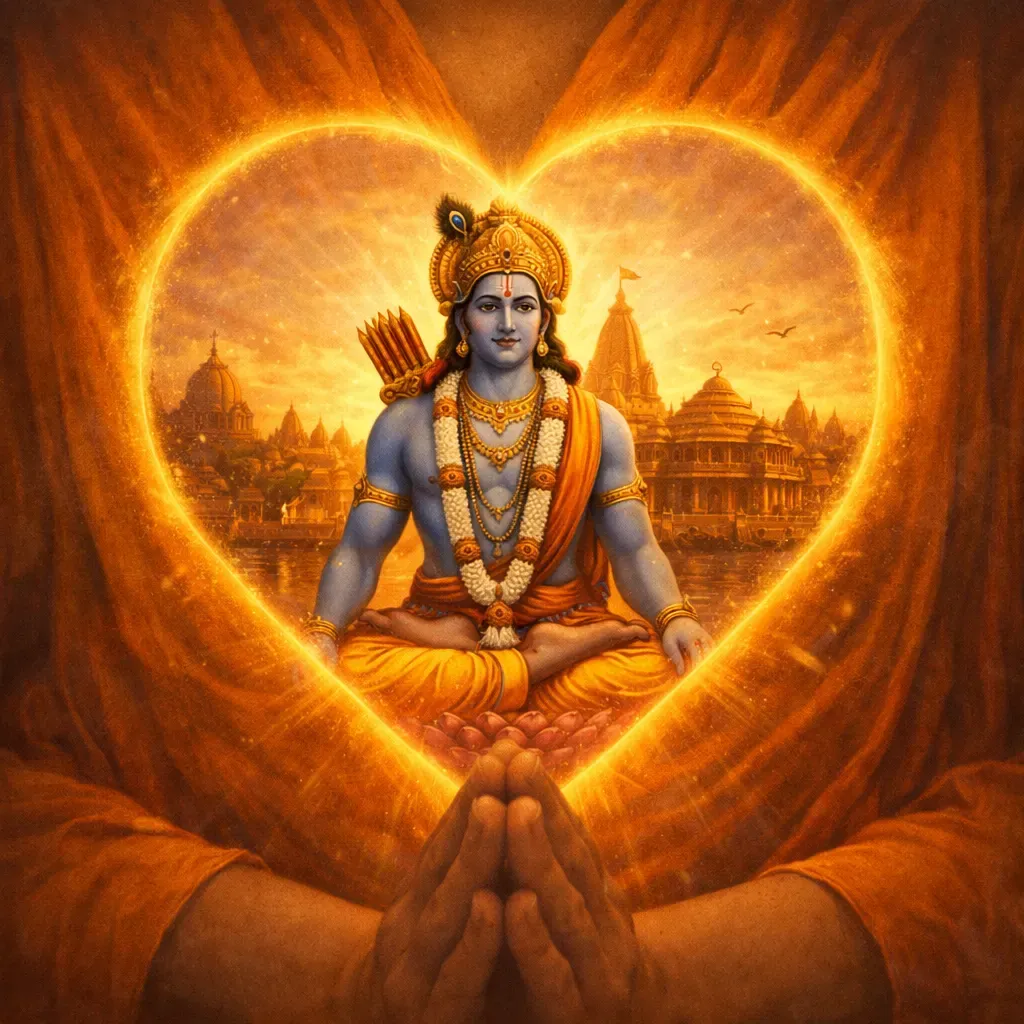
Ayodhya is revered as the birthplace of Lord Ram and is considered one of the most sacred cities in the spiritual tradition of India. However, saints and spiritual teachers often remind us that the deeper meaning of Ayodhya goes far beyond its physical boundaries.
Swami Mukundananda explains that Ayodhya also represents a state of consciousness. The word itself implies a place where there is no conflict or battle. In spiritual terms, Inner Ayodhya is the mind that is free from internal turmoil, ego, jealousy, anger, and restlessness.
When the mind becomes peaceful and pure, it becomes a suitable place for the divine to reside.
“रामहि केवल प्रेम पियारा
जान लेहु जो जाननिहारा”
Transliteration
Ram hi keval prem piyara
Jan lehu jo jananihara
Meaning
Lord Ram is pleased only by pure love and devotion. Those who truly understand this recognize that devotion, not status or rituals alone, is what attracts the Divine.
The Ramcharitmanas expresses this idea through the power of devotion:
This verse teaches that Ram loves only pure devotion. The external temple may inspire faith, but the real temple is built within the heart through love and sincerity.
When our mind becomes calm and filled with devotion, Ayodhya manifests within us. In that inner Ayodhya, the presence of Ram is naturally felt.
Example:
“The real temple of Ram is the purified heart. When the mind becomes free from ego and selfishness, Ram naturally takes residence within.”
— Swami Mukundananda
This reinforces the idea of internal devotion rather than external ritual.
Returning the Lord to the Center of Our Lives

Modern life often places material goals at the center of our attention. Career achievements, financial success, and social recognition consume much of our time and energy.
Swami Mukundananda frequently points out that this imbalance leads to stress and dissatisfaction. When spiritual connection is neglected, even material success fails to provide lasting fulfillment.
He shares a story during his discourse about a wealthy individual who had achieved everything he desired but still felt restless and unhappy. When asked about his spiritual practices, the man admitted that he rarely remembered God.
Swamiji explained that true balance in life comes when God becomes the center rather than the periphery.
When Ram occupies the central place in our thoughts and priorities, every action becomes aligned with higher values. Decisions become guided by dharma rather than impulse, and life gains deeper meaning.
Understanding the Essence of Rama
To bring Ram into our lives, we must understand who he represents.
Watch: Swami Mukundananda explains the deeper meaning of Ramcharitmanas
In the spiritual tradition, Ram is not only a historical figure but the embodiment of righteousness and divine virtue. His life demonstrates how divine principles can be lived in human form.
A famous verse describes his nature:
Ramo vigrahavan dharmah
This means that Ram is righteousness personified. His character represents the living expression of dharma.
Swami Mukundananda explains that Ram's greatness lies in his ability to uphold dharma even when it required immense personal sacrifice. He chose duty over comfort, truth over convenience, and righteousness over personal desire.
By reflecting on the life of Ram, we begin to understand how to align our own lives with higher principles.
Maryada Purushottam: Embracing the Ideal Man
Lord Ram is known as Maryada Purushottam, the supreme exemplar of righteous conduct.
The word maryada refers to moral discipline, ethical boundaries, and proper conduct. Ram followed these principles perfectly in every role he played.
As a son, he obeyed his father’s command without hesitation and accepted exile for fourteen years.
As a husband, he remained devoted to Sita with unwavering loyalty.
As a brother, he demonstrated deep affection and respect toward Lakshman and Bharat.
Swami Mukundananda emphasizes that Ram's life provides some of the most powerful role models for human relationships.
In a world where relationships often struggle due to ego and misunderstanding, the example of Ram teaches us how to nurture harmony through humility, respect, and responsibility.
Ramo Vigrahavan Dharmah: Rama as the Embodiment of Righteousness
The phrase Ramo Vigrahavan Dharmah highlights the profound idea that righteousness itself takes form in Ram.
In the Ramcharitmanas, Tulsidas beautifully describes the divine presence of Ram in all creation:
“सियाराम मय सब जग जानी
करहु प्रणाम जोरि जुग पानी”
Transliteration
Siyaram maya sab jag jani
Karahu pranam jori jug pani
Meaning
Tulsidas explains that the entire universe is pervaded by Sita and Ram. Realizing this, one should bow down with folded hands to all creation.
This verse encourages us to see the entire universe as pervaded by the presence of Sita and Ram.
Swami Mukundananda explains that when we begin to perceive the divine presence in all beings, our attitude toward others naturally becomes respectful and compassionate.
Righteousness then ceases to be merely a moral obligation and becomes an expression of spiritual awareness.
The Seven Virtues: Walking in His Footsteps
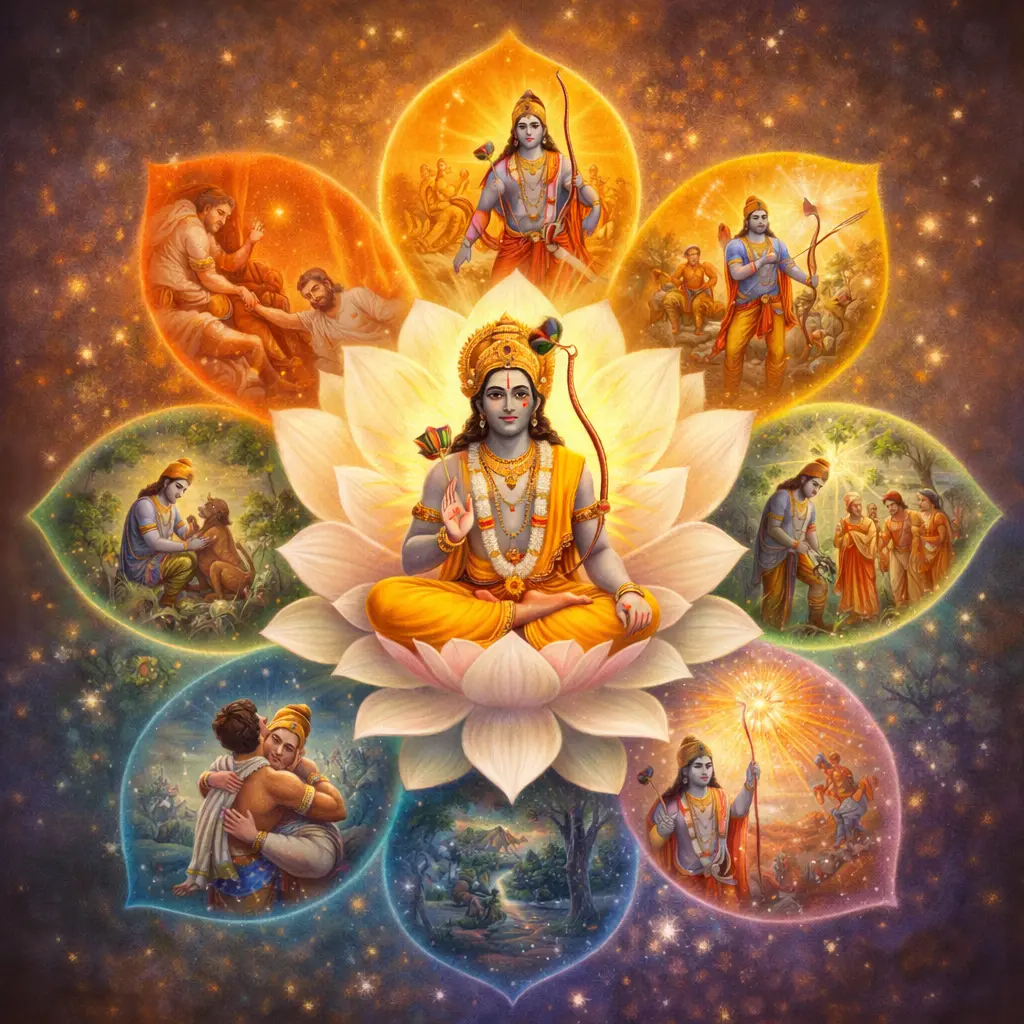
The life of Ram reflects many virtues that guide individuals toward spiritual and moral excellence.
These virtues form the foundation of a balanced and righteous life.
Truthfulness ensures integrity in speech and action.
Duty reminds us to fulfill responsibilities with dedication.
Compassion encourages kindness toward others.
Humility prevents ego from dominating our behavior.
Loyalty strengthens relationships.
Patience helps us endure difficult situations with calmness.
Devotion keeps the heart connected to the divine.
Swami Mukundananda teaches that practicing these virtues gradually transforms the personality and purifies the mind.
Each step taken in cultivating these qualities brings us closer to the spirit of Ram.
Spiritual Transformation: Internalizing the Journey
Creating an "Ayodhya" Within
The journey of devotion begins within the heart. True spiritual progress involves transforming the mind into a sacred space where divine consciousness can dwell.
Swami Mukundananda explains that creating an inner Ayodhya requires removing negative tendencies such as anger, jealousy, and pride.
When these disturbances are replaced with humility and devotion, the heart becomes a peaceful abode for the Divine.
The Inner Coronation
Many devotees celebrate the installation of Ram in temples through rituals and ceremonies. However, the deeper meaning lies in the inner coronation of Ram within our consciousness.
When divine values govern our thoughts and actions, Ram is effectively enthroned within our hearts.
Cleaning the Temple of the Mind
Just as temples are cleaned and decorated before worship, the mind must also be purified.
Negative thoughts, resentment, and selfish desires clutter the inner temple.
Through prayer, reflection, and devotion, we gradually cleanse the mind so that Ram’s presence can be felt more clearly.
The Invitation of Silence

Swami Mukundananda often explains that silence is essential for spiritual awareness.
The constant noise of modern life makes it difficult to hear the subtle voice of the divine.
Moments of quiet reflection, meditation, and prayer create the stillness necessary for divine connection.
Bringing Rama Into Daily Life (Practical Application)
Spiritual teachings become meaningful only when they are applied in everyday life.
Bringing Ram into daily life begins with small but sincere practices.
Start the day with remembrance of Ram through prayer or meditation. Reflect on his virtues and consciously try to embody them in daily interactions.
Swami Mukundananda often encourages devotees to ask themselves a simple question during challenging situations: What would Ram do in this moment?
This reflection helps guide our actions toward righteousness.
By practicing honesty, patience, and compassion in ordinary moments, we slowly transform our lives into expressions of dharma.
Dharma Over Desire: Making Ethical Decisions
One of the most powerful lessons from the life of Ram is the choice of dharma over personal desire.
When Queen Kaikeyi demanded that Ram be exiled so that Bharat could become king, Ram accepted the decision without resentment.
He understood that honoring his father’s promise was the higher duty.
Swami Mukundananda explains that life frequently presents similar choices. We must decide between what is easy and what is right.
Following dharma may sometimes require sacrifice, but it ultimately leads to inner peace and respect.
Ram’s life teaches that righteousness should always guide our decisions.
The Power of 'Ram Naam': Chanting as a Daily Sadhana
The chanting of Ram Naam holds a special place in devotional traditions.
Swami Mukundananda explains that the sacred name "Ram" is considered a seed mantra that combines the essence of two powerful mantras associated with Shiva and Narayana.
Because of this, Ram Naam carries immense purifying power.
The Ramcharitmanas emphasizes the importance of chanting the divine name:
“कलियुग केवल नाम अधारा
सुमिरि सुमिरि नर उतरहिं पारा”
Transliteration
Kaliyug keval naam adhara
Sumiri sumiri nar utarahin para
Meaning
In the age of Kali Yuga, the only support for spiritual liberation is the divine name of God. By repeatedly remembering and chanting the Lord’s name, one can cross the ocean of worldly existence.
Regular chanting helps calm the mind, purify the heart, and strengthen devotion.
Even a few minutes of sincere repetition of Ram Naam each day can uplift consciousness and bring inner peace.
Example:
“In the age of distraction, the simplest and most powerful spiritual practice is remembrance of the divine name. Ram Naam purifies the mind and connects the soul to the Supreme.”
— Swami Mukundananda
Relationships and Devotion: The Ram Parivar Model
The Bond of Sacrifice
The relationships within Ram’s family offer profound lessons.
Lakshman accompanied Ram into exile with complete dedication, demonstrating loyalty and sacrifice.
Sita’s devotion reflected courage, strength, and unwavering love.
Surrender and Service
Hanuman represents the highest example of devotion.
His service to Ram was completely selfless and filled with love.
Swami Mukundananda explains that Hanuman teaches us the power of surrender and service in spiritual life.
Harmony in the Household
The concept of Ram Rajya can also be applied within families.
When family members practice respect, honesty, and compassion, the household becomes harmonious.
Universal Love
A touching story describes how Ram acknowledged the small squirrel that helped in building the bridge to Lanka.
This story teaches that every contribution, no matter how small, has value.
Treating every being with respect reflects the universal love embodied by Ram.
Compassion and Forgiveness: Emulating Rama's Gentle Heart
Despite his strength and courage, Ram possessed a deeply compassionate heart.
He treated others with dignity and respect, even when dealing with enemies.
Swami Mukundananda often teaches that forgiveness is one of the most powerful expressions of spiritual maturity.
Holding onto anger and resentment only disturbs our inner peace. Forgiveness liberates the heart from negativity.
When we emulate the compassion of Ram, we create relationships rooted in understanding and harmony.
Patience and Resilience in Times of Adversity
The life of Ram demonstrates extraordinary patience and resilience.
Exile, separation from Sita, and the challenges of battle tested his endurance and faith.
Yet he faced every difficulty with dignity and calmness.
Swami Mukundananda explains that adversity often plays an important role in spiritual growth. Difficult circumstances refine our character and deepen our reliance on the divine.
When we remember Ram during challenging moments, we gain strength and courage to face life's trials.
Deepening the Inner Connection
Spiritual growth ultimately leads to a deeper connection with the divine.
External rituals such as prayer and temple visits are valuable, but their purpose is to awaken inner devotion.
Swami Mukundananda teaches that devotion becomes powerful when it arises from sincere love for God.
When Ram becomes the beloved center of the heart, every action becomes infused with remembrance of the divine.
This inner connection brings lasting joy and spiritual fulfillment.
Inviting the Divine: From Exterior Worship to Internal Devotion
Many spiritual journeys begin with external forms of worship such as rituals, offerings, and pilgrimages.
These practices help focus the mind and inspire devotion.
However, saints emphasize that the ultimate goal of worship is internal transformation.
When the mind becomes pure and the heart filled with love, the presence of Ram is experienced everywhere.
Meditation, chanting, and reflection gradually shift devotion from outer rituals to inner realization.
The Role of Seva: Serving Others as Service to Ram
Seva, or selfless service, is an important aspect of spiritual practice.
Swami Mukundananda frequently teaches that serving others with humility is equivalent to serving God.
When we help those in need, offer encouragement, or contribute to the well being of society, we express devotion in action.
Seva transforms spirituality from a personal pursuit into a force that benefits the entire community.
Through service, love for Ram becomes visible in our actions.
Surrender and Trust: Letting Go of Ego
One of the greatest challenges on the spiritual path is overcoming ego.
Ego creates the illusion that we are the sole controllers of life. This belief often leads to anxiety and frustration.
Swami Mukundananda teaches that surrendering to God means trusting divine wisdom while continuing to perform our duties sincerely.
When we offer the results of our actions to Ram, we release unnecessary stress and cultivate humility.
Surrender allows the heart to experience deeper peace and faith.
The Nine Forms of Devotion (Navadha Bhakti)
The Ramcharitmanas describes Navadha Bhakti, the nine forms of devotion that help cultivate love for God.
These include listening to divine stories, singing the Lord’s glories, remembering God, serving the divine feet, worship, prayer, humility, friendship with God, and complete surrender.
Swami Mukundananda explains that these forms of devotion can be practiced in daily life.
Listening to spiritual discourses develops understanding.
Chanting and singing devotional songs strengthen emotional connection.
Service and humility cultivate purity of heart.
Through these practices, devotion gradually deepens and the presence of Ram becomes more vivid within the heart
Modern Relevance and Daily Practice
From Ayodhya to Your Living Room
Sacred values should not remain confined to temples or festivals.
They can be expressed in everyday spaces such as homes, workplaces, and communities.
When families pray together, practice kindness, and support one another, the spirit of Ayodhya enters the living room.
Mindful Actions
Practices such as meditation, yoga, and mindful breathing help calm the mind.
These practices make it easier to reflect on Ram’s virtues and incorporate them into daily life.
Vanquishing Modern Demons

The demons described in the Ramayana symbolize inner weaknesses such as ego, greed, anger, and arrogance.
Swami Mukundananda teaches that conquering these inner demons is the true victory of spiritual life.
Justice means treating others fairly and making decisions based on integrity rather than personal gain.
Compassion means recognizing the divine presence in every being and responding with kindness.
Honesty means speaking truthfully and acting with transparency.
Service means contributing to the well being of others without expecting reward.
When these values shape our actions, our homes become places of trust and harmony. Families experience greater understanding, workplaces become more ethical, and communities grow stronger.
Swami Mukundananda often emphasizes that true change in the world does not begin with large systems or institutions. It begins with the transformation of the individual heart.
When one person chooses righteousness, it influences those around them. When families live by dharma, communities become more harmonious. When many individuals embrace these principles, the spirit of Ram Rajya naturally emerges in society.
In this way, establishing Ram Rajya is not a distant dream. It is a daily practice of living with integrity, compassion, and devotion.
Each thought guided by dharma, each act of kindness, and each moment of sincere service becomes a step toward creating a world that reflects the ideals of Lord Ram
If the ideals of Lord Ram are meant to guide our lives today, the natural question arises: how do we bring the spirit of Ram Rajya into our own homes and communities?
Establishing Your Own Ram Rajya
The idea of Ram Rajya is often imagined as the ideal kingdom ruled by Lord Ram, where justice, peace, and harmony prevailed. However, spiritual teachers remind us that Ram Rajya is not merely a historical or political concept. It is a way of living that begins within each individual.
Swami Mukundananda explains in his discourses that society is a reflection of the consciousness of its people. When individuals cultivate noble values, those values naturally influence families, communities, and eventually the entire world.
Creating Ram Rajya therefore starts with personal transformation.
The Ramcharitmanas describes the spirit of Ram Rajya in a beautiful verse:
“Daaihik daivik bhautik taapa
Ram raj nahin kahu hi byaapa”
This verse conveys that in the kingdom of Ram, people were free from suffering caused by physical, divine, or material disturbances because society functioned with righteousness and compassion.
To establish our own Ram Rajya in daily life, we must commit to the same foundational values that guided Lord Ram’s rule.
Justice means treating others fairly and making decisions based on integrity rather than personal gain.
Compassion means recognizing the divine presence in every being and responding with kindness.
Honesty means speaking truthfully and acting with transparency.
Service means contributing to the well being of others without expecting reward.
When these values shape our actions, our homes become places of trust and harmony. Families experience greater understanding, workplaces become more ethical, and communities grow stronger.
Swami Mukundananda often emphasizes that true change in the world does not begin with large systems or institutions. It begins with the transformation of the individual heart.
When one person chooses righteousness, it influences those around them. When families live by dharma, communities become more harmonious. When many individuals embrace these principles, the spirit of Ram Rajya naturally emerges in society.
In this way, establishing Ram Rajya is not a distant dream. It is a daily practice of living with integrity, compassion, and devotion.
Each thought guided by dharma, each act of kindness, and each moment of sincere service becomes a step toward creating a world that reflects the ideals of Lord Ram
Example:
As Swami Mukundananda explains, “The mind is the cause of bondage and the mind is the cause of liberation.” This reminds us that the ideals of Lord Ram are not just to be admired but to be lived within our own consciousness.
The life of Lord Ram offers timeless guidance for living with integrity, devotion, and compassion.
Through the teachings of the Ramcharitmanas and the insights of spiritual teachers like Swami Mukundananda, we learn that the ideals of Ram are not distant ideals but practical principles for everyday life.
When we cultivate devotion, practice righteousness, and remember the divine name, our inner world begins to transform.
A Continuous Celebration: Keeping the Spirit of Ayodhya Alive
The spirit of Ayodhya is not confined to festivals or sacred locations.
It lives in every moment when we choose kindness over anger, honesty over deception, and devotion over distraction.
Each act of righteousness keeps the spirit of Ayodhya alive in the world.
Letting Your Life Be a Reflection of Ram
The greatest offering we can make to Lord Ram is to reflect his virtues in our own lives.
When truth guides our words, compassion shapes our actions, and devotion fills our hearts, we become instruments of divine values.
In that moment, Ayodhya is no longer just a sacred city. It becomes a living presence within the peaceful and devoted heart.
Call To Action
Bringing the Spirit of Ram Into Your Life
The teachings of Lord Ram are not meant to remain within the pages of scripture. They are meant to shape the way we think, speak, and live.
Start with small steps.
Reflect on the virtues of Ram each morning.
Chant the sacred name of Ram even for a few minutes daily.
Practice honesty, compassion, and humility in your relationships.
Serve others with sincerity and gratitude.
As Swami Mukundananda often reminds devotees, transformation begins with a single sincere step.
When you purify your thoughts, cultivate devotion, and act with integrity, you begin to create an Ayodhya within your heart.
And when many individuals begin this journey, the ideals of Ram Rajya slowly come alive in the world.
So ask yourself today:
What is one virtue of Lord Ram that you will bring into your life today?
Your answer may be the first step toward building your own inner Ayodhya.
✨ Frequently Asked Questions
🌼 What does Ayodhya symbolize spiritually?
Ayodhya represents a peaceful mind where devotion and righteousness reside.
🕉️ Why is Lord Ram called Maryada Purushottam?
Because he is the perfect example of moral conduct and ideal human behavior.
🔔 What is the significance of Ram Naam?
Chanting Ram’s name purifies the mind and strengthens devotion.
📜 What is Navadha Bhakti?
Navadha Bhakti refers to the nine forms of devotion described in the Ramcharitmanas.
🙏 How can we practice Ram’s teachings today?
By living with truth, compassion, humility, and dharma.
🏵️ What does Ram Rajya mean?
Ram Rajya symbolizes an ideal society based on justice, harmony, and righteousness.