
In the contemporary spiritual discourse, many believe that abandoning worldly duties is the fastest track to spiritual advancement. This romanticized idea, while well-meaning, misrepresents the nuanced wisdom offered by the Bhagavad Gita. Swami Mukundananda, a renowned teacher and founder of JKYog, provides profound insights into this issue by decoding key verses from the Gita, particularly Chapter 5, Verse 6 and Chapter 6, Verse 1. His commentary not only dispels myths but also shows how one can stay spiritually grounded without renouncing responsibilities.
Myth of Renunciation: Is Giving Up Work Necessary for Spiritual Growth?

The idea of quitting one’s 9-to-5 job to pursue spirituality is alluring to many. Yet, Bhagavad Gita challenges this notion. Renunciation is often equated with physical withdrawal from the world—giving up jobs, wealth, and comforts. However, Shree Krishna redefines renunciation by focusing on detachment, not inaction.
“True renunciation lies in the mind, not the body. Giving up work is not the same as giving up attachment to the fruits of work.”
This foundational teaching is the Gita’s cornerstone and is eloquently interpreted by Swami Mukundananda.
BG Chapter 6, Verse 1: Who is a True Yogi?
BG 6.1 on holy-bhagavad-gita.org
श्रीभगवानुवाच |
अनाश्रित: कर्मफलं कार्यं कर्म करोति य: |
स संन्यासी च योगी च न निरग्निर्न च चाक्रिय: || 6.1||
Translation by Swami Mukundananda:
"The Supreme Lord said: Those who perform prescribed duties without desiring the results of their actions are actual sannyāsīs (renunciates) and yogis, not those who have merely ceased performing sacrifices such as Agnihotra yajna or abandoned bodily activities."
Debunking External Renunciation
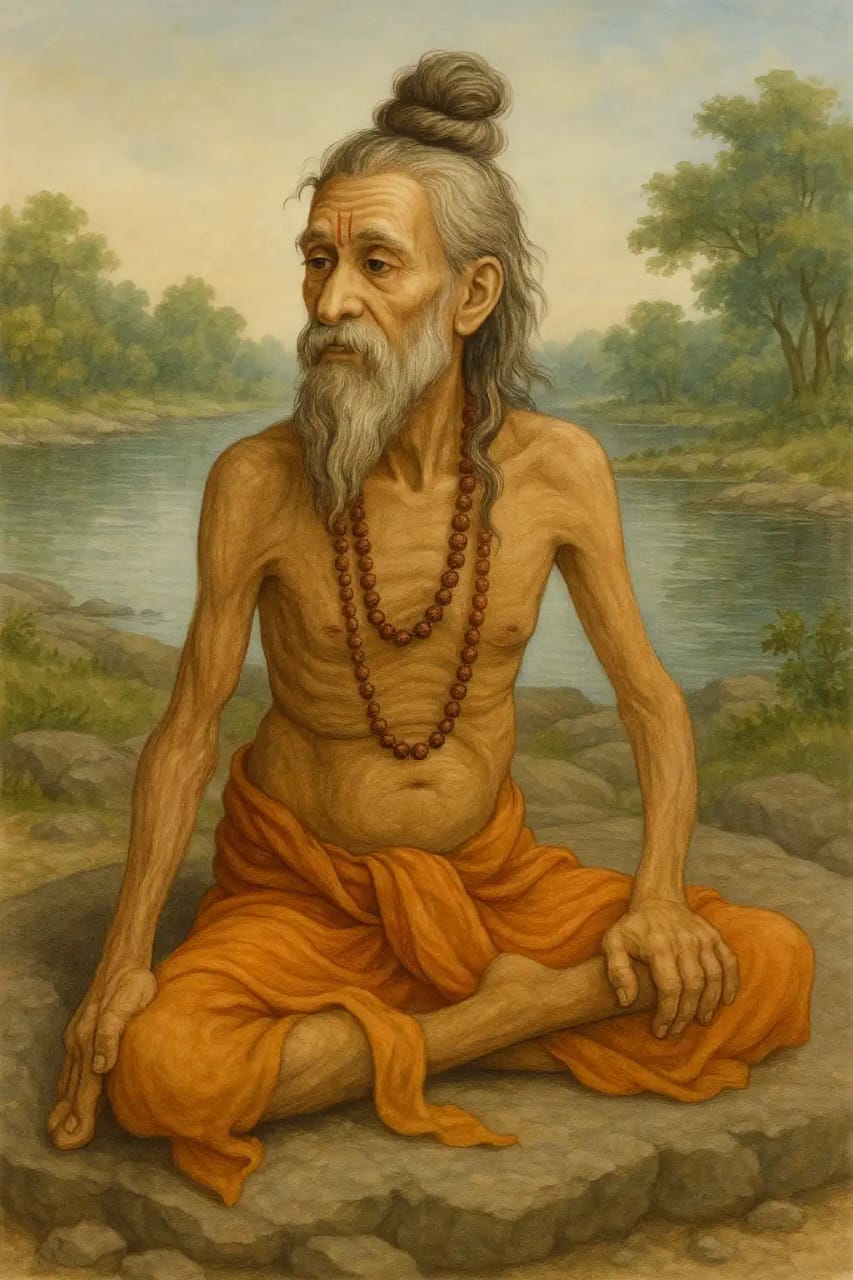
Swamiji explains that true yogis and renunciants are those who act without selfish expectations. Society often idolizes superficial markers of spirituality—wearing saffron, eating only fruits (phalāhārī), or abstaining from speech. However, Shree Krishna warns that such external symbols are not indicators of spiritual elevation.
The Story of Ashtavakra
Ashtavakra was a saint born with a body crooked in eight places. From the womb, he displayed immense spiritual wisdom. When his father mispronounced a Vedic mantra, Ashtavakra corrected him, angering the father who cursed him to be deformed. Despite his appearance, Ashtavakra was a towering spiritual personality.
Once, he visited the court of King Janak, where scholars mocked his physical form. Calmly, Ashtavakra replied, "I thought this assembly had wise scholars, but it seems filled with cobblers who judge based on skin and leather." King Janak recognized his greatness and became his disciple.
The story shows that external appearances and physical conditions do not determine spiritual depth. Inner realization, not outer form, is what defines a true yogi.
Understanding Yog: Union, Not Postures
Swamiji emphasizes that the word "yog" (not "yoga") means union—specifically the union of the individual soul with the Supreme. A yogi is one whose mind is absorbed in God, and such a person naturally becomes detached from the world, regardless of their profession or lifestyle.
Many misunderstand yog as merely physical postures. While these may aid in discipline, true yog is a mental and spiritual connection that can be achieved even amidst family life, work, and societal duties.
BG Chapter 5, Verse 6: The Role of Karma Yog
BG 5.6 on holy-bhagavad-gita.org
संन्यासस्तु महाबाहो दु:खमाप्तुमयोगत: |
योगयुक्तो मुनिर्ब्रह्म न चिरेणाधिगच्छति || 5.6||
Translation by Swami Mukundananda:
"Perfect renunciation (karm sanyās) is difficult to attain without performing work in devotion (karm yog), O mighty-armed Arjun, but the sage who is adept in karm yog quickly attains the Supreme."
Your Nature Is Not an Obstacle—It’s Your Path

Swamiji explains how each individual has a natural tendency based on their inherent guna (mode of nature)—sattva, rajas, or tamas. Attempting to suppress these tendencies in the name of spirituality can be counterproductive.
If Arjun, a born warrior, had renounced the battlefield, his nature would still push him toward leadership—even in a forest. Therefore, Shree Krishna advises him to channel his warrior instincts in service to God. The lesson? Use your natural skills and vocation for a higher purpose instead of discarding them.
“Perform your duty, but perform it as a sacrifice to the Divine.”
Premature Renunciation: The Danger of Skipping Steps
Swamiji shares the analogy of a sacred thread (yagyopavit) given during the Vedic ceremony. Although it must be renounced during sannyas, it must first be worn and respected. Likewise, one should not leap to renunciation without inner maturity. True detachment blossoms gradually through karm yog.
He also narrates his experience in an ashram where many took premature vows of renunciation only to leave disillusioned. Without the firm grounding of detachment and service, such efforts become unstable.
“Renunciation must grow from within—not be forced from without.”
Rajasic vs. Sattvic Renunciation
Shree Krishna classifies renunciation as rajasic (driven by discomfort) and sattvic (driven by wisdom and service). A person who gives up duties because of inconvenience is practicing rajasic renunciation.
Swamiji warns against using spirituality as an escape route. True vairagya is choosing renunciation not out of fear or fatigue but from an intense desire to serve more deeply.
Gopis and Household Saints: Karm Yog in Action

Swamiji highlights the Gopis—Shree Krishna’s beloved devotees—as perfect karm yogis. They lived household lives yet were internally detached and spiritually connected. Great saints and gurus from Ved Vyas to Shukadev Paramahans were also grihasthis (householders), showing that spiritual elevation is not limited to monks.
“You can live in the world and still be untouched by it—like a lotus in water.”
Conclusion: The Divine Path Lies Through Daily Life
Bhagavad Gita, through Shree Krishna's divine voice, declares that quitting the world is not a prerequisite for liberation. Instead, transforming work into worship, detachment into devotion, and duty into a spiritual offering is the essence of karm yog.
Call to Action
To truly integrate these teachings into your life:
- Subscribe to Swami Mukundananda’s YouTube Channel where each verse of the Bhagavad Gita is explained with depth and clarity.
- Read the Bhagavad Gita online with detailed commentary.
- Reflect: Start viewing your job not as a burden but as a sacred service to the Divine.
Stay in your role, but elevate your soul. That is the essence of karm yog. Necessary for Spiritual Growth?