
The Luminous Dawn of Devotion
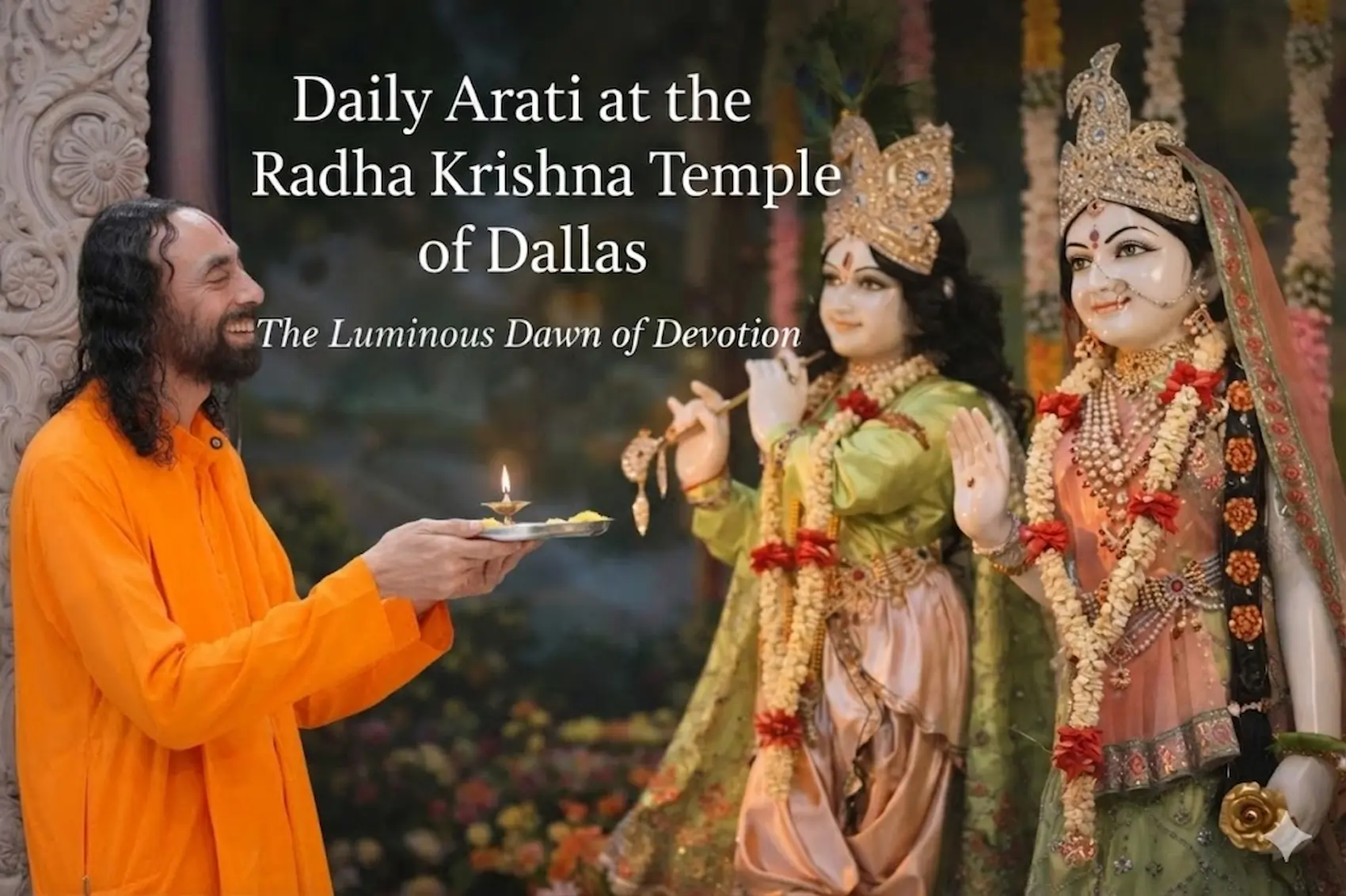
Each evening at 7:00 PM, as the temple bells begin to ring and the conch shell echoes through the marble halls, a quiet transformation begins to unfold at the Radha Krishna Temple of Dallas (Allen, Texas).
We often arrive thinking we have come to look at God – to offer a flame, to fulfill a duty, or to find a moment of peace.
But in the rising flame of Aarti, we discover something far more profound: God has been looking at us all along.
To truly enter this hour, one must carry the heart of a seeker, leaving behind the noise of the modern world to rediscover a secret hidden for centuries. We look at the Deities not to observe a statue, but to be captured by a Living Presence.
If living presence feels too lofty or mystical, let us begin where this transformation has begun before: with a human heart that loved fiercely but simply loved in the wrong direction.
Ramanujacharya and Dhanurdas: Redirecting the Heart
To understand the power of Daily Aarti at the Radha Krishna Temple in Dallas, we must travel back nearly eleven centuries to Srirangam in South India, the sacred Sri Ranganathaswamy Temple, where a single moment of divine vision changed the course of a man’s life forever.
In that sacred town, during the grandeur of the Garuda festival, the streets overflowed with devotion. Vedic chants flooded the streets like a river while drums thundered like a breaking storm. Elephants moved with royal gravity through the crowds, and the air was thick with the fragrance of jasmine and burning camphor. It felt as if heaven itself had descended upon the earth.
And yet, in the middle of that ocean of worship, one man saw none of it.
He was a powerful young wrestler named Dhanurdas—broad-shouldered, intense, and singular in his devotion. But the object of his devotion was not the Lord.
While thousands prostrated before the golden canopy of Sri Ranganatha, Dhanurdas remained upright, his back turned to the Creator, his eyes anchored solely to the face of his beloved, Hemamba. As devotees pressed forward for a glimpse of God, he walked backward through the crowd so he would not lose sight of her for even a breath. In one hand, he held an umbrella over her head to shield her from the scorching Tamil sun with the tenderness of a mother. With the other, he fanned her with the focus of a priest.
His heart beat a rhythm of total surrender to a human mirror.
To the onlookers, he looked like a fool—lost in the maya of a mortal face. But to a true knower of love, there was something else shining there: capacity. The raw, untapped power of a heart that could pour itself out without restraint. Dhanurdas had a large love problem—love large enough to become holy, if only it could be turned.
And then the gaze of Ramanujacharya, the ocean of compassion, fell upon him.
While others saw a man blinded by worldly attachment, the great Acharya saw a heart capable of extraordinary surrender. He did not mock him. He did not scold him. He did what only a true Guru can do: he asked a question that reveals the soul.
“What nectar have you found in those eyes,” Ramanuja asked gently, “that makes you turn your back on the Lord of the Universe?”
Dhanurdas, without shame and without diplomacy, replied with the raw honesty of a true lover:
“They are the most beautiful thing in existence.”
And this is where the story becomes the secret.
Ramanuja did not condemn the intensity. He did not ask him to become dry, detached, or emotionally dead. He made a divine bargain, one that reveals the heart of real spiritual guidance:
“If I show you eyes more beautiful,” he said, “eyes that hold the brilliance of a thousand suns and yet the coolness of the moon—will you leave these and adore those?”
Dhanurdas agreed.
That evening, as twilight draped velvet shadows over Srirangam, they stood before the heavy silk curtains of the inner sanctum of Sri Ranganathaswamy Temple. The air was thick with the scent of ancient stone and burning ghee. The hall quieted. The moment ripened. Then the curtains parted and the priest lifted the camphor flame for Aarti.
The light climbed slowly across the reclining form of the Lord until it came to rest upon His face.
Ramanuja did not offer a lecture. He did not explain metaphysics. He simply raised his hand and pointed.
“Look,” he whispered.
In that trembling flicker of sacred fire, with the grace of the Guru, the veil fell away. Dhanurdas did not see stone. He did not see sculpture. He saw a Living Person.
He saw eyes that did not merely contain beauty, but eyes that were the very source of it—eyes that looked back at him with warm, aching familiarity, like an Eternal Friend who had been waiting through lifetimes for this one moment of recognition.
Tears broke like a dam. The beauty of the world dissolved in the presence of that Living Gaze. Not because the world became ugly but because it became small. A candle next to the sun. A drop next to the ocean.
This is the turning point: Dhanurdas did not stop loving. He simply met a beauty so complete, so personal, so alive, that everything else lost its grip.
And that is why this story still matters.
Because the ancient question is not, “Do you love?” The question is: Where is your love going? What face has your heart been walking backward for? What temporary thing have you been shielding with an umbrella of anxiety? What fragile beauty have you been fanning with your entire life-force while God passes right behind you?
This is the Dhanurdas within us.
And this is why, Daily Aarti at the Radha Krishna Temple of Dallas—of all places—this same miracle can happen again.
The Eternal Invitation in Dallas: Verse-by-Verse Through the Two Aartis
The geography has shifted from the banks of the Kaveri River to the heart of Allen, Texas, but the human heart remains unchanged.
The white-marble grandeur of the Radha Krishna Temple of Dallas stands serene just minutes from the rush of Highway 75. And when you step through those doors for the Daily Aarti at 7:00 PM, the noise of the world—the deadlines, the traffic, the digital static—begins to dissolve.
You aren’t just entering a building. You are stepping out of the scorching Texas sun of material worry and into the cooling shade of grace.
A sacred tension fills the hall. The altar curtains remain closed. You stand and wait, shedding your worldly identities like an old coat. This waiting is not empty. It is a spiritual posture. It echoes Dhanurdas standing before the veil, just seconds before the flame reveals what the heart is not ready to see on its own.
The Shankh—the conch shell—blows like a primordial thunderclap. It tears through the atmosphere, shattering the calcified layers of stress. For a heartbeat, the mind stops negotiating with itself.
The curtains part.
And there They are.
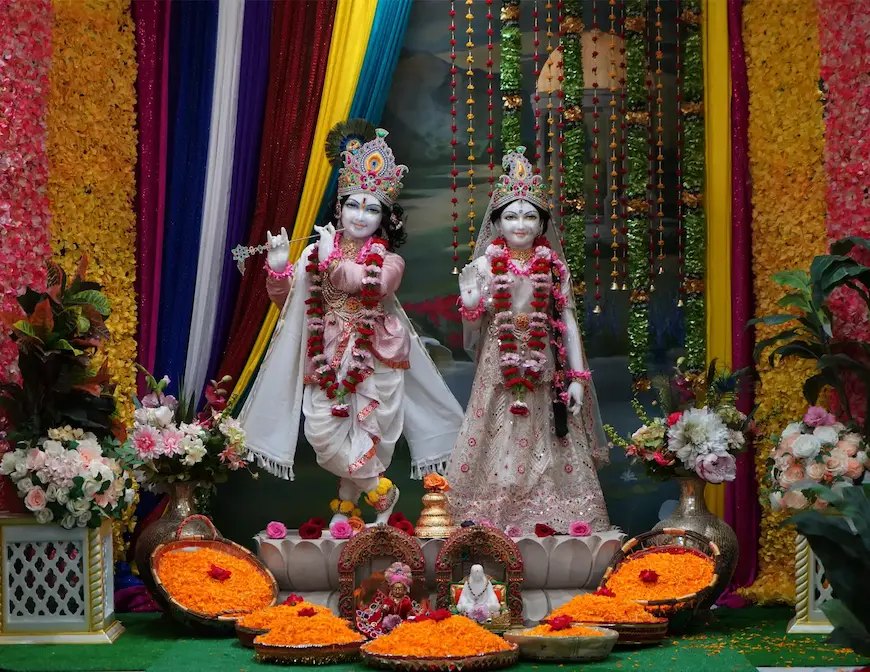
Shree Radha Krishna stand in serene radiance, Their forms carved from luminous white marble that softly reflects the temple light. Krishna is adorned in flowing golden garments and a jeweled crown with a peacock feather, His gentle smile welcoming every heart. Beside Him, Radha stands graceful and resplendent, draped in rich blue silk and delicate ornaments, her expression tender and compassionate like a mother who accepts every soul that comes before her.
But simply seeing is not enough.
Our eyes are coated in the fine dust of a thousand obsessions. We spend the day measuring, comparing, defending, scrolling, reacting. Left to ourselves, we would merely glance and move on. We need a pointer, a Guru. We need a guide who trains vision the way a musician trains the ear.
This is where the Aarti of Jagadguru Shri Kripalu Ji Maharaj becomes our spiritual GPS. It becomes instruction—gentle, rhythmic commands that lead the mind into real darshan: Look here. Now look deeper. Do not look away.
He is training our vision to see and feel the living presence of Radha Krishna – eternally youthful, eternally loving and eternally engaged in divine sweetness. This pointing by the Guru is mercy. Through that mercy, the heart begins to enter into madhurya bhav, the sweet intimacy of divine love.
“Aarti Pritam Pyari Ki” — The Guru Trains the Gaze
The Aarti begins with intimacy:
“Aarti preetam pyaari ki, ki banavaari nathavari ki.”
He doesn’t say, “Aarti of the Almighty.” He says Preetam—Beloved. He says Pyari—the most dear. He gives the heart a relationship to stand in.
As Swami Mukundananda ji explains, we begin by addressing Them as Preetam Pyari – the most beloved ones. This establishes a relationship of madhurya bhav, a mood of sweet intimacy. We are not praying to a distant Ruler; we are singing to the Beloved of the soul.
Swamiji often reminds us that the mind cannot love an abstraction. It needs something it can hold, behold, and remember. Love needs a face, a name, a form. The first mercy is that the Divine allows Himself to be known in a personal way, so the scattered mind can finally gather itself in one direction.
Then the song begins to point, detail by detail, like a Guru gently tilting our chin upward and teaching us how to fall in love.
“Duhuna sira kanaka mukuta jhalakei, duhuna shruti kundala bhala halakei.”
Golden crowns shimmer upon Their heads. In the path of devotion, the crown is a declaration of divine sovereignty. It reminds us that Radha Krishna are the eternal King and Queen of creation, the ultimate refuge of the soul.
As Swami Mukundananda ji explains, meditating on this divine grandeur transforms fear into unshakable joy, because the One who governs the universe is also your Beloved and protector.
Then the verse draws our attention to the earrings.
Halakei – swaying, moving.
One small word changes everything.
A marble statue’s earrings do not move. But Maharaj ji refuses to let the mind remain in stone. The poetry gently forces visualization. You begin to imagine the ornaments swaying, catching the glow of the lamp.
And when the mind imagines movement long enough, something subtle begins to happen. The heart starts to sense presence.
The jewelry glitters in the flame’s light. The ornaments seem almost alive in reflection.
And without even realizing it, you stop observing a statue and begin meeting your Beloved.
Then the gaze turns where it always turns, because the soul has always been thirsty for this:
“Duhuna driga prema sudha chhalakei…”
The nectar of love overflows from Their eyes.
In the flickering flame, the marble eyes seem to come alive. The eyes glisten. They soften.
The word chhalakei means brimming over, like a cup too full to contain what is inside it. The Guru is guiding our attention to imagine eyes so filled with compassion and sweetness that love itself seems to spill from them.
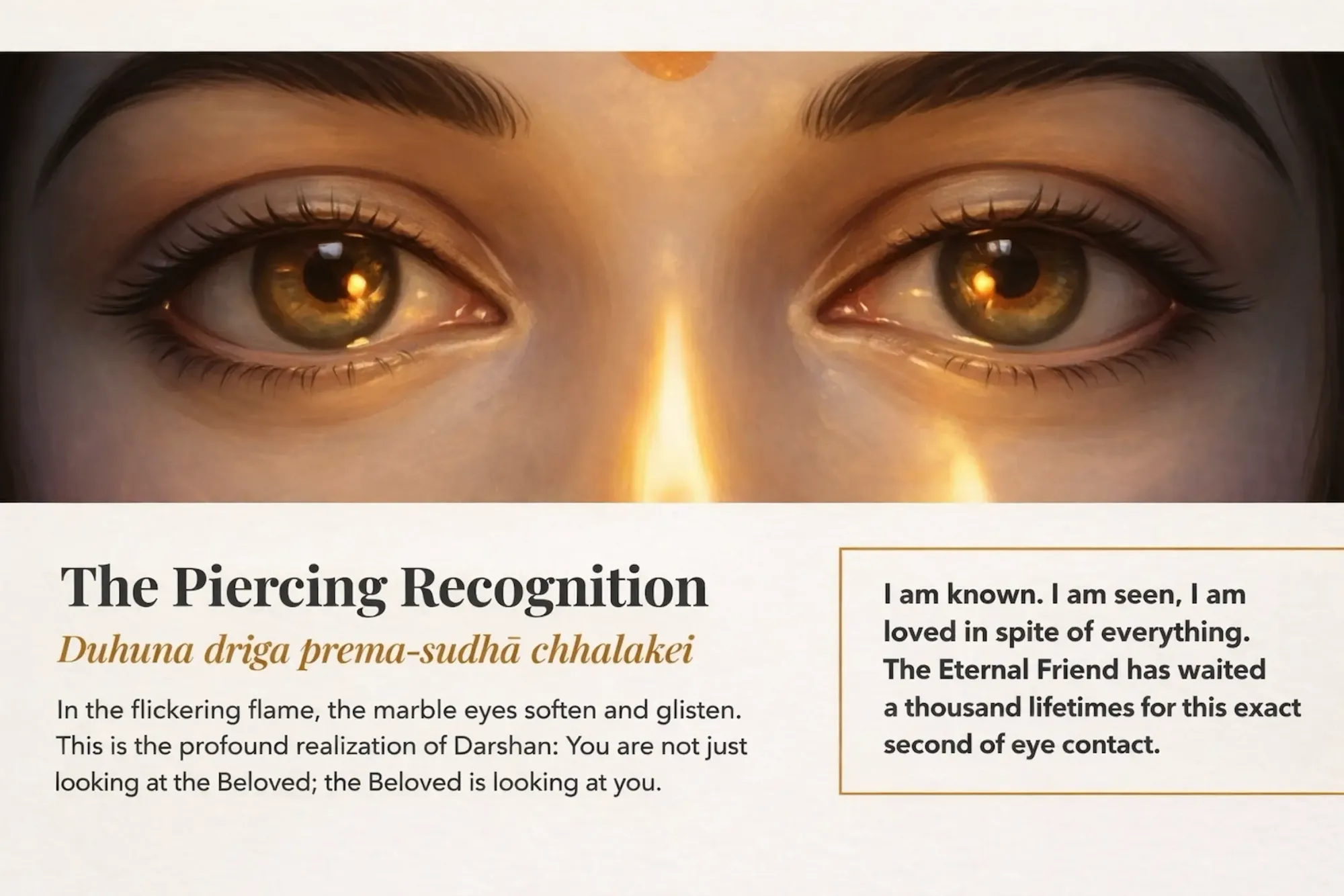
This is Darshan the profound realization that you are not just looking at the Beloved; the Beloved is looking back at you. This is the same moment that transformed Dhanurdas in Srirangam.
In the world, people look at us with judgment, expectation, hidden calculations, or indifference. Even love in the world can carry subtle demands. But here, you meet a gaze that feels unreasonably pure one that has no need to take from you, only to give.
And suddenly a startling recognition rises within the heart:
I am known. I am seen. I am loved.
God sees me and still does not turn away.
And in that silent exchange of glances, devotion awakens.
The Arati continues, drawing the mind into the intimacy of face, smile, and expression:
“Duhuni driga chitavani para vaari, duhuni lata-latakani chhavi nyaari…”
Now the Arati invites us to notice the subtle expressions of Their faces. The glances, the playful movement of the eyebrows, the soft curls of hair that frame Their cheeks. These details may seem small, but they draw the mind deeper into intimacy.
Then the verse continues:
“Rasana mukha paana, hasana muskaana, dasana damakaana…”
Our attention moves to Their lips, Their gentle smile, and the sparkle of Their teeth in the light of the Aarti flame. This isn’t the frozen smile of a statue; it’s the smile of a friend who has just shared a secret joy.
These lines do not allow a distant God. They insist on closeness. They insist that God is not only majestic—God is tender, expressive, responsive. The heart begins to soften in a way it cannot force by willpower.
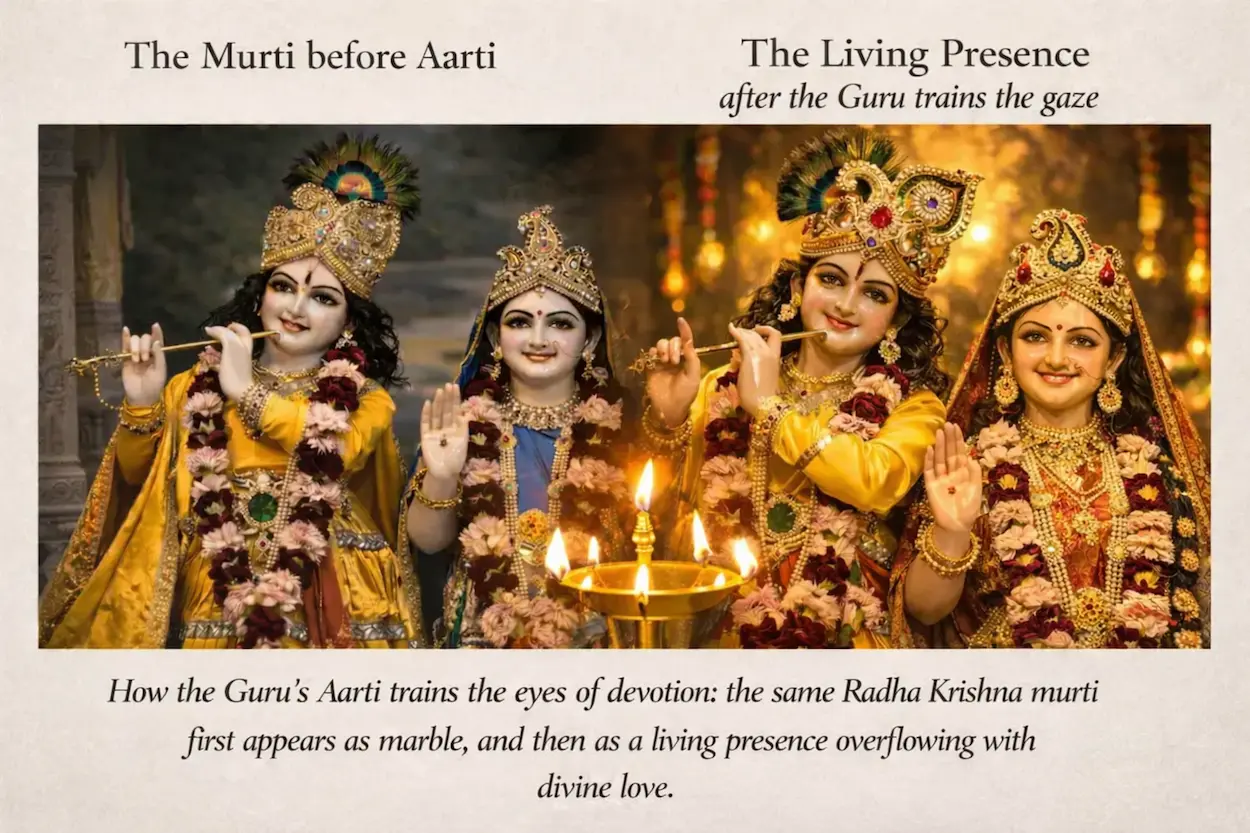
Then comes the astonishing contrast of colors:
“Eka ura peetaambara phaharai, eka ura neelaambara laharai.”
Krishna’s yellow pitambar flows like lightning. Radha’s blue drape moves like monsoon cloud. The poetry use of words like phaharai and laharai – fluttering, flowing, moving.
Nothing in this vision is stiff or lifeless. The garments seem to sway gently, as if stirred by the breeze of the chamar fan waving in service before Them.
The contrast of yellow and blue is not merely aesthetic. It quietly expresses a profound harmony. Radha Krishna stand together as the eternal union of the Divine and His loving energy the source from which all love, beauty, and joy flow into creation.
Then the verse begins to awaken another sense: sound.
“Kankanana khanaka, kinkinina jhanaka, nupoorana bhanaka…”
Bangles chime. Waist-bells tinkle. Anklets softly ring.
The delicate rhythm of divine ornaments of Radha Krishna, move in eternal joy.
In that moment, something subtle happens inside the devotee.
The marble temple fades.
The mind begins to feel as though it has stepped into Vraja, the sacred land of divine play, where every sound, every movement, every breath carries sweetness.
God is active and moving toward us.
As Swami Mukundanandaji teaches, what we repeatedly contemplate becomes the shape of our mind. The world has trained our attention outward; Aarti trains it homeward—toward the Divine center.
Finally, the vision completes:
“Eka sira mora-mukuta raajai, eka sira chunaree-chhavi chhaajai…”
The peacock feather. Radha’s chunari.
And then the line that dissolves the boundary between “altar” and “audience”:
“Sanga braja baala, laadilee-laala…”
The companions of Vraja stand around Them, immersed in joy, their arms resting on one another as they watch the Divine Couple with affection.
You are no longer merely standing in front of an altar.
You are standing within the circle of witnesses, alongside the lovers of Vraja, beholding the sweetness of Radha and Krishna together.
The Aarti has done its work.
It has trained the wandering eyes of the soul until they can finally recognize the beauty that was waiting all along.
As the lamp circles for the final time before Radha Krishna, a quiet realization rises in the heart.
I would never have learned to see this beauty if the Guru had not pointed the way.
The vision of the Divine Couple has filled the eyes, but it also awakens gratitude deep, humbling gratitude for the one who trained those eyes to see.
And so the singing gently shifts.
The Aarti of the Guru.
“Jayati Jagadguru Guruwar Ki, gaao mili aarti rasikavar ki..”
Victory to the Jagadguru, the revered spiritual master. Let us all sing the Aarti of the crest-jewel among rasik devotees.
The devotee now turns toward the Guru with folded hands, recognizing that the grace which revealed Radha and Krishna did not originate in their own effort. It came through guidance.
Just as Ramanujacharya pointed Dhanurdas toward the eyes of Lord Ranganatha, the Guru performs the same sacred act for us. He does not merely teach philosophy. He points—again and again—until the heart finally sees what it had been searching for all along.
The Aarti continues:
“Guru pada nakh mani chandrika prakash, jake ura base take moha tama naash.”
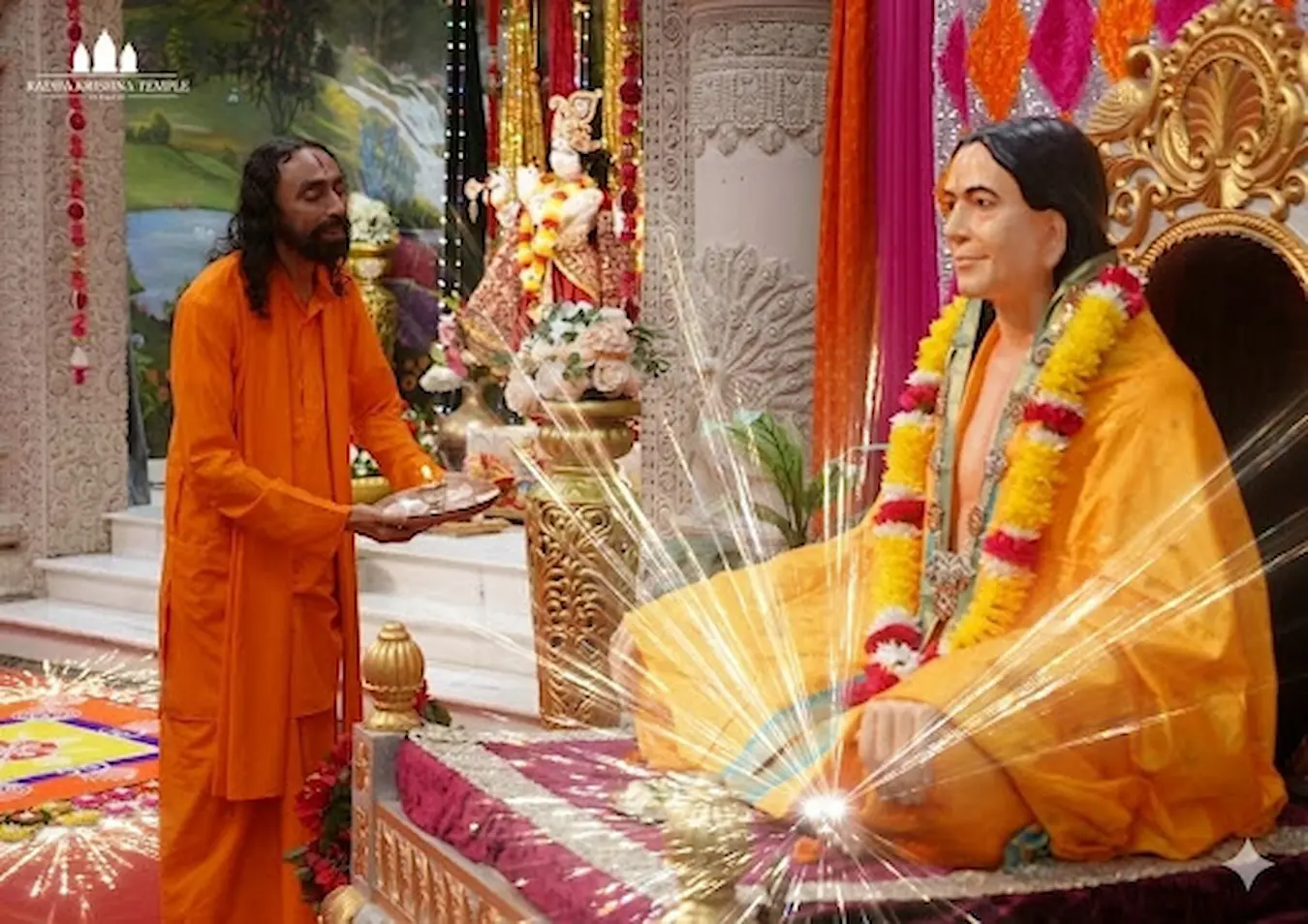
The radiant moonlike glow from the jewel-like nails of the Guru’s lotus feet dispels the darkness of delusion from the heart.
The imagery is striking. Even the smallest part of the Guru is filled with divine light. And when that light enters the heart of the disciple, the confusion of worldly attachment slowly begins to dissolve.
The Guru becomes the bridge between two worlds, the restless world of wandering minds and the eternal world of divine love.
Without that bridge, the temple would remain marble.
With the Guru’s grace, the marble becomes presence.
Then comes a verse that speaks directly to the restless mind.
“Are mana! moorh kahaan bhatakyo, Guru binu kou Hari se milayo?”
“O foolish mind! Where are you wandering? Without the Guru, no one can reach the Lord.”
This is not an insult. It is compassion spoken with clarity.
The devotee realizes that the spiritual path is not a lonely struggle to discover truth alone. There is guidance. There is protection. There is someone who has already walked the path and now walks beside us.
The Aarti then continues with a verse filled with tenderness:
“Komala kripalu, bare kripa sindhu naath…”
The Guru is described as gentle, compassionate, an ocean of grace who places his hand of mercy upon those who take shelter.
The Significance of the Aarti Ritual
Aarti is not meant to illuminate the Divine—Radha Krishna need no illumination. It is meant to illuminate our vision.
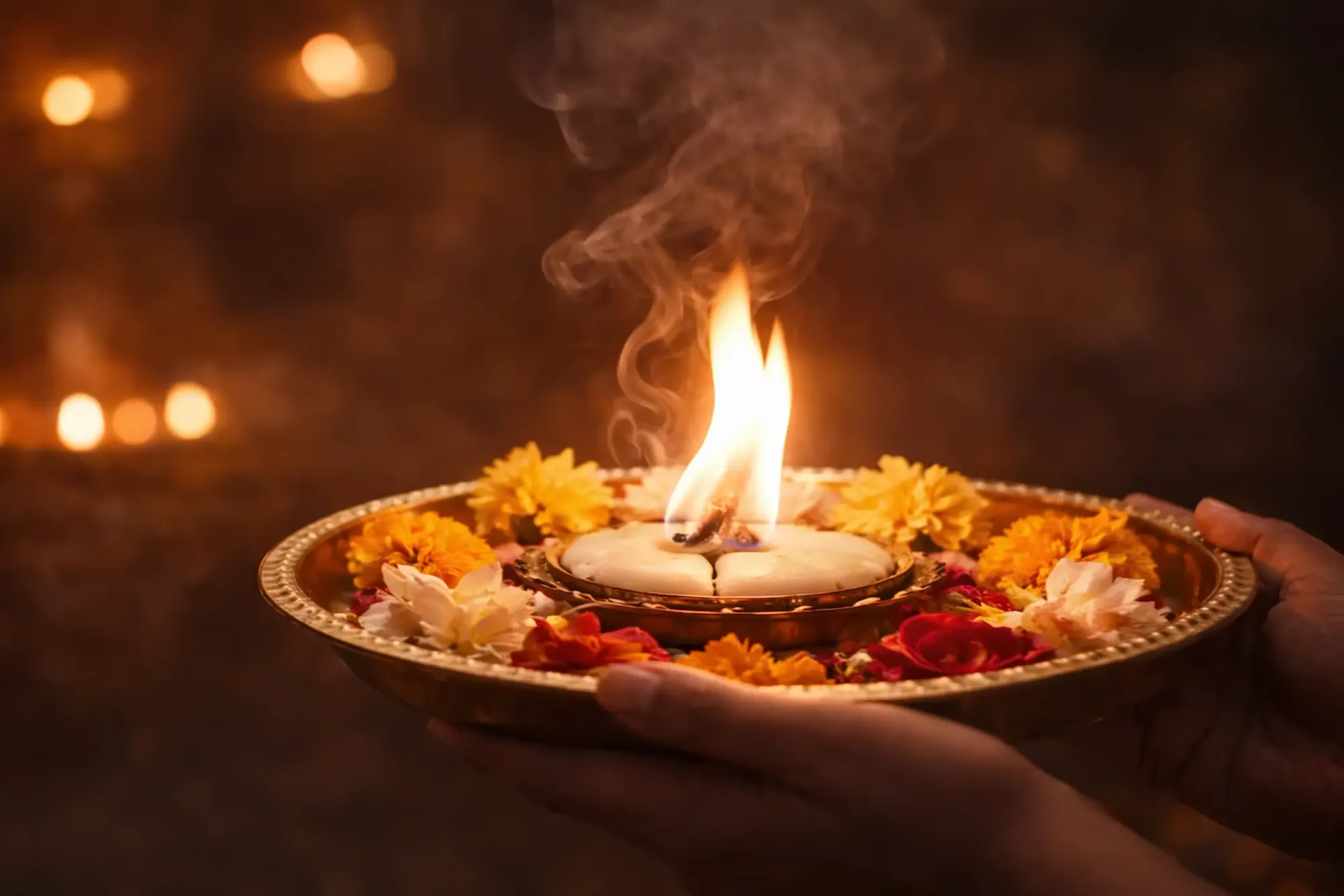
All day long our attention is scattered. Our eyes chase endless distractions, our ears absorb constant noise, and the mind circles through worry and desire. Arati gathers those wandering senses and gently brings them home.
The flame draws the eyes. The fragrance of incense softens the breath. Bells and the call of the conch interrupt the mind’s restless chatter. For a few moments the senses move together toward a single center: The heart becomes anchored in the present moment, standing before Radha Krishna.
And when the lamp is finally shared with the devotees, touching the flame to the eyes becomes a silent prayer:
Lord, the eyes with which I see, the mind with which I think, the life with which I move—all of this has come from You. Let it now be used in Your service.
May the vision I received in the temple remain with me. May my eyes learn to see the world through the light of the Divine.
The Inward Aarti: Carrying the Flame Home
You have felt the warmth of grace upon your eyelids. The Raseele Naina—those nectar-filled, piercing eyes—are now etched into your inner vision.
Swami Mukundanandaji teaches a profound truth: the external Aarti lasts only minutes, but the internal Aarti should continue for twenty-four hours.
The ritual at the Radha Krishna Temple of Dallas trains the senses, it is a rehearsal for eternity. As Swamiji teaches, the goal is not to stop loving, but to love higher. Not to kill desire, but to purify desire until it becomes devotion
The Aarti has ended, but the bhav has only begun.
Because Aarti was never merely about waving light before God.
It was about lighting an eternal flame within the soul.
The flame is now yours.
Go—and live in the light.
Call to Action
Wherever you are in the world, you can join the live Daily Kirtan and Aarti from the Radha Krishna Temple of Dallas and experience the sacred moment when the rising flame invites the heart to remember the Beloved — https://www.radhakrishnatemple.net/daily-kirtan.
FAQ
1) Do I have to be Hindu to attend Daily Aarti?
No. The temple welcomes everyone. Aarti is an experience of light, sound, reverence, and inner stillness—open to any sincere heart.
2) Why do we move the lamp in circles?
The circling trains attention: it places the Divine at the center and gently guides the mind from scattered thinking into focused remembrance.
3) Why are there two Aartis—Radha Krishna and Guru?
Because vision and gratitude belong together. The Radha Krishna Aarti reveals the Beloved; the Guru Aarti honors the grace that taught us how to see.
4) What should I do when the lamp comes to me?
Receive it quietly hover your palms above the flame, then touch your eyes and head with reverence, as a prayer for purified vision and steady remembrance.
5) Is watching Aarti online meaningful if I can’t come in person?
Yes, when watched with focus and devotion. In Bhakti, inner attention is the real offering; distance cannot block sincere remembrance.