As the auspicious festival of Chaitra Navratri approaches, beginning March 19, 2026, millions of devotees prepare to welcome the Divine Mother into their homes and hearts. But who exactly is this Divine Mother we worship? Is Durga different from Parvati? Is Lakshmi separate from Saraswati? And where does Shree Radha Rani, the beloved of Vrindavan, fit into this celestial tapestry?
Based on the profound teachings of Swami Shri Mukundananda ji—the IIT-IIM alumnus turned spiritual master and senior disciple of Jagadguru Kripaluji Maharaj—this comprehensive guide will unravel the deepest secrets of the Divine Mother's manifestations. Swamiji reveals that all goddesses are but different forms of the ultimate Yogmaya Shakti, the divine energy of Lord Krishna Himself .
The Fundamental Truth: Shakti and Shaktiman Are One
Before we explore the nine forms of Navratri, we must establish the foundational Vedantic truth that Swami Mukundananda ji emphasizes in his discourses: Shakti (energy) and Shaktiman (the possessor of energy) are non-different, just as fire and its heat are inseparable .
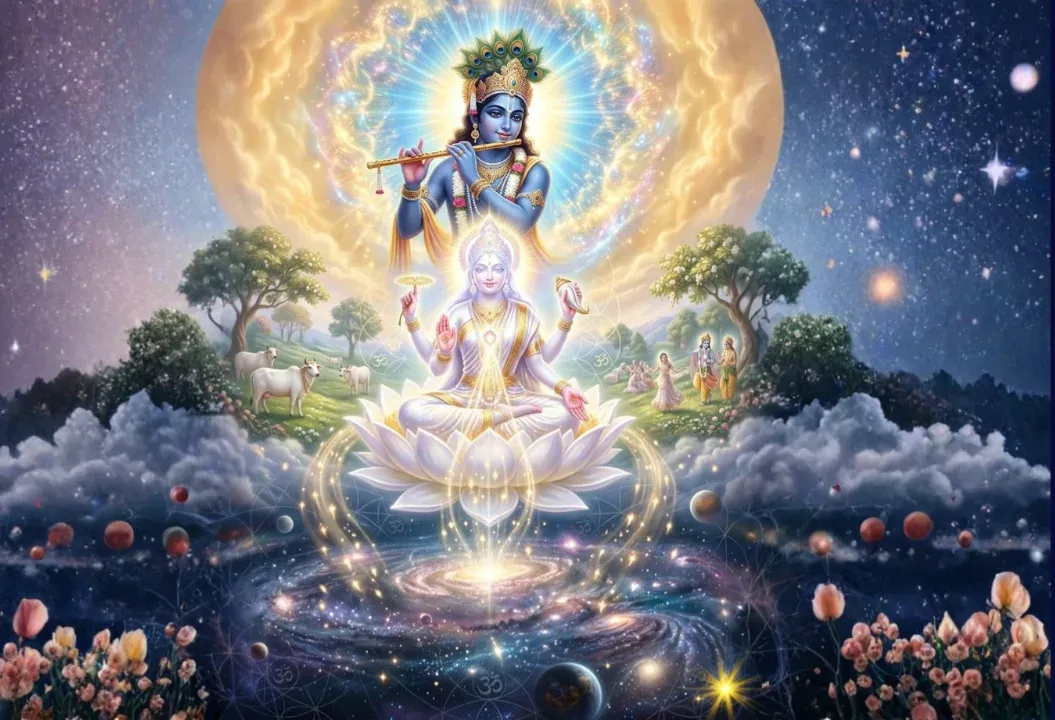
The Supreme Lord Krishna is Sarva-Shaktiman—the possessor of countless divine energies, each boundless and unlimited. Among these energies is Maya, the material force behind the universe's creation and operation. But surpassing Maya is a far more elevated and sublime power—Yogmaya. This spiritual energy governs Maya itself, and hence Yogmaya is called the Divine Mother of the universe .
It is through Yogmaya that the sweetness of God's Form, His Pastimes, His Abodes, and the divine nectar of His infinite virtues come to life. Most importantly, this energy enables God to bestow His divine grace upon us, granting ordinary souls the gift of God-realization, eternal bliss, and unconditional love .
This all-powerful Yogmaya manifests in personal forms such as Durga, Parvati, Sita, Lakshmi, Saraswati, Kali, and Radha. Just as Lord Krishna, Lord Shiva, and Lord Ram are distinct forms of the same Divine, these manifestations of Yogmaya are fundamentally unified .
The Twofold Manifestation: Fierce and Loving
Swami Mukundananda ji offers a beautiful analogy to help us understand the different forms of the Divine Mother:
A young boy, on his way home from school, excitedly imagines his mother welcoming him with a warm hug and tasty snacks. But when he arrives, he finds his mother angry, scolding his older brother. Realizing her mood is off, the boy retreats to his room, waiting for a better time to approach her. The mother is the same, but one is her fierce form and the other is her loving form .
Similarly, Mother Durga or Mother Kali is the form of Yogmaya where she is combating and subduing demons. She wields weapons, rides lions or tigers, and drinks the blood of evil forces. This is the fierce aspect necessary for cosmic protection.
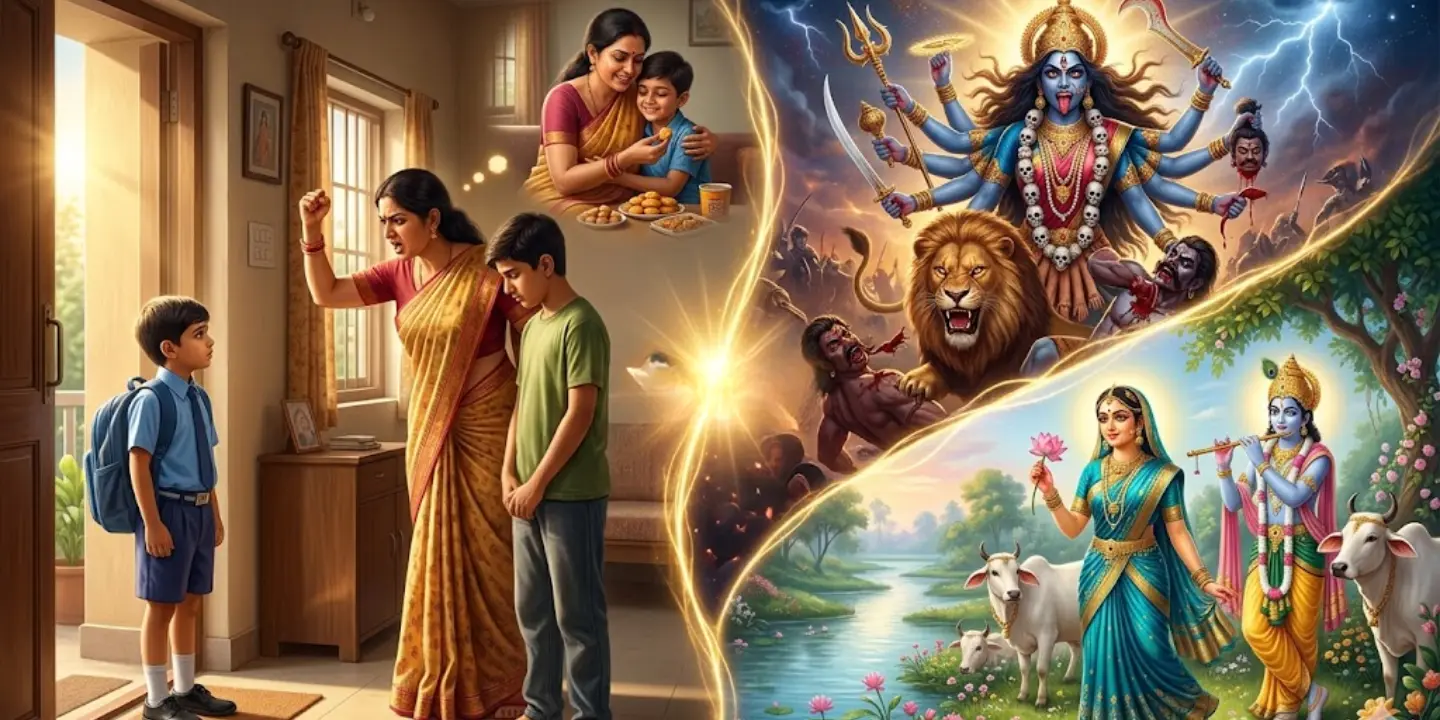
But the Radha form of the Divine Mother simply engages in the loving service of Lord Krishna, showering the highest level of divine love upon souls. She represents the sweetest aspect of Yogmaya, the Hladini Shakti—the bliss-giving energy that enables God to experience His own sweetness .
Chaitra Navratri 2026: The Cosmic Signature
Dates: March 19 - March 27, 2026
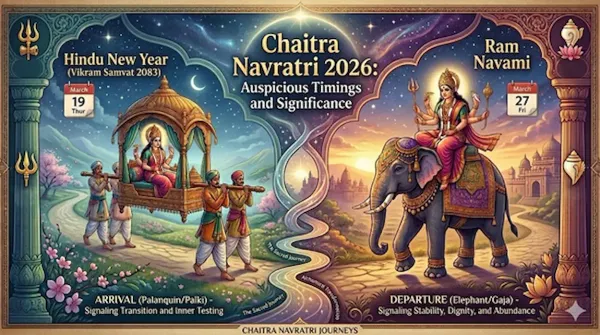
Chaitra Navratri marks the beginning of the Hindu New Year, Vikram Samvat 2083. According to the Agama Shastras, the day of the week on which Navratri begins determines the vehicle of the Goddess, setting the theme for the entire year.
In 2026, Navratri begins on a Thursday, the day of Guru Brihaspati (Jupiter). Therefore, the Goddess arrives on a Palki (Palanquin) . A palanquin sways—it represents a year of movement, transition, and perhaps uncertainty .
However, the festival ends on a Friday, meaning the Goddess departs on an Elephant. The Elephant is the symbol of royal stability, dignity, and grounded abundance. Swami Mukundananda teaches us that if we surrender to the Divine will and perform our sadhana with discipline, the swaying of the palanquin (the mind's restlessness) transforms into the majestic steadiness of the elephant (a mind anchored in God) .
The Nine Divine Forms: Manifestations of the One Yogmaya
Now, let us journey through the nine forms of Navratri, understanding each as a unique expression of the same ultimate Divine Mother—the Yogmaya Shakti of Shri Krishna.
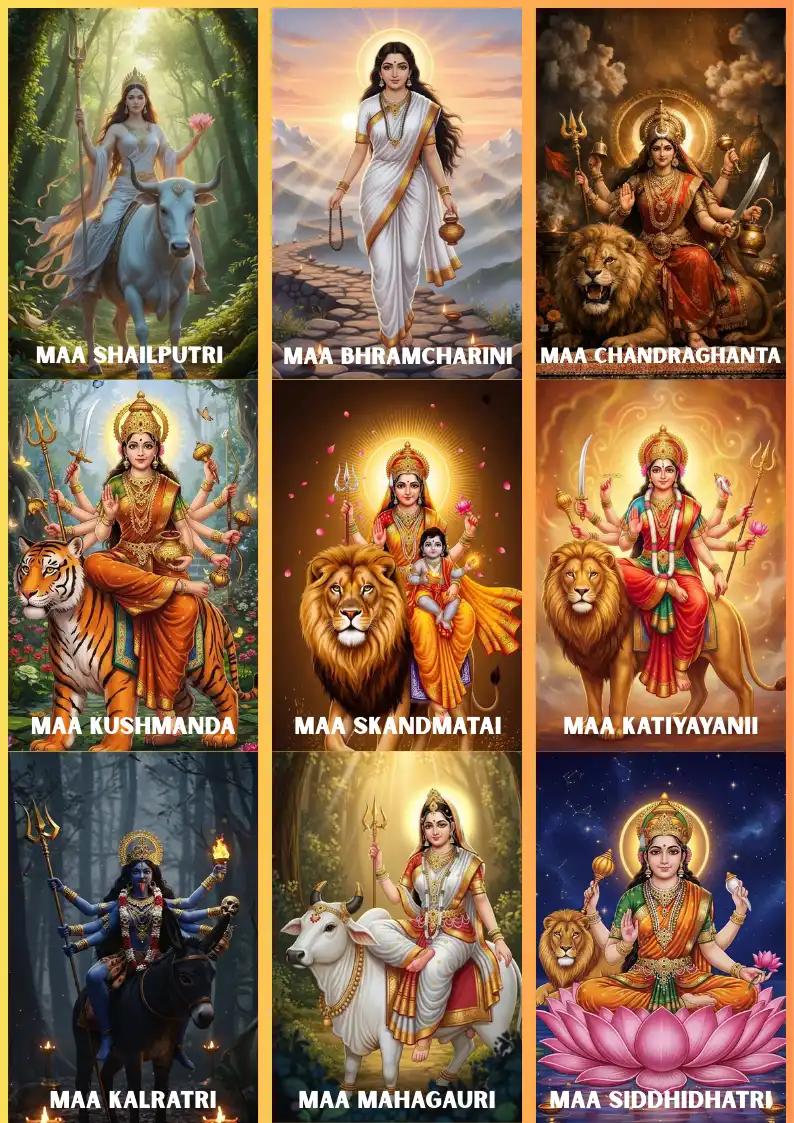
Day 1: Maa Shailaputri (March 19, 2026) – The Daughter of Mountains
Color: Yellow | Offering: Pure Ghee
Maa Shailaputri, the daughter of the Himalayas, is the first form of the Goddess. She is the embodiment of the power of Brahma, Vishnu, and Shiva. In her previous birth, she was Sati, who immolated herself when her father insulted Lord Shiva. Reborn as the daughter of King Himalaya, she represents unwavering determination.
Who is She Really? Shailaputri is none other than Yogmaya in her foundational aspect. She represents the Muladhara Chakra—the root chakra that grounds all spiritual energy . As the palanquin sways this year, we need her grounding force to steady our lives.
Day 2: Maa Brahmacharini (March 20, 2026) – The Goddess of Penance
Color: Green | Offering: Sugar
This form of the Goddess is the epitome of severe penance (Tapasya). She walked barefoot, carrying a japa mala and a kamandalu. It was through her intense austerities that she won Lord Shiva as her consort.
Who is She Really? Brahmacharini is the disciplinary aspect of Yogmaya. Swami Mukundananda ji explains that spiritual longing alone is insufficient; it must be backed by Abhyasa—repeated, disciplined practice . This form teaches us that the path to God requires steadfast commitment, just as Parvati underwent severe penance to unite with Shiva.
Day 3: Maa Chandraghanta (March 21, 2026) – The Warrior's Serenity
Color: Grey | Offering: Milk Sweets
On the third day, the Goddess adorns her forehead with a half-moon shaped like a bell. This is a fierce form, riding a tiger, yet her complexion remains serene gold. She is ready for war against demons like ego and anger, yet her face remains calm.
Who is She Really? Chandraghanta is Yogmaya in her protective aspect. She represents the perfect balance of ferocity and serenity. Swami Mukundananda ji teaches the concept of Samatvam—equanimity—and Chandraghanta embodies this paradox perfectly . The same Divine Mother who annihilates demons also bestows peace.
Day 4: Maa Kushmanda (March 22, 2026) – The Cosmic Creator
Color: Orange | Offering: Malpua
When there was nothing but darkness, Maa Kushmanda created the entire universe with her divine smile. "Ku" (little), "Ushma" (warmth), "Anda" (cosmic egg)—she is the one who created the cosmic egg with her warmth . She resides in the core of the Sun, giving energy to the solar system.
Who is She Really? Kushmanda is Yogmaya as the creative principle. Swamiji often says that worry is the misuse of imagination. Kushmanda teaches us to redirect that creative energy toward divine purpose. She is the radiant joy that creates worlds from mere smiles.
Day 5: Maa Skandamata (March 23, 2026) – The Divine Mother
Color: White | Offering: Bananas
Skandamata is the mother of the war god, Skanda (Kartikeya). She holds her son in her lap, representing the perfect balance of worldly duty and spiritual power. She is seated on a lotus, indicating one who is completely detached yet deeply loving.
Who is She Really? Skandamata is Yogmaya in her nurturing aspect. She represents the Vishuddhi Chakra and the role of the Buddhi (intellect) guiding our actions . The same Divine Mother who creates universes also holds her child with tender love. This is the Mother we approach for protection and guidance.
Day 6: Maa Katyayani (March 24, 2026) – The Fierce Warrior
Color: Red | Offering: Honey
Born from the anger of the gods to slay the demon Mahishasura, Maa Katyayani is the warrior goddess par excellence. She is the destroyer of the demon of inertia and procrastination. According to scriptures, she was born to the sage Katyayana through the combined energies of the angry gods.
Who is She Really? Katyayani is Yogmaya as the power of righteous anger. She represents the divine energy that annihilates evil. In Vrindavan, the Gopis worshiped Katyayani to attain Krishna as their husband. Swami Mukundananda ji warns against the victim mindset and teaches that Katyayani is the energy of decisive action . She is both the slayer of demons and the bestower of divine love.
Day 7: Maa Kaalratri (March 25, 2026) – The Dark Night of the Soul
Color: Dark Blue | Offering: Jaggery
This is the fiercest form. She is dark as night, with wild hair and a necklace of lightning, signifying the destruction of all impurities. She rides a donkey (symbolic of the slow, stubborn mind) and destroys ignorance. Her very name means "the night of death."
Who is She Really? Kaalratri is Yogmaya as the destroyer of ego. Swami Mukundananda ji states that this is the form we must face when confronting our deepest fears. She is the Divine Mother who annihilates the demon of Ahankara (false ego) . If you feel fear on this night, know it is the Mother herself, destroying the ego that fears death.
Day 8: Maa Mahagauri (March 26, 2026) – The Radiant Purification
Color: Pink | Offering: Coconut
After Kaalratri destroys the impurities, Maa Mahagauri emerges. She is the cleansed soul, radiant as a white flower. Having bathed in the Ganges of penance, she became extremely fair. She rides a bull and holds a trident and a drum.
Who is She Really? Mahagauri is Yogmaya as the purified consciousness. She represents the stage of recovery and purification after the darkness of ego-death . The coconut offered to her represents the ego—hard on the outside, but pure white within. Breaking the coconut symbolizes the breaking of the ego shell to reveal the pure soul inside.
Day 9: Maa Siddhidhatri (March 27, 2026) – The Bestower of Perfection
Color: Light Blue | Offering: Sesame Seeds
The final form is Maa Siddhidhatri, the possessor and giver of all Siddhis (spiritual perfections). It is said that even Lord Shiva attained his form by worshiping her. She sits on a lotus, holding a mace, discus, conch, and lotus.
Who is She Really? Siddhidhatri is Yogmaya in her most complete aspect. She bestows the ultimate perfection—the realization of our eternal relationship with God . Swami Mukundananda ji teaches that the ultimate Siddhi is not flying through the air, but the attainment of pure, unalloyed love for God.
The Supreme Manifestation: Shree Radha Rani as Yogmaya
Among all forms of the Divine Mother, one stands supreme in terms of sweetness and divine love—Shree Radha Rani. Swami Mukundananda ji reveals profound secrets about Radha Tattva in his discourses .
Radha: The Hladini Shakti
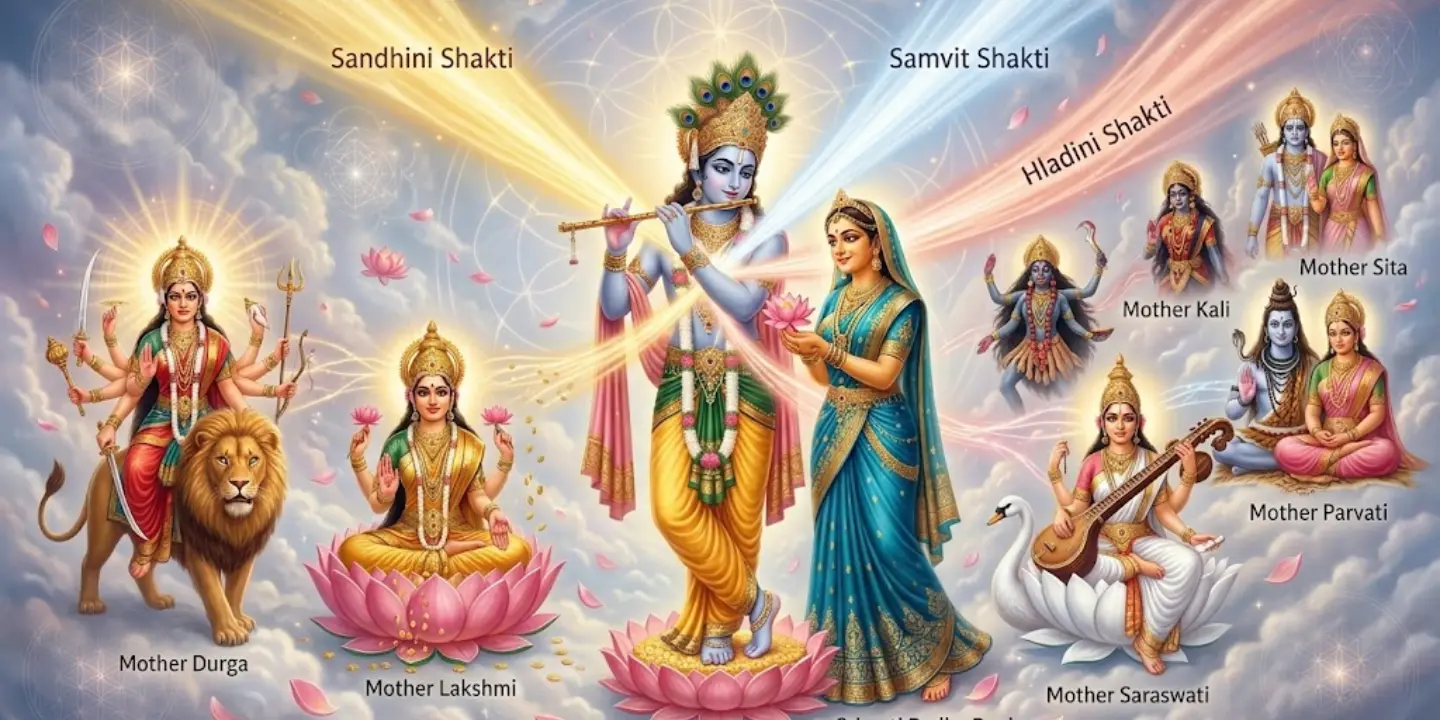
The Vedic scriptures describe that the Supreme Lord Krishna possesses three primary energies:
- Sandhini Shakti – The power of existence
- Samvit Shakti – The power of knowledge
- Hladini Shakti – The power of bliss
Shree Radha Rani is the personification of Hladini Shakti—the bliss-giving energy of Krishna . Through her, Krishna experiences the sweetness of His own love. Swamiji explains that Radha is not just a goddess among goddesses; she is the very energy that enables God to taste His own divine nectar.
Are Radha, Durga, and Parvati the Same?
This question has puzzled devotees for centuries. Swami Mukundananda ji provides crystal-clear clarity:
"Shakti-Shaktiman are one, just like fire is one with its heat. Radha and Krishna are one, Shiv and Parvati are one" .
The Divine Mother appears in different forms for different purposes:
- As Durga, Kali, and Kaalratri, she subdues demons and protects the universe
- As Lakshmi, she bestows prosperity
- As Saraswati, she grants knowledge
- As Sita, she exemplifies wifely devotion
- As Parvati, she embodies the ideal consort of Shiva
- As Radha, she engages in the loving service of Krishna, showering the highest level of divine love
The energy is one, but the rasa (divine flavor) differs in experience and intensity. Just as the same mother can be fierce when protecting and loving when nurturing, the same Yogmaya manifests differently according to the need of the universe and the yearning of the devotee .
The Unique Position of Radha
Swami Mukundananda ji emphasizes that while all goddesses are manifestations of Yogmaya, Radha holds a unique position. She is the Maha-bhava—the highest form of divine love. Even Krishna, in his form as Chaitanya Mahaprabhu, incarnated to experience the love that Radha feels for Him .
This is not to create hierarchy but to reveal the depth of divine love. As Swamiji explains, through Radha's grace alone can one attain Krishna's love. Serving Radha automatically leads to serving Krishna, for they are eternally united as Shakti and Shaktiman .
Practical Application: Worshipping the One in Many
How do we apply this profound understanding to our Chaitra Navratri sadhana?
1. See Unity in Diversity
When you worship Durga on the first day, know that you are worshipping the same Divine Mother who appears as Lakshmi on the fifth day. When you invoke Saraswati, remember that she is the same Yogmaya who dances as Radha in Vrindavan. This understanding deepens our devotion and removes all sectarian narrowness.
2. Understand the Mood of Each Form
As Swami Mukundananda ji explains, the mother is the same, but her mood differs . Approach Durga with reverence for her protective power. Approach Radha with the intimacy of a beloved. Each form has its own rasa, and we must tune our hearts accordingly.
3. Recognize Yogmaya's Grace in Daily Life
By the grace of Yogmaya energy—whether as Radha, Durga, or Lakshmi—one receives the love, knowledge, and grace of God. Great souls who receive divine grace become endowed with divine love and engage in uninterrupted devotion toward God. Thus, we must take shelter of the divine energy of God in all her forms .
The Inner Journey: From Muladhara to Sahasrara
The nine nights of Navratri correspond to the journey of spiritual energy (Kundalini) through the seven chakras. Swami Mukundananda ji explains that the nine forms are not external deities to be worshipped from a distance—they are the very energies within us waiting to be awakened.
- Shailaputri awakens the Muladhara (root chakra)
- Brahmacharini activates the Swadhisthana (sacral chakra)
- Chandraghanta energizes the Manipura (solar plexus)
- Kushmanda illumines the Anahata (heart chakra)
- Skandamata purifies the Vishuddhi (throat chakra)
- Katyayani opens the Agya (third eye)
- Kaalratri cleanses the pathways to the crown
- Mahagauri purifies the entire system
- Siddhidhatri bestows the realization of the Sahasrara (crown chakra)
As we worship each form externally, we are actually awakening these divine energies within ourselves.
Conclusion: The Elephant of Grace
As Chaitra Navratri 2026 concludes, we return to the symbol of the Elephant. The swaying Palki of our mind, which we steadied day-by-day with each form of the Divine Mother, now becomes the majestic Elephant of Siddhidhatri's grace .
The nine nights are over, but the nine forms remain within us as energies waiting to be expressed. Whether you feel drawn to the fierce protection of Durga, the prosperity of Lakshmi, the wisdom of Saraswati, or the divine love of Radha—know that you are approaching the same Yogmaya Shakti, the divine energy of Shri Krishna.
Swami Mukundananda ji reminds us that the heart matters more than the ritual. A perfect altar without a transformed heart is mere decoration. But a simple altar established with genuine surrender becomes a powerhouse of grace when we understand that the Mother we worship is none other than the ultimate energy of the Supreme Lord.
As you break your fast and celebrate Ram Navami on March 27, carry this profound understanding forward: The Divine Mother is one, though her names and forms are many. She is Durga, she is Lakshmi, she is Saraswati, she is Sita, she is Parvati, and in her sweetest form, she is Shree Radha Rani—the embodiment of divine love, the Hladini Shakti of Shri Krishna.
May the Divine Mother in all her forms bless you with stability, prosperity, wisdom, and ultimately, the highest gift of pure, unalloyed love for God.
Jai Mata Di! Jai Shree Radhe!
🌸✨ Celebrate the Divine Power of Chaitra Navratri! ✨🌸
Step into nine sacred days of devotion, transformation, and inner awakening. Each form of the Divine Mother brings unique blessings—strength, courage, wisdom, and peace—guiding you toward a more fulfilled and positive life.
💫 Which form of Goddess Durga inspires you the most?
Share your thoughts in the comments and connect with others celebrating this beautiful festival.
🪔 Light a diya, offer your prayers, and let the divine energy fill your heart and home with positivity.
📿 Save this guide for your daily Navratri rituals, and share it with your friends & family to spread the festive joy.
🔔 Follow us for more spiritual insights, festival guides, and meaningful traditions!
Celebrate Chaitra Navratri 2026Mar 19th - 29th
View Chaitra Navratri Events at Radha Krishna Temple
FAQs
1. What is Chaitra Navratri?
Chaitra Navratri is a nine-day Hindu festival celebrated in the month of Chaitra (March–April), dedicated to the worship of the nine forms of Goddess Durga.
2. When is Chaitra Navratri in 2026?
In 2026, Chaitra Navratri is expected to begin in March/April (exact dates depend on the lunar calendar and may vary slightly by region).
3. What are the nine forms of the Divine Mother worshipped during Navratri?
The nine forms are Shailputri, Brahmacharini, Chandraghanta, Kushmanda, Skandamata, Katyayani, Kalaratri, Mahagauri, and Siddhidatri.
4. Why are the nine forms of Goddess Durga worshipped?
Each form represents a different aspect of feminine divine energy, guiding devotees through spiritual growth, strength, wisdom, and liberation.
5. How do devotees celebrate Chaitra Navratri?
Devotees observe fasting, perform daily prayers, chant mantras, and participate in rituals to honor each form of the Goddess over nine days.