
Chapter 9 of the Bhagavad Gita, titled Raja Vidya Yog, unveils the most confidential spiritual knowledge, emphasizing the supremacy of devotion (bhakti) as the path to realizing the Divine. This chapter, often referred to as the "King of Sciences and the King of Secrets," bridges the metaphysical understanding of the universe with the intimate relationship between the soul and the Supreme Being.
1. The Supreme Knowledge and Its Confidential Nature
In the opening verses of Chapter 9 of the Bhagavad Gita, Lord Krishna introduces the essence of Raja Vidya—the Royal Knowledge—as the most exalted and transformative wisdom available to the human soul. He calls it Rāja-vidyā rāja-guhyaṁ pavitram idam uttamam—“the king of sciences and the king of secrets, supremely purifying, the highest knowledge.”
"This knowledge is the king of sciences and the king of secrets. It is the purest knowledge, and because it gives direct perception of the self by realization, it is the perfection of religion. It is everlasting and it is joyfully performed."
— Bhagavad Gita 9.2
Lord Krishna affirms that this knowledge is not merely theoretical or intellectual, but directly realizable (pratyakṣhāvagamaṁ). It leads the practitioner to firsthand spiritual experience—much like the warmth one feels when sitting near fire, not just hearing about it. This realization is the gateway to moksha, or liberation.
This knowledge is not bound by caste, class, gender, or external qualifications—it is available to all with a sincere heart and faith. It is pavitram—utterly purifying—because it removes the deepest stains of ignorance and ego, not by external rituals but through inner transformation.
The verse also states that it is susukham kartum—“easily and joyfully performed.” Unlike severe austerities or rigid dogmas, bhakti yoga—the path of devotion Krishna reveals—can be practiced joyfully in daily life. Singing the Lord’s name, remembering His form, and offering the heart’s devotion are acts that uplift the soul without strain.
Spiritual Insight from the Upanishads and Yoga Sutras
The Katha Upanishad declares:
“nāyam ātmā pravacanena labhyo na medhayā na bahunā śrutena…”
“This Self cannot be attained by much learning or intellect, but by the one whom the Self chooses—he alone attains it.”
This aligns beautifully with Krishna’s teaching: the true seeker must possess faith (śraddhā), humility, and love. Knowledge must be received with a clean heart, not a restless intellect.
Patanjali’s Yoga Sutras (1.12–1.14) support this by emphasizing two qualities for realization:
- Abhyasa – consistent, sincere effort, and
- Vairagya – dispassion from ego and worldly attachments.
Hence, Raja Vidya is not an ordinary science like physics or mathematics. It is the highest inner science that brings direct awareness of our eternal identity as the soul (atman) and our loving relationship with the Supreme (Paramatma).
Story from the Ramayana: Bharata’s Pure Knowledge and Devotion

A poignant illustration of this exalted knowledge can be seen in the story of Bharata, the younger brother of Lord Rama. When Lord Rama was exiled, Bharata refused to take the throne of Ayodhya, though all political and social obligations urged him to do so. He traveled to the forest to beg Rama to return and rule.
Despite being urged by sages, citizens, and his own mother, Bharata rejected the material power and authority of the kingdom. Instead, he worshipped Rama’s padukas (wooden sandals) as the rightful ruler, ruling only as a servant in his stead.
This act reflects deep spiritual realization—Bharata had Raja Vidya. He knew that the source of all dharma, all purity, and all joy, was not in kingship but in surrender to the Divine. Even without formal scriptures or philosophies, Bharata exhibited the highest wisdom: humility, selflessness, and devotion.
Summary and Lesson
Lord Krishna’s message in these verses is profound and universally accessible:
- This knowledge is sacred not because it is hidden, but because it is protected from the ego.
- It purifies not by punishing sin, but by uplifting the soul into divine remembrance.
- It is joyful because it connects us to our eternal nature, removing the burdens of fear, guilt, and material anxiety.
In a world driven by transactional knowledge and external achievements, Raja Vidya invites us to turn inward—to experience, not just believe; to love, not merely worship.
Lesson: When received with faith and practiced with devotion, this royal knowledge transforms not just our intellect but our very being. It leads to inner joy, outer detachment, and eternal union with the Divine.
2. The All-Pervading Nature of the Divine
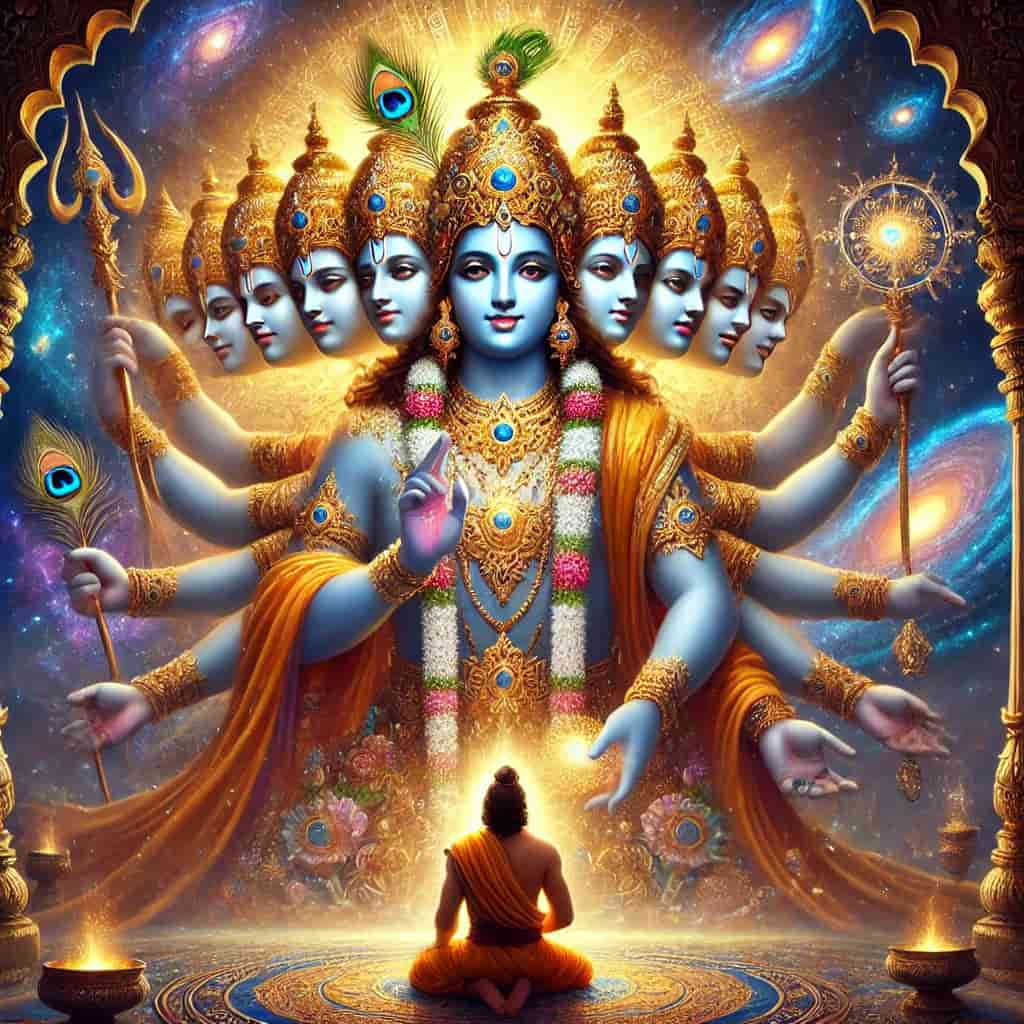
Verses 4-10 describe how the Divine pervades all creation, yet remains untainted and beyond it.
"By Me, in My unmanifested form, this entire universe is pervaded. All beings are in Me, but I am not in them."
— Bhagavad Gita 9.4(Wikipedia)
Lesson: The Divine essence is immanent in all beings and transcends them, highlighting the non-dual nature of reality.
Story from the Puranas: In the Bhagavata Purana, Lord Vishnu manifests as the cosmic form (Vishvarupa) to Arjuna, illustrating the all-encompassing nature of the Divine.
References:
- The Chandogya Upanishad states, "All this is Brahman," emphasizing the omnipresence of the Divine.
- Patanjali's Yoga Sutras discuss the concept of Ishvara as a special purusha, untouched by afflictions and karma.(Quiz DB)
3. The Nature of Devotion and Worship
Verses 11-19 contrast the understanding of the wise and the ignorant, emphasizing the importance of unwavering devotion.
"Those who are not faithful on the path of devotional service cannot attain Me, O conqueror of enemies. Therefore they return to the path of birth and death in this material world."
— Bhagavad Gita 9.3
Lesson: Faith and devotion are essential for transcending the cycle of birth and death and realizing the Supreme.
Story from the Ramayana:

Shabari, a tribal woman, waited for years with unwavering devotion to meet Lord Rama. Her sincere love and faith exemplify the power of pure devotion in attaining the Divine.
References:
- The Bhakti Sutras by Narada highlight the supremacy of devotion over other spiritual practices.
- Saints like Mirabai and Tukaram exemplified unwavering devotion in their lives.
4. The Impermanence of Material Rewards
Verses 20-25 discuss the temporary nature of rewards obtained through ritualistic practices and the superiority of devotion to the Supreme.
"Those who worship the demigods will take birth among the demigods; those who worship ancestors go to the ancestors; those who worship ghosts and spirits will take birth among such beings; and those who worship Me will live with Me."
— Bhagavad Gita 9.25
Lesson: While ritualistic worship may yield temporary benefits, devotion to the Supreme leads to eternal union with the Divine.
Story from the Mahabharata: King Yayati exchanged his old age with his son's youth to enjoy worldly pleasures but eventually realized their futility, turning towards spiritual pursuits.
References:
- The Isha Upanishad warns against the pursuit of transient pleasures, advocating for the realization of the eternal Self.
- Patanjali's Yoga Sutras describe vairagya (dispassion) as essential for spiritual progress.
5. The Simplicity of Devotional Offerings
Verses 26-29 emphasize that the Divine accepts even the simplest offerings made with love and devotion.
"If one offers Me with love and devotion a leaf, a flower, fruit or water, I will accept it."
— Bhagavad Gita 9.26
Lesson: The sincerity and love behind an offering are more important than its material value.
Story from the Puranas:

Sudama, a poor Brahmin, offered Lord Krishna a handful of beaten rice with immense love. In return, Krishna blessed him with prosperity, highlighting the value of heartfelt devotion.
References:
- The Bhagavata Purana narrates numerous instances where the Lord accepts humble offerings made with devotion.
- Saints like Sant Eknath emphasized the importance of devotion over ritualistic practices.
6. The Assurance of Divine Protection
Verses 30-34 conclude the chapter with the assurance that even the most sinful individuals can attain the Supreme through unwavering devotion.
"Even if one commits the most abominable action, if he is engaged in devotional service, he is to be considered saintly because he is properly situated in his determination."
— Bhagavad Gita 9.30
Lesson: The transformative power of devotion can purify even the gravest sins, leading the devotee to liberation.
Story from the Mahabharata: The story of Valmiki, a highway robber who transformed into a revered sage through devotion and penance, exemplifies this teaching.
References:
- The Narada Bhakti Sutra states that devotion purifies the heart and leads to liberation.
- Saints like Kabir and Ravidas, who came from humble backgrounds, attained spiritual heights through devotion.
Conclusion
Chapter 9 of the Bhagavad Gita encapsulates the essence of spiritual wisdom, emphasizing that sincere devotion transcends all barriers, leading the soul to eternal union with the Divine. Through stories from the Ramayana, Mahabharata, and the lives of saints, we witness the transformative power of love and surrender, reinforcing the timeless relevance of these teachings.
Ready to Walk the Eternal Path?
Life may be uncertain, but your spiritual journey doesn’t have to be. Let the wisdom of Bhagavad Gita Chapter 9: Raja Vidya Yog guide you toward the ultimate truth and divine realization.
📘 Dive Deeper Into the Gita:
Uncover the profound teachings of the Bhagavad Gita and learn how to live a life filled with devotion, wisdom, and divine connection.
🎓 Join Online Gita Classes with JKYog and the Radha Krishna Temple of Dallas:
Study the Gita systematically and apply its teachings to experience a spiritually fulfilling life.
📲 Download the Free “Bhagavad Gita Krishna Bhakti” App:
Access daily verses, audio explanations, guided meditations, and more spiritual resources for your journey.
📺 Subscribe to Swami Mukundananda’s YouTube Channel:
Watch powerful spiritual discourses and find inspiration for your soul’s journey.
🌐 Start now: www.holy-bhagavad-gita.org
✨ Let every breath become a prayer, and every moment a step closer to the Supreme. Your journey begins now.
Further Reading:
- Bhagavad Gita Chapter 9 – Holy Bhagavad Gita
- Bhagavad Gita Chapter 9 Summary – Vedanta Vision
- Lives of Indian Saints – eSamskriti
FAQs
1. What is the meaning of Raja Vidya Yog in Bhagavad Gita Chapter 9?
Raja Vidya Yog means the King of Sciences and the most confidential knowledge shared by Lord Krishna in Chapter 9 of the Bhagavad Gita. It reveals the path of devotion (bhakti) and the eternal truth of God.
2. Why is Chapter 9 of the Bhagavad Gita called the King of Sciences?
Chapter 9 is called the King of Sciences because it unveils the supreme knowledge of Yog, devotion, and God’s divine nature, which is sacred, pure, and liberating.
3. What is the central theme of Bhagavad Gita Chapter 9?
The central theme is bhakti yog, where Lord Krishna emphasizes the power of unwavering devotion and reveals the divine truth about His omnipresence and grace.
4. How does Raja Vidya Yog help in spiritual transformation?
Raja Vidya Yog provides deep spiritual insight that purifies the mind, strengthens devotion, and guides one toward God-realization and inner peace.
5. What are the key teachings of Yog through the King of Sciences?
Key teachings include: the supremacy of devotion, God’s impartial love for all, the omnipresence of the divine, and the assurance of salvation for sincere devotees.