Introduction: The War Within
Chapter 16 of the Bhagavad Gita is a profound psychological and spiritual discourse where Lord Krishna classifies human tendencies into two broad categories — Daivi Sampad (divine qualities) and Asuri Sampad (demoniac qualities). This classification is not about judging others, but about introspecting and refining our own inner nature.
🔗 Read Chapter 16 – Verse by Verse
1. The Divine Qualities (Daivi Sampad)
Verse Reference: Bhagavad Gita 16.1-3
"Fearlessness, purity of heart, perseverance in knowledge and yoga, charity, control over senses, sacrifice, study of the scriptures, austerity, uprightness..."
Scriptural Story – Lord Rama’s Daivi Sampad
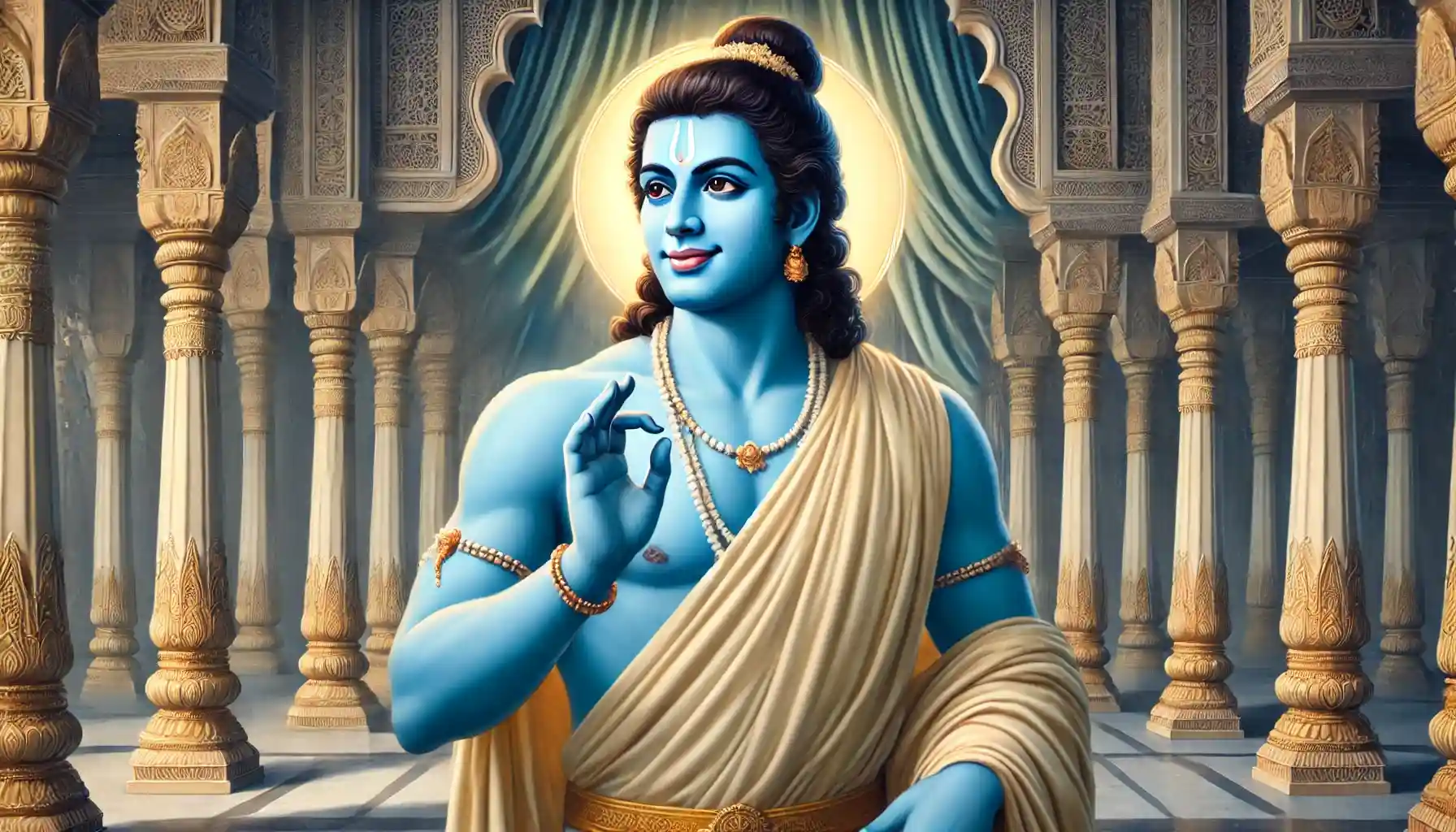
In the Ramayan, Lord Rama embodied Daivi qualities perfectly. Despite being exiled unjustly, Rama never complained. He remained calm, dharmic, and focused on duty — demonstrating kshama (forgiveness), tyag (renunciation), and daya (compassion).
Lesson:
True strength lies in cultivating inner virtues, not outer dominance. These qualities become our shield in life’s trials.
Yogic Insight – Patanjali Yog Sutra:
Patanjali mentions ahimsa, satya, asteya, aparigraha, and shauch as yamas and niyamas — overlapping significantly with Daivi Sampad. These qualities are the foundation of a sattvic and yogic life.
2. The Demoniac Nature (Asuri Sampad)
Verse Reference: Bhagavad Gita 16.4
“Pride, arrogance, conceit, anger, harshness, and ignorance — these qualities belong to those of demoniac nature.”
🔗 BG 16.4
Puranic Example – Ravana’s Ego
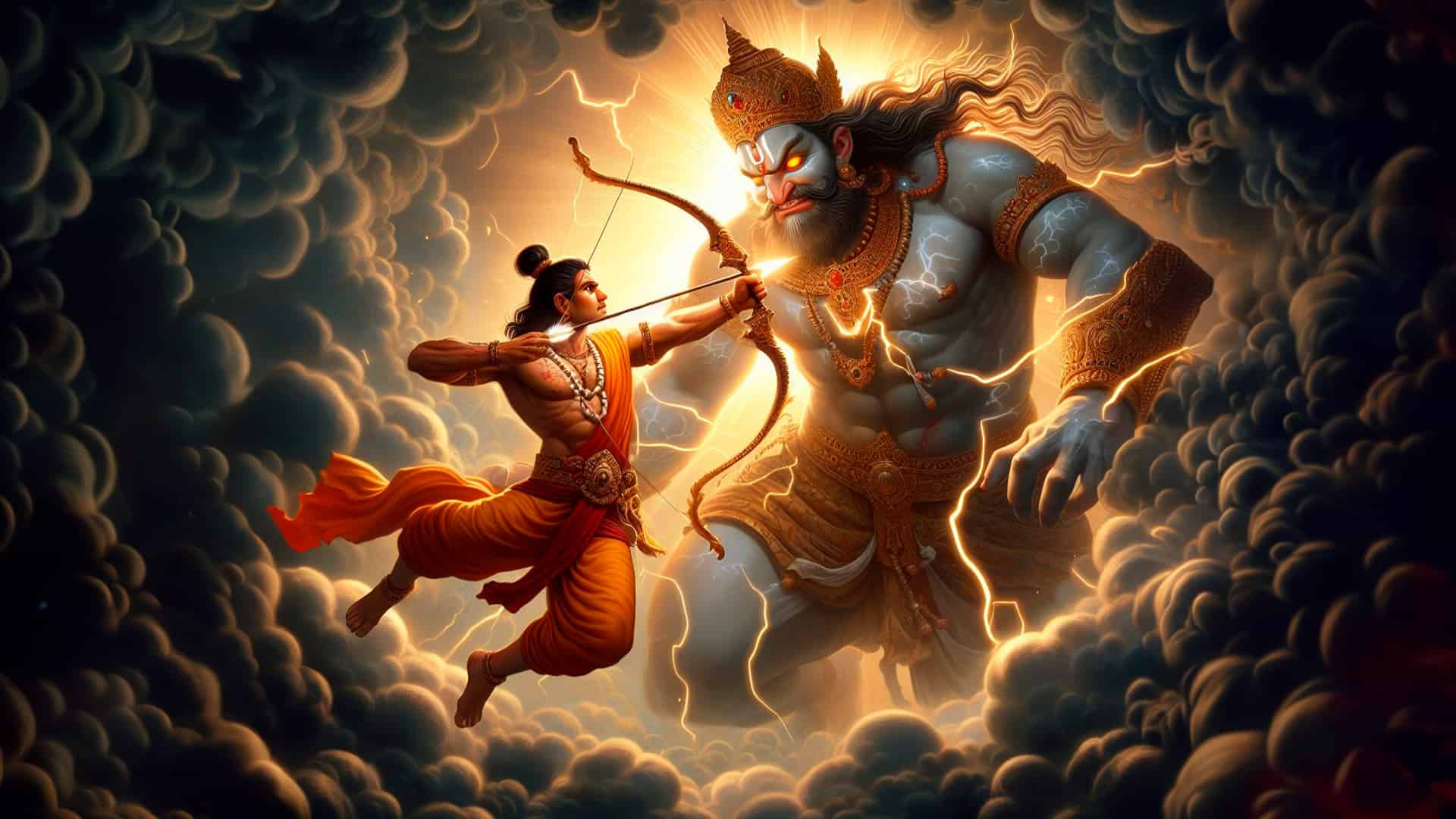
Ravana, though learned and powerful, let his pride and lust overpower wisdom. His downfall was not due to Lord Rama’s strength but his own uncontrolled Asuric tendencies — krodha (anger), mada (arrogance), and moha (delusion).
💡Lesson:
Power without humility is destructive. The demons are not outside us; they are our uncontrolled impulses.
📜 Upanishadic Echo:
The Katha Upanishad says, “The self is like a chariot. The intellect is the driver, and the mind the reins.” Demoniac nature arises when the mind runs wild, uncontrolled by discrimination (viveka).
3. Two Paths: Liberation vs. Bondage
Verse Reference: Bhagavad Gita 16.5
“The divine qualities lead to liberation, while the demoniac qualities lead to bondage. Do not grieve, O Arjuna, for you are born with divine qualities.”
🔗 BG 16.5
Mahabharat Insight – Arjuna vs. Duryodhana
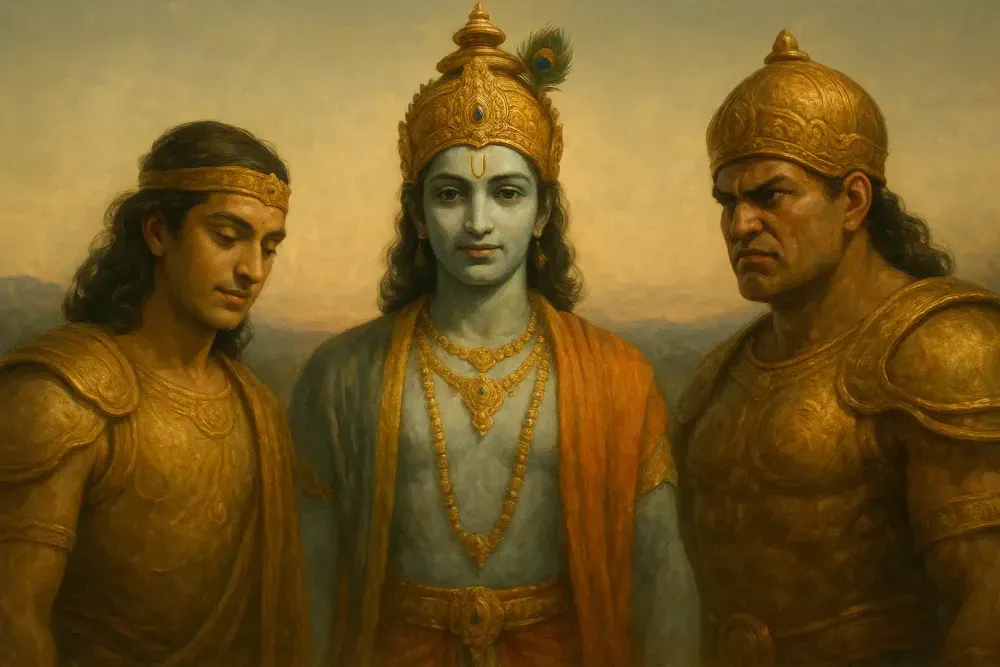
Arjuna, though faced with inner conflict and despair, possessed divine qualities that led him to ultimately surrender to Lord Krishna and choose the path of righteousness. In contrast, Duryodhana, though aware of dharma, allowed pride, envy, and greed to dominate his choices, leading him toward destruction. This contrast highlights how divine qualities pave the way to liberation, while demoniac traits bind the soul in suffering.
💡Lesson:
It’s not knowledge alone that liberates, but living according to higher principles. Discrimination and surrender lead to moksha.
4. The Worldview of the Asuric Nature
Verse Reference: Bhagavad Gita 16.7-9
“Those of demoniac nature do not know what is to be done and what is not to be done... They say, ‘This world is without truth, without basis, and without God.’”
The Story of Hiranyaksha and Hiranyakashipu – The Demonic Brothers Who Challenged the Divine
In the vast tapestry of Vedic lore, the tale of Hiranyaksha and Hiranyakashipu stands out as a powerful lesson in pride, ego, and the invincibility of divine will. These two asura brothers, born of Diti and Sage Kashyapa, descended from a noble lineage, but chose the path of adharma, rejecting spiritual truths and opposing the very existence of God.
Their Birth and Rising Arrogance
Hiranyaksha and Hiranyakashipu were born during the evening twilight, a time considered inauspicious. Their mother, Diti, in a moment of emotional weakness, conceived them against the guidance of her husband, Sage Kashyapa. As a result, these children were destined to be born with demonic tendencies.
Even though they were born of a sage, they turned away from dharma. Fueled by arrogance, they considered themselves the supreme controllers of the universe. They rejected the authority of the Vedas, mocked saints and devotees, and declared themselves gods. Their hatred toward Lord Vishnu was particularly intense, for He stood as the protector of dharma and the destroyer of ego.
Hiranyaksha and the Boar Incarnation – Varaha Avatar
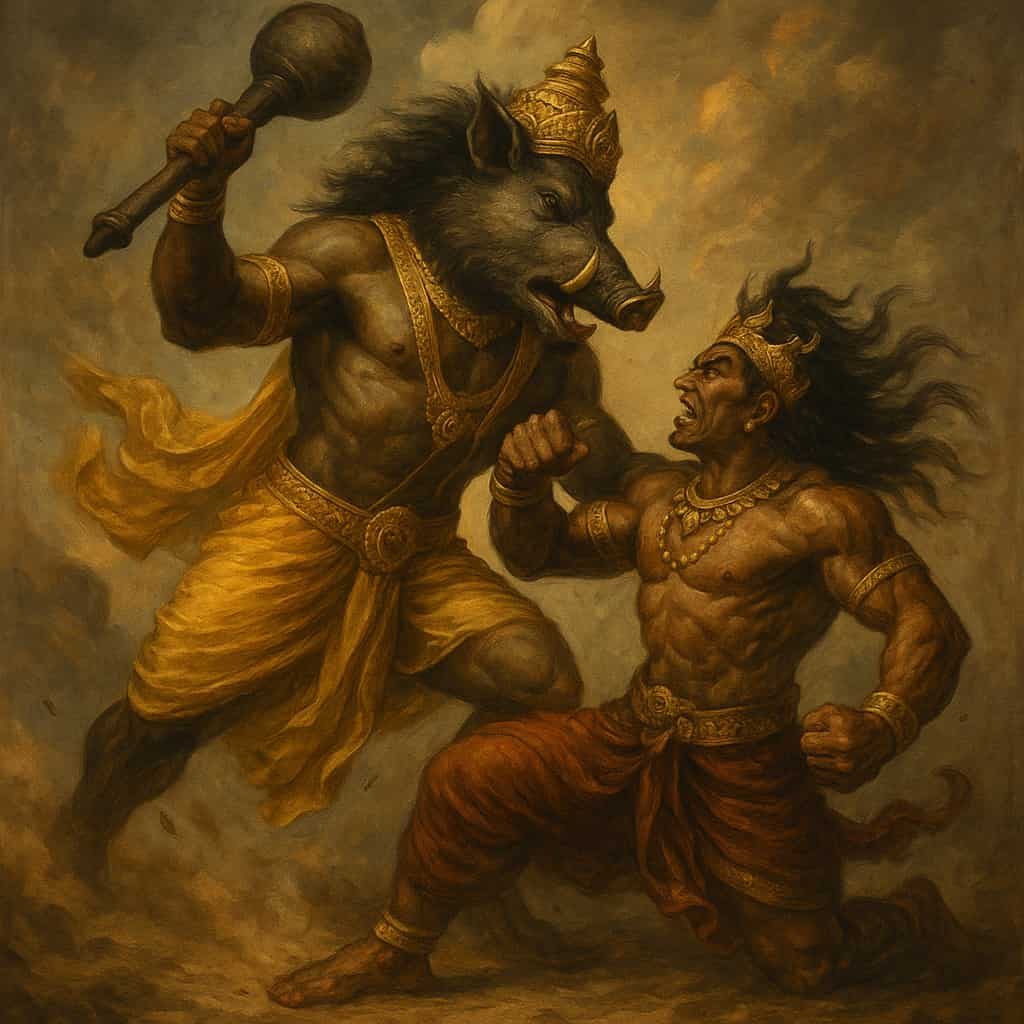
The younger brother, Hiranyaksha, was a fearsome warrior. He performed severe penances and gained immense power from Lord Brahma. With his newfound strength, he rampaged across the three worlds, tormenting demigods and sages. In his ultimate act of arrogance, he desecrated Mother Earth (Bhudevi) by kidnapping her and dragging her into the cosmic ocean, attempting to submerge her into the depths of chaos.
This act of cosmic imbalance invoked the divine intervention of Lord Vishnu, who assumed the form of a mighty boar – Varaha. In a fierce and divine battle that shook the heavens, Varaha lifted the Earth on His tusks and fought Hiranyaksha in the depths of the ocean. After a long and intense fight, Lord Varaha killed Hiranyaksha, restoring balance to the world.
Hiranyakashipu’s Revenge and the Narasimha Avatar
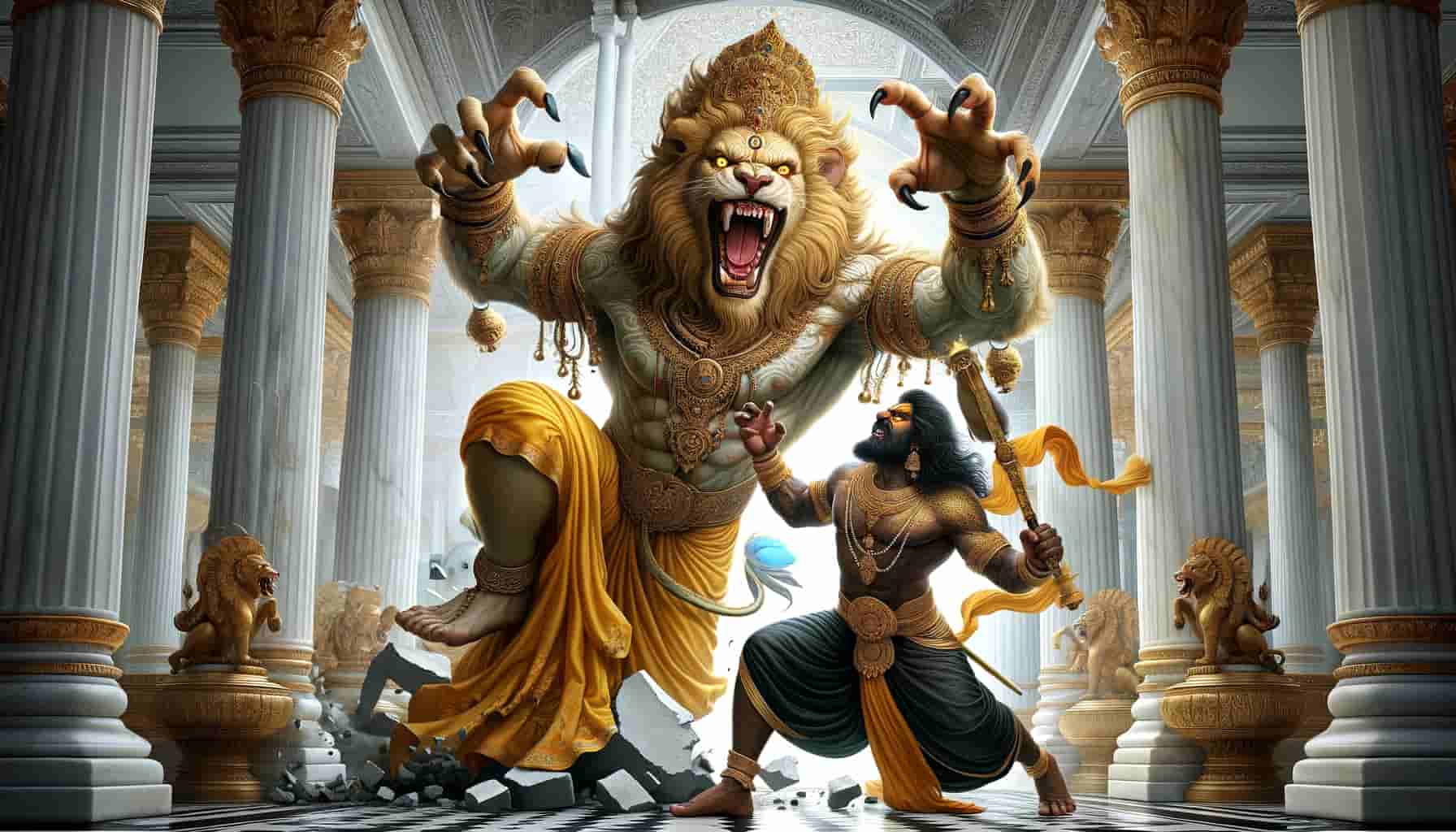
The elder brother, Hiranyakashipu, was devastated by his brother’s death and swore vengeance against Lord Vishnu. He, too, undertook severe austerities and received a powerful boon from Lord Brahma — he could not be killed by man or beast, indoors or outdoors, during day or night, on earth or in the sky, or by any weapon. Empowered by this seemingly invincible protection, he declared himself the supreme ruler of the universe.
He banned the worship of Vishnu, punished devotees, and terrorized the gods. However, irony lay in his own household — his son, Prahlad, was a pure devotee of Lord Vishnu. No matter how many ways Hiranyakashipu tried to dissuade or punish him, Prahlad's devotion only grew stronger.
Furious, Hiranyakashipu once challenged his son, “Where is your Vishnu? Is He present in this pillar?”
To this, the fearless child-devotee replied, “He is everywhere, even in this pillar.”
Enraged, Hiranyakashipu struck the pillar, and in that very moment, emerged the most awe-inspiring and terrifying form of the Lord — Narasimha, the half-man, half-lion incarnation. He was neither man nor beast, and He appeared at twilight (neither day nor night), on the threshold of the palace (neither inside nor outside), placed Hiranyakashipu on His lap (neither earth nor sky), and slew him with His nails (not a weapon).
This divine manifestation upheld the boon of Brahma while also destroying the evil that threatened cosmic balance.
Conclusion: The Fall of the Demoniac, as Declared in the Gita
The lives of Hiranyaksha and Hiranyakashipu are living illustrations of the demoniac nature described in the Bhagavad Gita (16.7–9), where Lord Krishna states:
"Those who are of demoniac nature do not know what is to be done and what is not to be done. Neither purity, nor truth, nor proper conduct is found in them. They say, ‘This world is without truth, without moral foundation, and without God.’”
(Bhagavad Gita 16.7–9)
Blinded by arrogance, these brothers rejected the authority of dharma, denied the existence of God, and declared themselves as the ultimate rulers of the universe. Their hearts were devoid of humility and reverence, echoing the very traits Krishna warns about — pride, hypocrisy, cruelty, and delusion.
Yet, no matter how invincible they seemed, their downfall was inevitable. The Supreme Lord incarnated in forms beyond comprehension — Varaha and Narasimha — to protect righteousness and destroy evil. Through these divine interventions, the Lord reaffirmed that adharma may rise, but it can never prevail.
Their stories serve as timeless reminders that:
- Rejecting God and dharma leads to ruin.
- True power lies not in domination, but in devotion.
- God always protects those who surrender to Him with faith.
Let us, like Prahlad, embrace the path of faith, truth, and righteousness — for in doing so, we align with the will of the Divine, who forever upholds and protects dharma.
5. The Qualities and Lifestyle of Asuric Beings
Verse Reference: Bhagavad Gita 16.10-12
“Obsessed with insatiable desires... bound by hundreds of expectations, given over to lust and anger... they strive to accumulate wealth by unjust means.”
🔗 BG 16.10 | BG 16.11 | BG 16.12
Ramayan Insight – Kaikeyi’s Greed
Kaikeyi initially loved Rama but fell prey to moha (attachment), lobha (greed), and ahamkar (ego) due to Manthara’s influence. This cost her not only Rama’s exile but the eventual downfall of her family.
Lesson:
Unchecked desires and attachments make us vulnerable to manipulation and suffering. Watch your desires, and you’ll preserve your peace.
6. “I am the Doer” Mentality
Verse Reference: Bhagavad Gita 16.13-15
“‘I have gained this today, I will fulfill this desire, I am the lord, I am perfect...’ They are deluded by ignorance.”
🔗 BG 16.13 | BG 16.14 | BG 16.15
Example – Kansa’s Arrogance
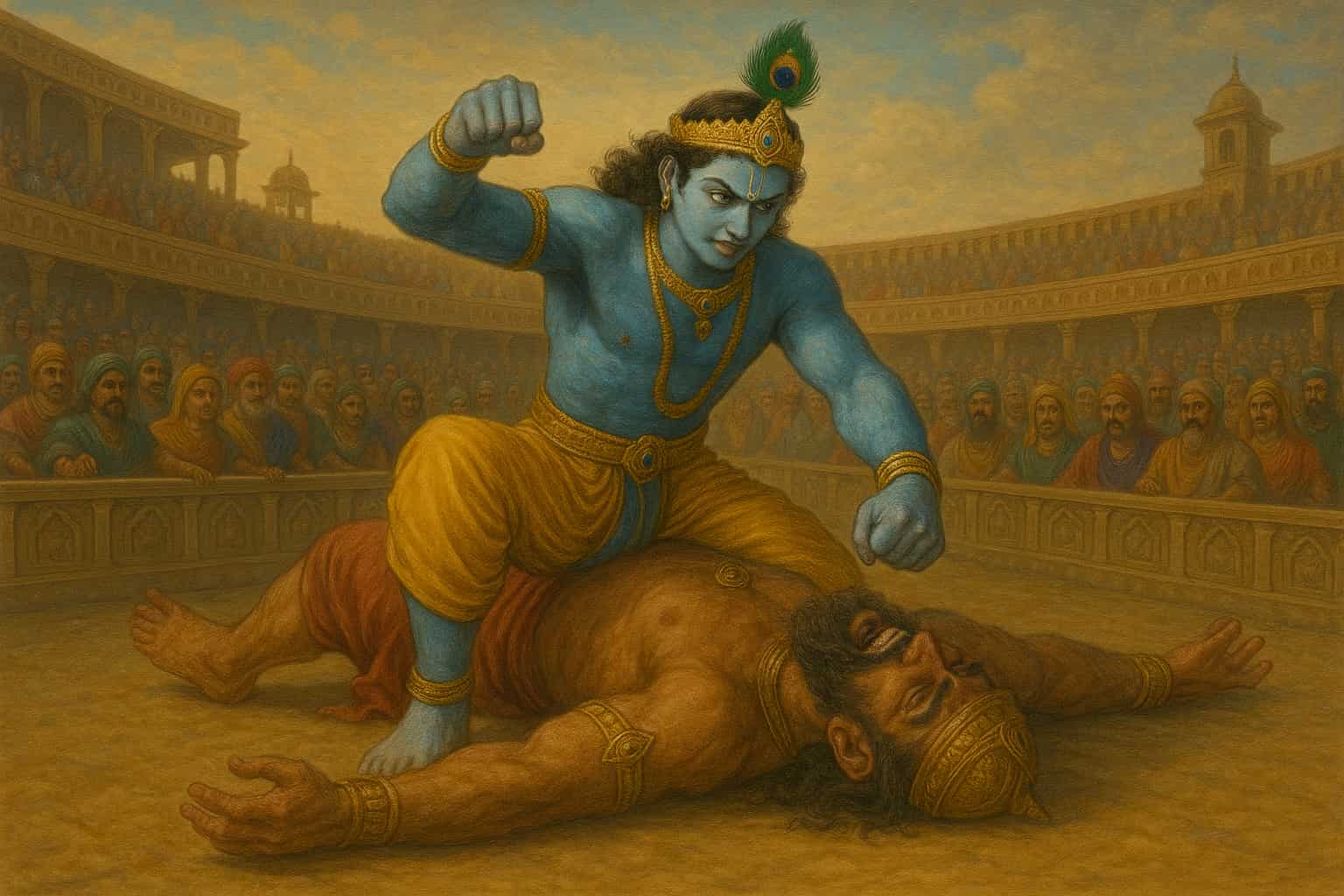
Kansa, the tyrannical king of Mathura, was consumed by fear and pride. When a prophecy warned him that his sister Devaki’s eighth child would be his destroyer, Kansa decided to eliminate this threat before it could come true. He imprisoned Devaki and her husband Vasudeva, ruthlessly killing each of their newborns.
Despite the many warnings and omens, Kansa’s ego blinded him to the inevitable. He believed his power and ruthless actions made him invincible. He tightened his grip over Mathura, punishing anyone who dared to oppose him, convinced no one could challenge his reign.
However, fate had already set its course. Devaki’s eighth child, Krishna, was secretly taken to Gokul to be raised away from Kansa’s reach. As Krishna grew up, He displayed divine qualities and miraculous powers, symbolizing hope and justice.
When Krishna finally returned to Mathura, He confronted Kansa. Despite the king’s strength and cruelty, Krishna’s divine power was unstoppable. In a decisive battle, Krishna defeated Kansa, ending his tyranny and fulfilling the prophecy.
Kansa’s downfall is a powerful reminder that no one can escape destiny. Ego and arrogance may cloud judgment, but truth and righteousness always triumph in the end.
Lesson:
When “I” and “mine” dominate our consciousness, we fall from grace. True wisdom lies in seeing oneself as a servant of God, not the master.
7. Their Fate: Hell and Rebirth
Verse Reference: Bhagavad Gita 16.16-20
“Bewildered by many thoughts... they fall into the unclean hell. These demoniac beings, cruel and hateful, are repeatedly cast into demoniac wombs.”
Puranic Story – The Curse of Jaya-Vijaya
Jaya and Vijaya, gatekeepers of Vaikuntha, once disrespected the Kumaras. As a result, they were cursed to be born in asuric wombs thrice — as Hiranyaksha, Ravana, and Shishupala — before returning to Vaikuntha.
Lesson:
Karma is precise and unavoidable. One’s inner nature determines one’s future, not just actions.
8. The Three Gates to Hell
Verse Reference: Bhagavad Gita 16.21
“There are three gates leading to hell — lust, anger, and greed. Every sane person should abandon them.”
🔗 BG 16.21
Mahabharat Insight – Duryodhana’s Fall
Duryodhana’s kama for power, krodha against the Pandavas, and lobha for kingdom pushed him into war despite knowing the consequences.
Lesson:
Lust, anger, and greed — if not checked — can destroy our mental, moral, and spiritual well-being.
Vedic Support:
The Atharva Veda emphasizes self-restraint: “Let your mind be controlled. Let anger be conquered. Let desires be sublimated.”
9. The Way to Elevation

Verse Reference: Bhagavad Gita 16.22-23
“One who avoids these three gates... and acts by scriptural injunctions attains the supreme goal.”
Example from Shri Ram’s Life — The Exile to the Forest
📜 The Situation:
When Shri Ram was about to be crowned as the king of Ayodhya, Kaikeyi, under the influence of greed and manipulation, demanded that her son Bharata be crowned king instead and that Shri Ram be exiled for 14 years.
🧘 Shri Ram’s Response:
- No Lust for Power or Kingdom:
Though he was the rightful heir and beloved by all, Ram displayed no attachment or desire (kāma) for power, position, or luxury. - No Anger (Krodha):
Shri Ram did not express anger toward Kaikeyi, even though her demand was clearly unjust. He showed compassion and honored her wishes. - No Greed (Lobha):
Even when offered the kingdom by Bharata later, Ram did not accept it out of greed. He insisted on fulfilling the promise made by his father, sticking to his dharma. - Acting by Scriptural Injunctions:
Shri Ram’s actions were always guided by dharma as prescribed in the scriptures. He obeyed his father’s command (pitṛvakya paripālan), respected elders, and upheld truth and righteousness over personal gain.
Spiritual Outcome:
Because Shri Ram remained above these destructive vices and perfectly adhered to dharma:
- He inspired millions as Maryada Purushottam — the ideal man.
- He attained the supreme goal not just for himself but uplifted countless beings spiritually.
- His entire life became a leela glorified in the scriptures for ages.
Lesson:
Shri Ram’s unwavering control over lust, anger, and greed, even under the most painful circumstances, and His steadfast adherence to scriptural dharma make Him the perfect example of the Gita's teaching:
“One who avoids these three gates of darkness and follows the scriptures reaches the supreme goal.”
— Bhagavad Gita 16.23-24
10. Faith in Scriptures Brings Perfection
Verse Reference: Bhagavad Gita 16.24
“Therefore, let the scriptures be your guide in determining what is to be done and what is not.”
🔗 BG 16.24
Bhagavatam Example – Dhruva Follows Sage Narada’s Scriptural Advice
Young Dhruva, hurt by his stepmother’s harsh words, set out to attain Lord Vishnu. Initially, his mind was clouded with anger and pride. On the way, he met Sage Narada, who counseled him with deep scriptural wisdom.
Narada Muni first tried to calm Dhruva's emotions, but seeing his sincere determination, he taught Dhruva the right method of devotion based on Vedic injunctions — how to chant the sacred mantra “Om Namo Bhagavate Vasudevaya,” how to meditate, and how to control his senses.
Instead of blindly acting on emotion, Dhruva aligned himself with scriptural guidance and performed penance as instructed. Within months, he had a divine vision of Lord Vishnu and became immortalized as the Dhruva star.
📜 Lesson:
Dhruva’s transformation came only after surrendering to scriptural wisdom. Had he followed anger or ego, he would have lost the path. By acting as per Narada’s scriptural guidance, he attained the highest goal.
“Therefore, let the scriptures be your guide in determining what is to be done and what is not.”
— Bhagavad Gita 16.24
When emotions run high or life feels unfair, let the Gita and Puranic wisdom lead your actions — like they did for Dhruva.
Conclusion: Cultivating Daivi Sampad in Modern Life
This chapter teaches us a powerful truth — we all have both divine and demoniac tendencies. The spiritual journey is about reducing the latter and nurturing the former. With practice, prayer, and introspection, we can steadily cultivate Daivi Sampad.
✅ Summary Takeaways:
|
Divine Qualities |
Demoniac Qualities |
|
Fearlessness, compassion, self-control |
Pride, arrogance, lust, greed |
|
Scriptural living |
Denial of God and ethics |
|
Leads to liberation |
Leads to bondage and repeated birth |
🌺 Practical Steps:
- Reflect daily: Am I acting from Daivi or Asuri tendencies?
- Practice yamas/niyamas from Patanjali’s Yog Sutra.
- Read one verse of the Gita daily.
- Seek association of saintly people and spiritual wisdom.
Join the Path
Want to learn more about the Bhagavad Gita?
🎓 Join Online Gita Classes with JKYog and the Radha Krishna Temple of Dallas:
Study the Gita systematically and apply its teachings to experience a spiritually fulfilling life.
📲 Download the Free “Bhagavad Gita Krishna Bhakti” App:
Access daily verses, audio explanations, guided meditations, and more spiritual resources for your journey.
🎥 Subscribe to Swami Mukundananda’s YouTube Channel for in-depth discourses.
FAQs
1. What are the divine qualities described in Bhagavad Gita Chapter 16?
Divine qualities (Daivi Sampad) include fearlessness, purity, perseverance in knowledge, charity, self-control, sacrifice, study of scriptures, austerity, and truthfulness.
2. What are demoniac qualities according to the Gita?
Demoniac qualities (Asuri Sampad) include pride, arrogance, anger, harshness, ignorance, and uncontrolled desires that lead to bondage and suffering.
3. How does Bhagavad Gita classify human nature?
The Gita divides human nature into two broad types: divine qualities that lead to liberation, and demoniac qualities that cause bondage and suffering.
4. What examples from Indian epics illustrate divine and demoniac natures?
Lord Rama exemplifies divine qualities, showing patience and dharma; Ravana and Hiranyakashipu exemplify demoniac traits like pride and ego leading to their downfall.
5. What is the ultimate consequence of following demoniac tendencies?
The Gita warns that those with demoniac tendencies fall into bondage and hell, suffering repeated births in unfavorable conditions until they surrender to divine will.
Reference Links
- Bhagavad Gita Chapter 16 – Verse by Verse
- Patanjali Yoga Sutras
- Ramayan Overview
- Varaha and Narasimha Avatars
- Katha Upanishad Text