The Bhagavad Gita presents one of history's most profound moral dilemmas when Arjuna, poised for battle, suddenly refuses to fight. Set against the backdrop of the epic Mahabharata war between the Pandavas and Kauravas, Chapter 1 introduces us to Arjuna's emotional turmoil as he faces his own relatives, teachers, and friends across the battlefield. His trembling limbs and dry mouth physically manifest the inner conflict tearing him apart.
Known as "Arjuna Vishad Yog" or the "Yoga of Arjuna's Grief," Bhagavad Gita Chapter 1 contains 47 verses that establish the setting for Lord Krishna's timeless teachings. The battlefield of Kurukshetra, described as a "dharma-ksetra" or field of righteousness, becomes the stage where blind King Dhritarashtra inquires about the progress of war, symbolizing ignorance about spiritual truth. When Arjuna asks Krishna to position his chariot between the two armies, he experiences overwhelming grief that ultimately leads to his surrender—creating the perfect opening for the spiritual wisdom that follows.
The Battlefield Setup and Key Characters
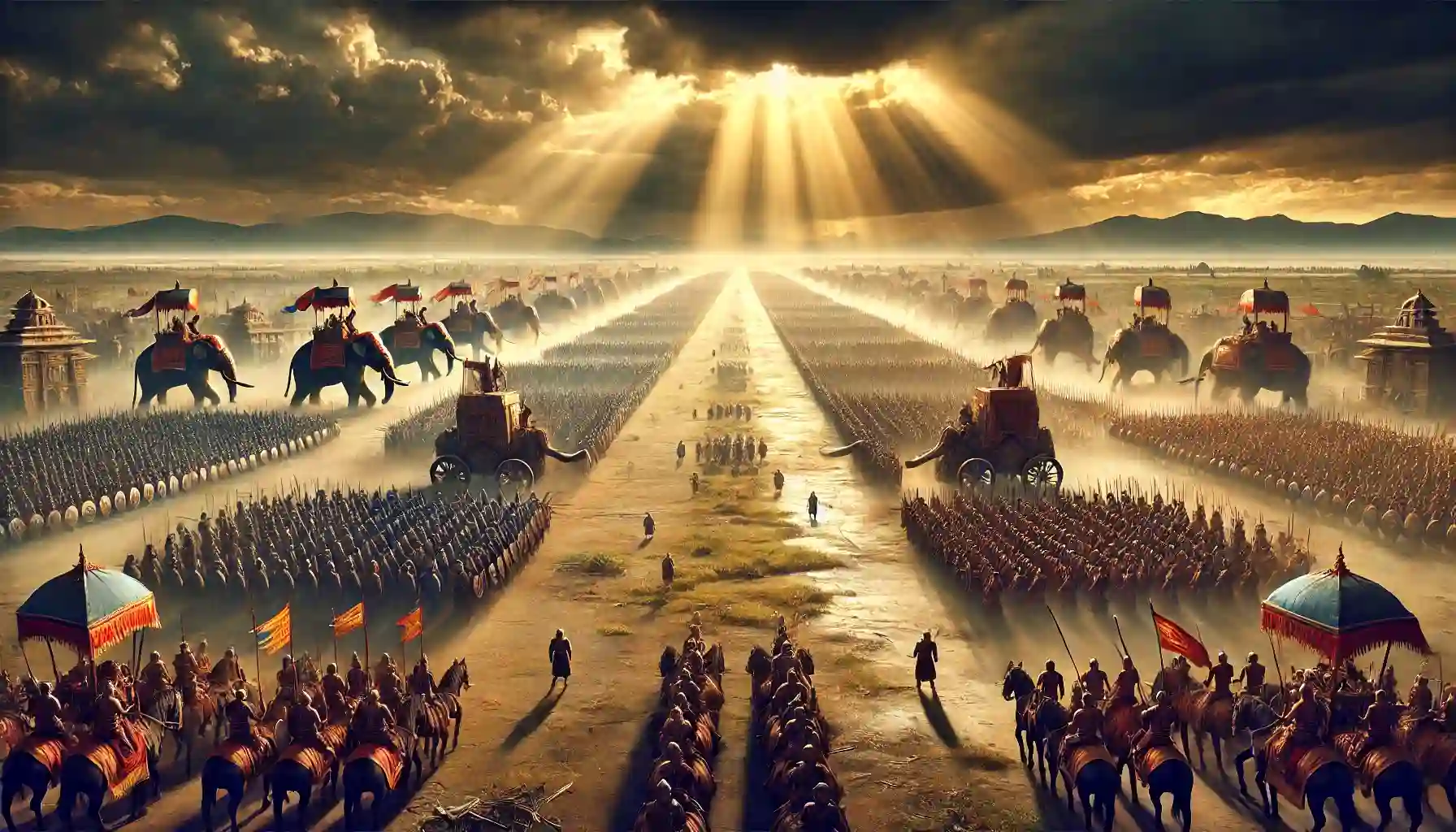
The ancient battlefield of Kurukshetra sets the stage for one of humanity's most influential spiritual discourses in the Bhagavad Gita. As armies gather and tension mounts, the dialog begins not with clashing weapons but with a blind king's question and the extraordinary narration of his gifted minister.
Kurukshetra: The field of dharma and war
Known significantly as "Dharmakshetra" (the realm of duty), Kurukshetra holds profound significance in Hindu tradition. This sacred land, located in present-day Haryana, India, derives its name from King Kuru, the ancestor of both the Pandavas and Kauravas. According to the Vedas, Kurukshetra was not merely a city but an entire region—"kshetra" literally meaning "region" in Sanskrit.
The spiritual importance of this battlefield stems from an ancient blessing. As described in the Vamana Purana, King Kuru performed intense spiritual practices on this land, embedding it with eight virtues: austerity, truth, forgiveness, kindness, purity, charity, devotion, and righteous conduct. Lord Vishnu, impressed by these acts, granted two boons—first, that this land would forever be known as Kurukshetra (the land of Kuru), and second, that anyone dying on this land would attain heaven. Notably, this sacred region was situated between two rivers—the Sarasvati and the Drishadvati.
Dhritarashtra's question to Sanjaya
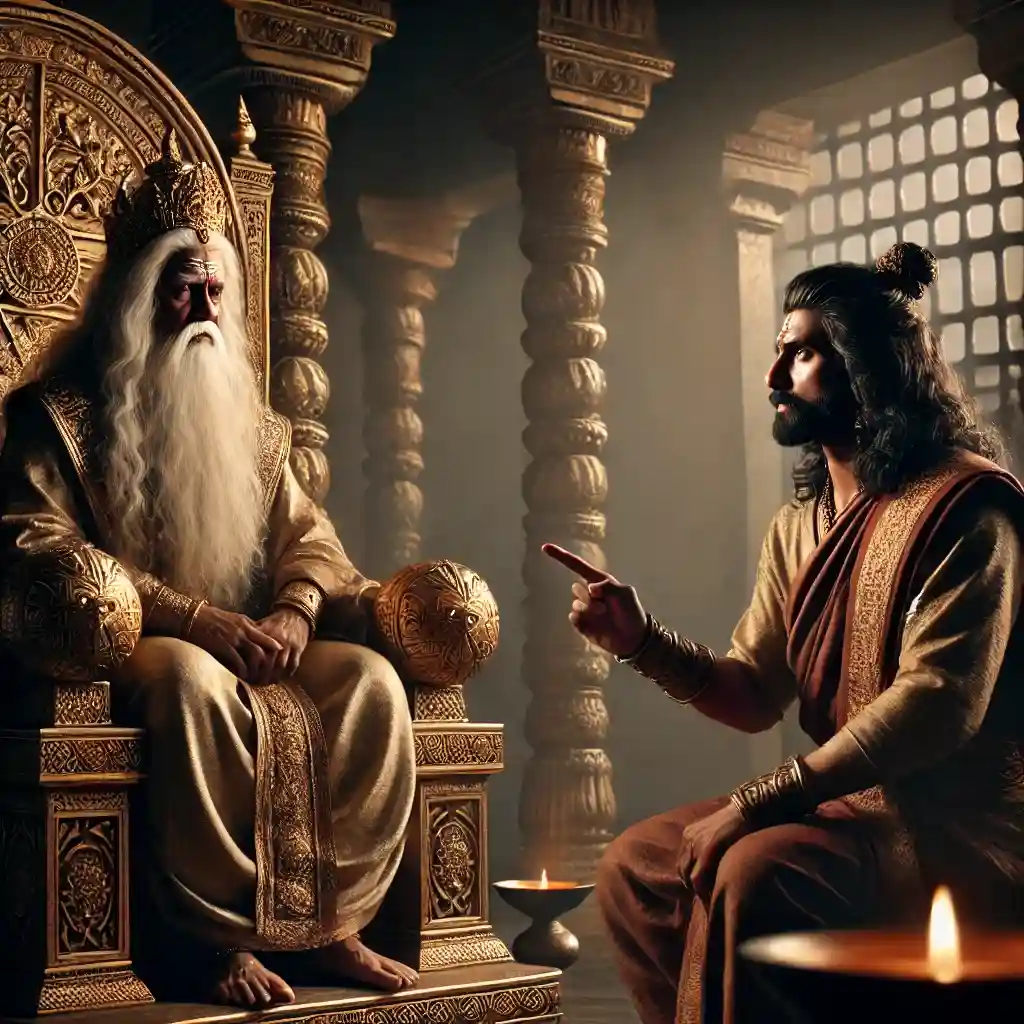
The Bhagavad Gita opens with a seemingly simple yet profound question from Dhritarashtra, the blind king of Hastinapura: "O Sanjay, after gathering on the holy field of Kurukshetra, and desiring to fight, what did my sons and the sons of Pandu do?". This question reveals much about the king's character and concerns.
Dhritarashtra, physically blind since birth and unable to leave his palace, was nonetheless eager to know the developments on the battlefield where his children faced their cousins in mortal combat. His name itself reveals his mentality—"one who holds on to (dhrita) a kingdom (rashtra)"—an attached king whose inability to relinquish what was not rightfully his ultimately led to this catastrophic war.
The king's question initiates the narrative framework for the entire Bhagavad Gita, as it prompts Sanjaya's detailed account of the unfolding events at Kurukshetra, including Krishna's divine discourse to Arjuna that forms the heart of this sacred text.
Sanjaya's divine vision and narration
Sanjaya, Dhritarashtra's trusted minister and charioteer, possessed an extraordinary gift that made him the perfect narrator for these momentous events. As a disciple of Sage Ved Vyas (Vyasa), Sanjaya had been bestowed with "divya drishti" (divine vision)—the miraculous power to witness distant events within his mind.
Unlike ordinary subtle perception, Sanjaya's divine vision allowed him to see events as if physically present, hearing sounds with his physical ear rather than merely as thought currents. Consequently, while remaining in Hastinapura's palace, he could observe everything transpiring on the battlefield with perfect clarity.
Throughout the Bhagavad Gita, passages often begin with "Sanjaya uvāca" ("Sanjaya said"), marking his role as the primary narrator. His perception extended beyond mere military movements—he described Earth, other planets, and gave elaborate accounts of kingdoms, tribes, provinces, rivers, and mountains of ancient Bharata Varsha (India).
Furthermore, Sanjaya's character embodied honesty and straightforwardness. Despite his loyalty to Dhritarashtra, he never concealed difficult truths, even when reporting the deaths of the king's sons. This made him not just a passive observer but a virtuous witness representing "intuitive knowledge, which arises from long and arduous spiritual practice".
Duryodhana’s Strategy and Army Overview
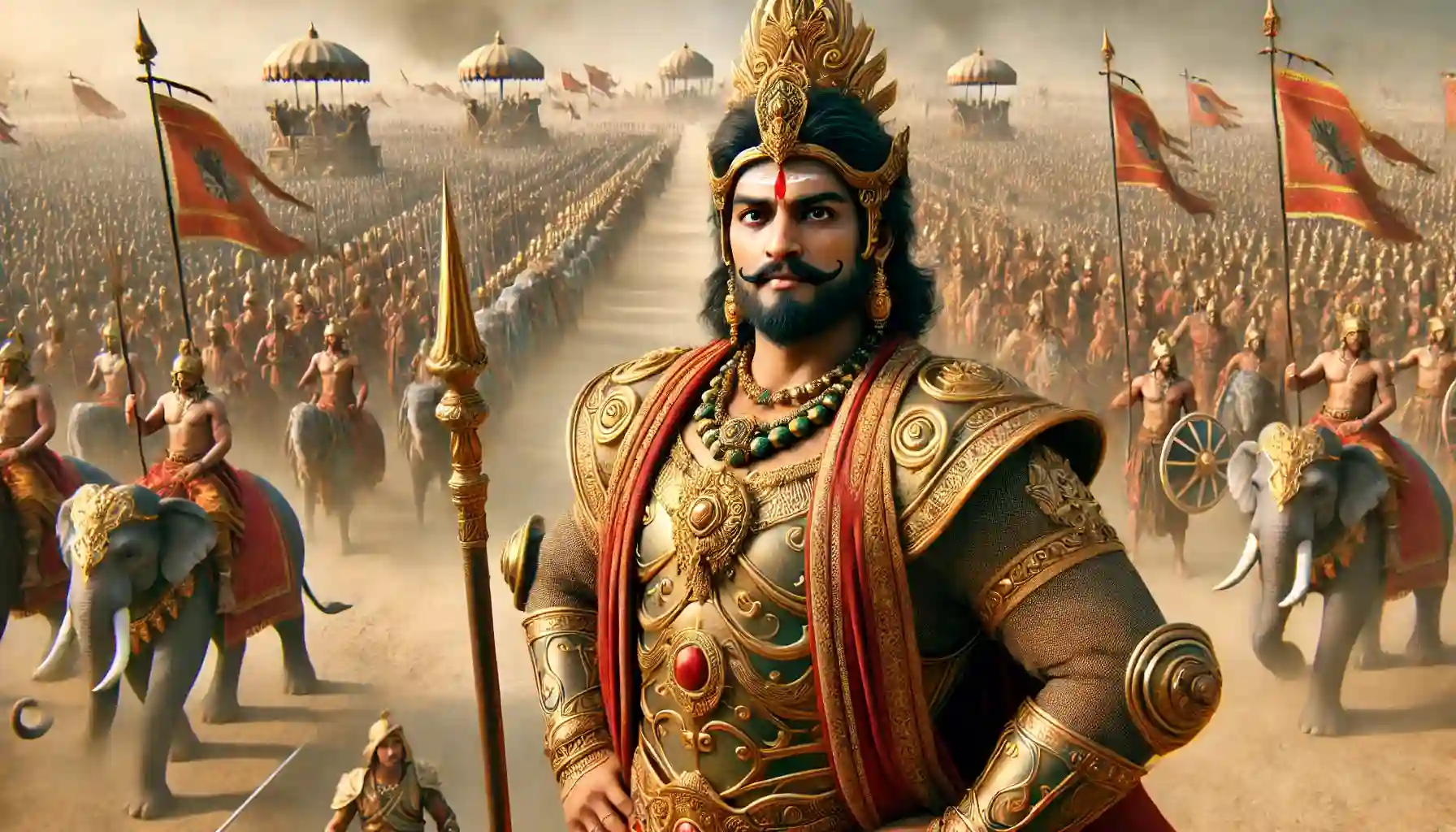
As tensions mounted on the sacred field of Kurukshetra, Duryodhana—the eldest Kaurava prince—meticulously assessed the military formations before him. This pivotal moment in the Bhagavad Gita's first chapter reveals not just battle preparations but also the psychological warfare that preceded the physical conflict.
Listing of warriors on both sides
With calculating eyes, Duryodhana surveyed both armies before approaching his teacher Dronacharya. The Kaurava force boasted eleven akshauhinis (military divisions), while the Pandavas commanded seven—creating a formidable gathering of warriors from across the subcontinent. Each akshauhini contained precisely 21,870 chariots, 21,870 elephants, 65,610 horses, and 109,350 foot soldiers.
Among the Kaurava champions stood legendary figures like Bhishma (the supreme commander), Karna (the formidable archer), Kripa (the learned sage-warrior), Ashwatthama (Drona's powerful son), Vikarna, and Bhurishrava. Duryodhana specifically mentioned these warriors to emphasize their military strength. On the Pandava side, equally mighty warriors assembled—Bhima (known for his strength), Arjuna (the peerless archer), the twin brothers Nakula and Sahadeva, King Dhrishtadyumna, Virata, Drupada, Dhrishtaketu, Chekitana, and the mighty king of Kashi.
Additionally, warriors like Purujit, Kuntibhoja, Shaibya, Yudhamanyu, Uttamauja, Abhimanyu (Arjuna's son), and the sons of Draupadi reinforced the Pandava ranks. Each side included maharathis (great chariot warriors) capable of fighting 10,000 warriors simultaneously.
Duryodhana's appeal to Dronacharya
Following his assessment, Duryodhana approached his revered teacher Dronacharya with calculated reverence. "Behold, O Teacher, this mighty army of the sons of Pandu, arranged in battle formation by your talented pupil, Dhrishtadyumna," he remarked. This statement served a dual purpose—acknowledging the enemy's strength while subtly reminding Drona that his own student now opposed him.
Duryodhana's strategic flattery continued as he methodically named the great warriors on his side. "Our army is invincible under Bhishma's protection," he declared, "while their force seems inadequate under Bhima's guard." This psychological tactic aimed to boost his army's morale while establishing hierarchy. Interestingly, Duryodhana failed to mention Arjuna—perhaps deliberately avoiding acknowledgment of the Pandavas' greatest warrior.
Moreover, Duryodhana instructed all his warriors to give full support to Bhishma, revealing his command structure and attempt to unite his diverse forces behind a single leader. This political maneuvering showed Duryodhana's understanding that unity would be crucial against the smaller but more cohesive Pandava army.
The blowing of conch shells
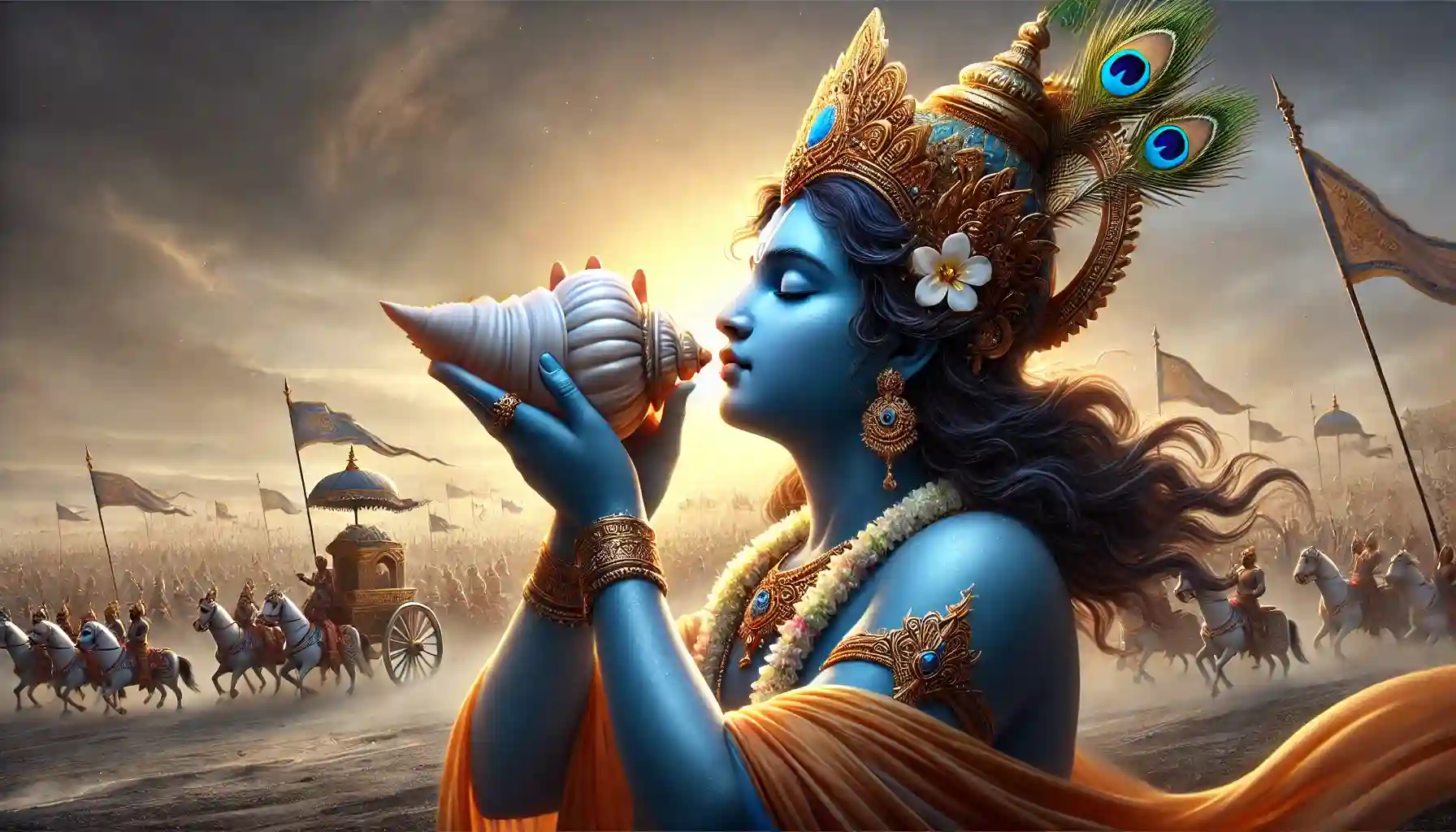
After the armies assembled and Duryodhana completed his strategic assessment, both sides announced their presence through the ceremonial blowing of conch shells. This ancient battle tradition served as both communication system and psychological warfare.
The thunderous sound began with Bhishma, the Kaurava commander, blowing his conch named "Poundra." Subsequently, other instruments joined—drums, kettledrums, and cow-horns—creating what the text describes as "tumultuous uproar" that "shattered the hearts of Dhritarashtra's sons."
In response, Krishna blew his divine conch "Panchajanya," followed by Arjuna's "Devadatta." Bhima the terrible then sounded his "Paundra," while King Yudhishthira blew "Anantavijaya." Nakula and Sahadeva sounded "Sughosha" and "Manipushpaka" respectively. The cacophony continued as King of Kashi, Shikhandi, Dhrishtadyumna, Virata, Satyaki, and other warriors joined with their individual instruments.
This orchestrated soundscape had profound significance beyond mere noise—each warrior's conch carried a specific name and power, and the order of sounding reflected battle hierarchy. Furthermore, the terrifying sound was designed to demoralize enemies and steel allies for the coming conflict—a critical psychological component of ancient warfare as described in the Srimad Bhagavad Gita.
Arjuna’s Request and the Turning Point
Amid the deafening symphony of conch shells and war drums, a pivotal moment unfolded that would transform a military confrontation into humanity's most profound spiritual discourse. Arjuna, the legendary archer of the Pandavas, made a request that would alter the course of the Bhagavad Gita and expose his innermost vulnerabilities.
Arjuna asks Krishna to place the chariot in the middle
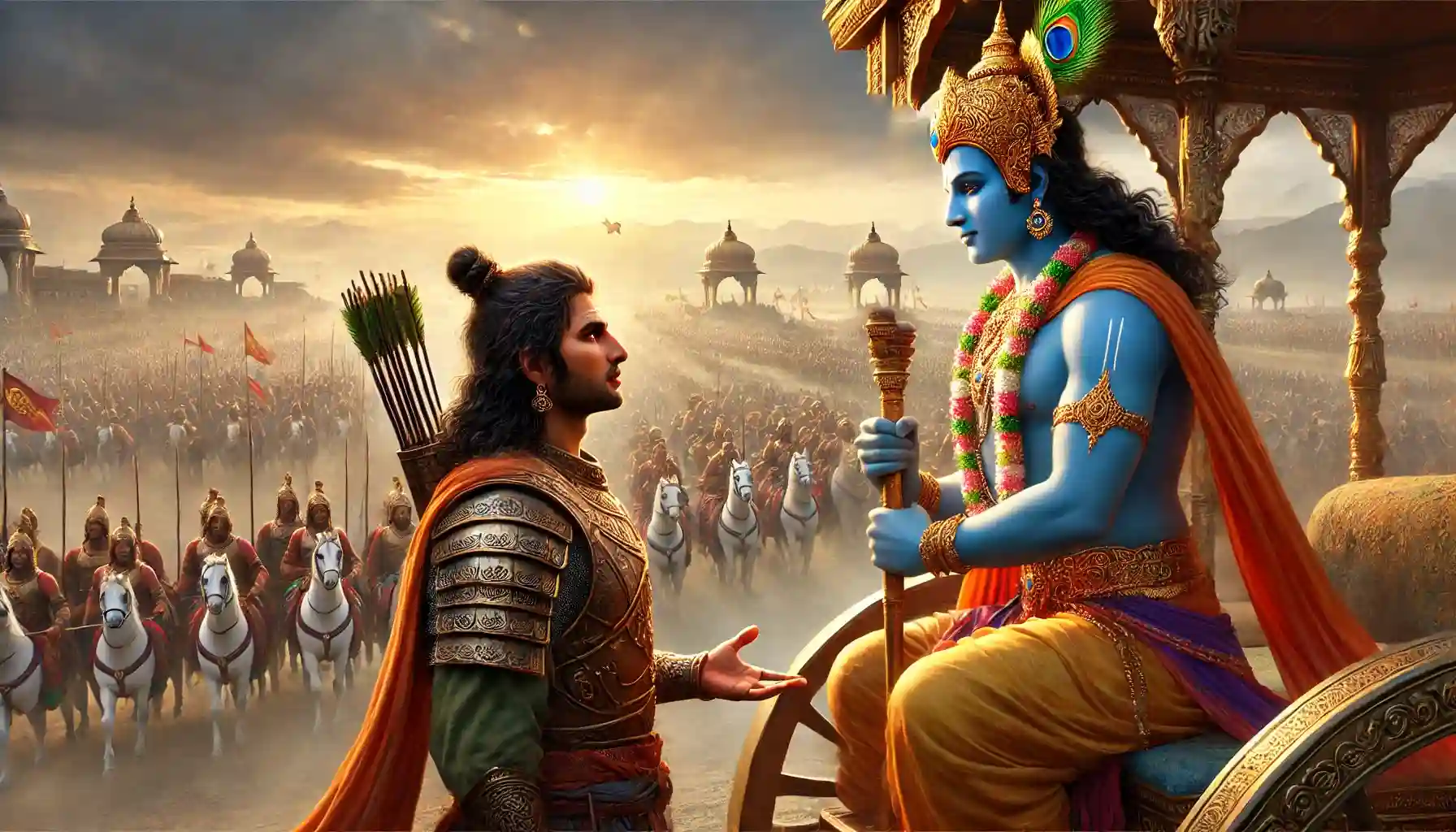
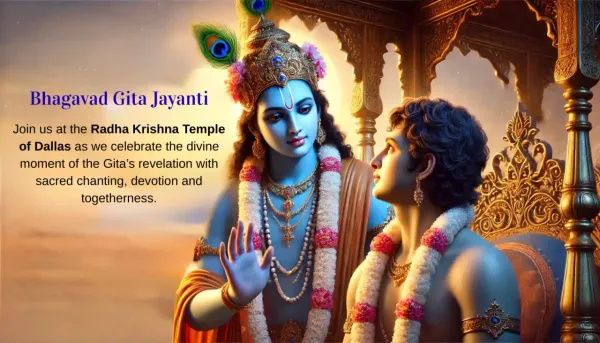
"O Achyuta (Krishna), please place my chariot between the two armies," Arjuna requested of his charioteer, Lord Krishna. This seemingly simple directive carried immense significance in the unfolding drama at Kurukshetra. Arjuna specifically asked Krishna to position him where he could clearly observe "these men who stand eager for battle" and identify "with whom I must fight in this impending war."
Krishna, understanding the gravity of this moment, guided the magnificent chariot emblazoned with the emblem of Hanuman between the opposing forces. Upon reaching the central position, he announced, "Behold, O Partha (Arjuna), all the Kurus assembled here." This strategic placement—directly facing Bhishma, Drona, and other elders—was no accident but rather a divine arrangement to trigger Arjuna's existential crisis.
He sees his relatives on both sides
From this vantage point, Arjuna's gaze fell upon an overwhelming sight. Before him stood grandfathers, teachers, uncles, brothers, sons, grandsons, friends, fathers-in-law, and well-wishers—distributed across both armies. The warrior beheld respected elders like Bhishma, who had raised him, and Dronacharya, who had taught him archery. He saw his cousins, the sons of Dhritarashtra, alongside allies from many kingdoms.
In that moment, the abstract concept of "enemy" dissolved into the faces of beloved family members. Particularly poignant was seeing Bhishma and Drona—figures who had nurtured him since childhood—now positioned as adversaries whom he would need to strike down to achieve victory.
The emotional impact of the sight
The visual reality of confronting his own kinsmen overwhelmed Arjuna's warrior resolve. "My limbs grow weak, my mouth dries up, my body trembles, and my hair stands on end," he confessed to Krishna as physical manifestations of his inner turmoil became evident. The Gandiva bow, which had never before felt heavy in his skilled hands, slipped from his grasp. His skin burned with fever as he found himself unable to stand steadily.
This emotional paralysis marked the precise turning point of the Bhagavad Gita Chapter 1. The mighty Arjuna, who had never before hesitated in battle, now declared, "I see inauspicious omens, O Krishna. I do not foresee any good coming from killing my own kinsmen in this battle." His mind became clouded with confusion (moha), and the psychological impact rendered him incapable of fulfilling his warrior duty.
Through this profound moment of vulnerability, Arjuna unwittingly created the perfect opening for the divine wisdom that would follow in subsequent chapters of the Srimad Bhagavad Gita.
Stages of Arjuna’s Inner Conflict
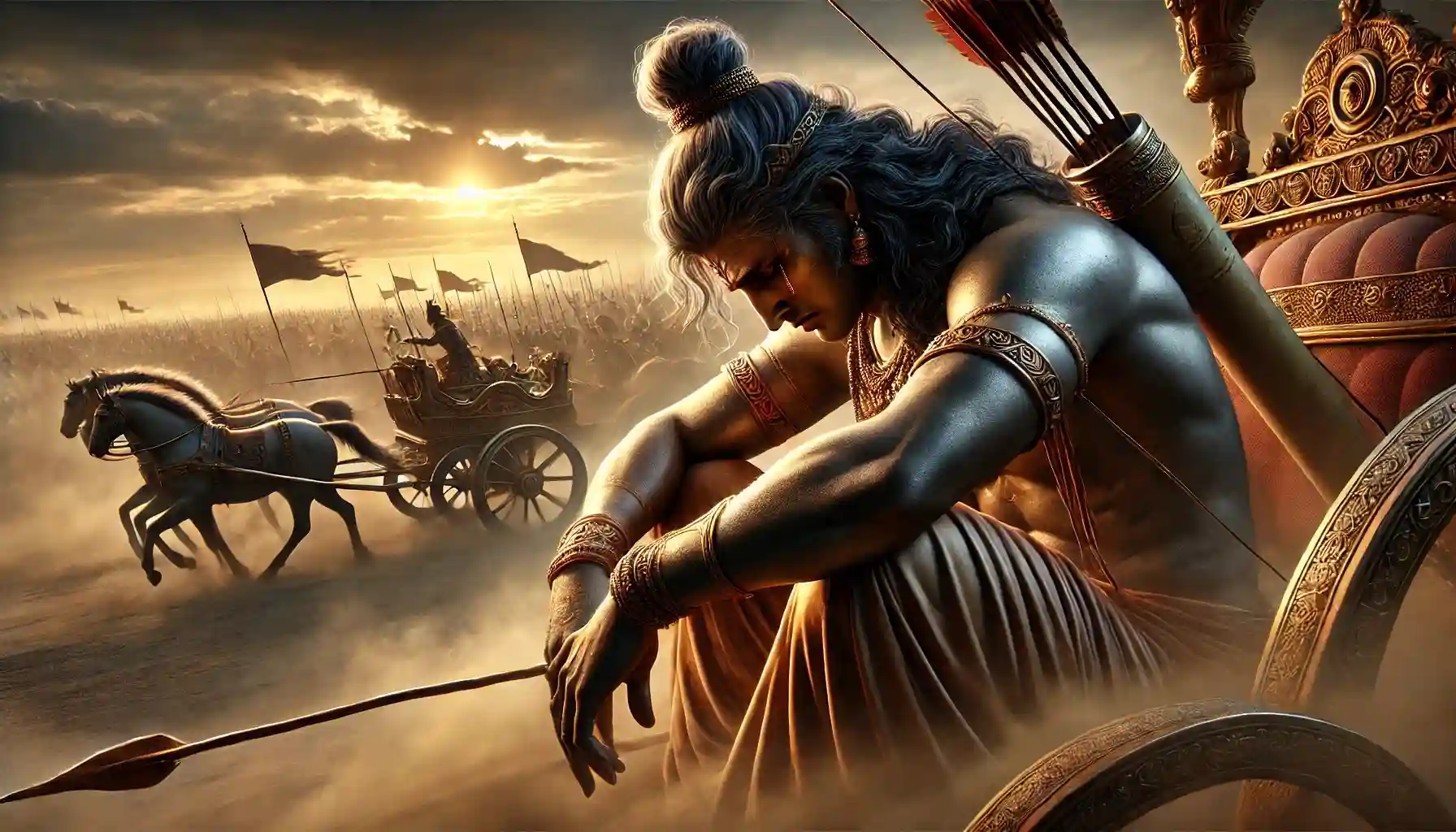
Arjuna's inner turmoil unfolds in distinct stages throughout the first chapter of the Bhagavad Gita, revealing the psychological depths of his moral crisis. What begins as physical discomfort escalates into a profound philosophical questioning that paralyzes the mighty warrior.
Physical symptoms of distress
As Arjuna comprehends the reality of facing his kinsmen in battle, his body betrays his mental anguish. "I am unable to stand here any longer. I am forgetting myself, and my mind is reeling," he confesses to Krishna. His legendary steadiness dissolves as his limbs tremble, mouth becomes parched, and skin burns with fever. Even the Gandiva bow—his trusted weapon—slips from his grasp as his hands grow sweaty. These visceral reactions illustrate how deeply the psychological conflict affects his physical being, essentially creating psychosomatic symptoms that render the warrior temporarily incapacitated.
Moral confusion and fear of sin
Beyond physical distress, Arjuna experiences profound moral disorientation. "How shall I strike Bhishma and Drona with arrows?" he asks, recognizing that these revered figures deserve worship rather than violence. His ethical framework collapses as he contemplates the paradox of achieving victory through sinful acts. "Better indeed in this world to accept alms than to slay these noble elders," he laments, questioning whether any worldly gain could justify such spiritual transgression. This represents Arjuna's entanglement in "dharma-sankata"—a conflict between different aspects of duty.
Arguments against war based on family values
Afterward, Arjuna shifts to broader concerns about family destruction. He reasons that killing family members would destroy ancient family traditions, leading to lawlessness among survivors. "With the destruction of family, the eternal family traditions perish," he argues, foreseeing that such collapse would cause women's corruption and create "varna-sankara" (unwanted progeny). His concern extends beyond immediate casualties to the long-term degradation of societal order and family structures.
Fear of social and spiritual downfall
Finally, Arjuna expresses anxiety about eternal spiritual consequences. He worries that ancestors would fall from heaven without proper funeral offerings and that survivors would suffer hell-bound fates. "Hell awaits those who destroy family traditions," he declares with conviction. This represents his ultimate fear—that in pursuing victory, he might secure material triumph yet suffer irredeemable spiritual failure. The chapter culminates with Arjuna casting aside his bow and arrows, overwhelmed by grief (vishada) that ironically marks the beginning of his spiritual enlightenment.
The Emergence of Arjuna Vishad Yog
The final verse of the Bhagavad Gita's first chapter marks a profound transformation as Arjuna's devastating grief (vishada) unexpectedly becomes the gateway to spiritual awakening. This paradoxical concept—that emotional devastation might constitute a form of yoga—sets the foundation for all spiritual instruction that follows.
Why grief is called a form of yoga
Vishada (despair) combined with yoga (spiritual discipline) creates a seemingly contradictory term that nevertheless holds deep philosophical significance. In fact, Arjuna's overwhelming sorrow represents a legitimate spiritual stage rather than mere weakness. The term "yoga" derives from the Sanskrit root yuj, meaning "to join" or "to unite," and Arjuna's grief serves precisely this function—connecting him to deeper questions about existence, duty, and purpose. His emotional breakdown strips away his warrior identity, creating the necessary emptiness for spiritual wisdom to enter.
Furthermore, his anguish demonstrates qualities essential to spiritual growth: sincerity, emotional honesty, and recognition of one's limitations. Just as physical yoga postures create beneficial discomfort that leads to growth, Arjuna's mental suffering creates the necessary tension for spiritual transformation.
Arjuna's surrender to Krishna
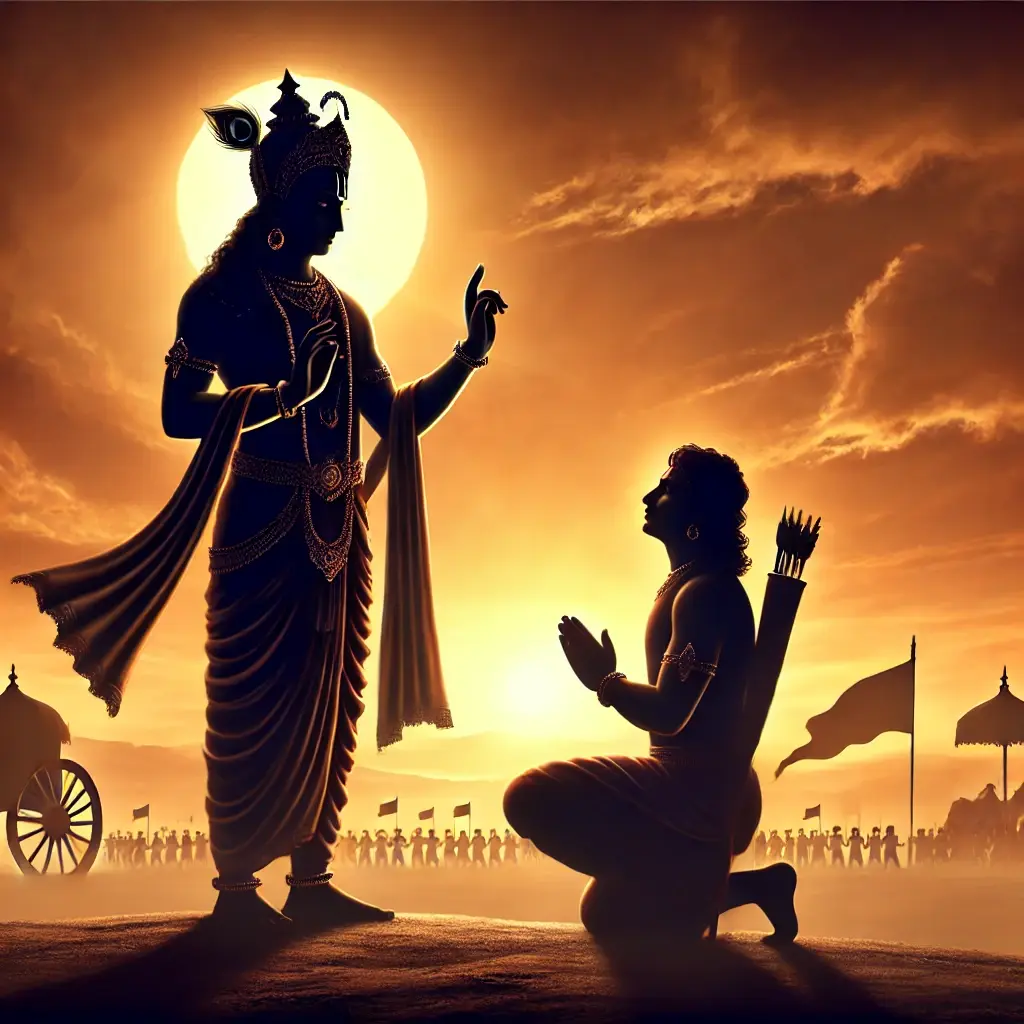
The chapter concludes with a pivotal moment: "Sanjaya uvāca: Having spoken thus, Gudakesh, that chastiser of enemies, addressed Hrishikesh: 'Govinda, I shall not fight,' and became silent." This silence represents the complete collapse of Arjuna's self-sufficiency and marks his transition from warrior to disciple. In verse 2.7, he makes his surrender explicit: "I am Your devoted student, and have fully surrendered to You. Please enlighten me on the most appropriate path."
This surrender (prapatti) becomes the essential prerequisite for receiving spiritual knowledge. As spiritual traditions often emphasize, knowledge only truly enters when ego diminishes.
How this sets the stage for spiritual wisdom
Arjuna's vulnerability creates the perfect opening for Krishna's teachings. Therefore, the entire Bhagavad Gita emerges only because Arjuna reaches this state of complete helplessness. His qualification to receive transcendental knowledge stems precisely from his recognition that material knowledge cannot resolve his dilemma.
Meanwhile, Krishna's response in the next chapter begins with surprising laughter rather than sympathy, highlighting that this apparent tragedy actually constitutes a necessary breakthrough in Arjuna's spiritual evolution.
Conclusion
The first chapter of the Bhagavad Gita, therefore, serves as more than mere prelude to Krishna's divine teachings. Indeed, "Arjuna Vishad Yog" establishes the essential human context necessary for spiritual wisdom to manifest. Through Arjuna's collapse from confident warrior to paralyzed questioner, readers witness the universal human experience of facing moral ambiguity and existential crisis. His physical symptoms—trembling limbs and parched mouth—mirror the internal devastation when one's ethical frameworks suddenly seem inadequate against life's complex demands.
Furthermore, this opening chapter brilliantly positions the entire battlefield of Kurukshetra as both literal and metaphorical setting. The sacred field becomes simultaneously a place of external warfare and internal spiritual battle. Duryodhana's strategic calculations, consequently, stand in stark contrast to Arjuna's emotional honesty, highlighting two fundamentally different approaches to life's challenges—calculation versus contemplation.
Perhaps most significantly, Arjuna's grief ultimately constitutes the first step toward enlightenment rather than a weakness to overcome. His surrender to Krishna demonstrates that spiritual transformation often begins when certainty collapses. Thus, Chapter 1 establishes the profound paradox at the heart of the Bhagavad Gita: that our moments of greatest confusion and despair might actually represent the necessary preparation for deepest wisdom. Without Arjuna's complete breakdown on the battlefield, Krishna's immortal teachings would have found no receptive vessel.
Ready to Deepen Your Understanding of the Bhagavad Gita?
Take the next step in your spiritual journey by immersing yourself in the timeless wisdom of the Bhagavad Gita through these transformative opportunities:
- ✅ Learn the Bhagavad Gita through Online Classes
Join structured and insightful Bhagavad Gita courses offered by JKYog and Radha Krishna Temple of Dallas. Perfect for all age groups! - 📺 Subscribe & Watch Swami Mukundananda’s YouTube Channel
Explore engaging video series where Swamiji simplifies complex Gita concepts with real-life applications.
🔗 Subscribe here - 📚 Read the Bhagavad Gita with Accurate Translation & Commentary
Access all 700 verses with verse-by-verse meaning and deep commentary.
🔗 Visit Holy-Bhagavad-Gita.org - 🕉️ Attend Spiritual Retreats with Swami Mukundananda
Experience in-person spiritual upliftment through retreats featuring Gita lectures, kirtans, yoga, and meditation.
🔗 View Upcoming Retreats
FAQs
Q1. What is the main conflict Arjuna faces in the Bhagavad Gita's first chapter? Arjuna faces a profound moral dilemma as he must choose between his duty as a warrior and his attachment to family members on the opposing side of the battlefield. This conflict causes him great emotional distress and leads to his refusal to fight.
Q2. How does Arjuna's emotional state manifest physically? Arjuna experiences intense physical symptoms of distress, including trembling limbs, dry mouth, fever, and inability to stand steadily. His legendary bow, Gandiva, even slips from his grasp as he becomes overwhelmed by the situation.
Q3. Why is the first chapter of the Bhagavad Gita called "Arjuna Vishad Yog"? The chapter is called "Arjuna Vishad Yog" or the "Yoga of Arjuna's Grief" because Arjuna's despair and confusion paradoxically become the starting point for spiritual wisdom. His emotional breakdown creates the necessary openness for receiving Krishna's teachings.
Q4. What role does Sanjaya play in the narrative of the Bhagavad Gita? Sanjaya, gifted with divine vision, serves as the narrator of the events on the Kurukshetra battlefield. He relays the dialog between Krishna and Arjuna to the blind king Dhritarashtra, providing a framework for the entire text.
Q5. How does the first chapter set the stage for the rest of the Bhagavad Gita? The first chapter establishes the context for Krishna's spiritual teachings by presenting Arjuna's moral crisis. It transforms the battlefield into both a literal and metaphorical setting, where external conflict mirrors internal spiritual struggle, creating the perfect scenario for imparting divine wisdom.
Reference
- Bhagavad Gita 1.1 – Dhritarashtra’s Question
🔗 https://www.holy-bhagavad-gita.org/chapter/1/verse/1 - Bhagavad Gita 1.2 – Sanjaya Begins Narration
🔗 https://www.holy-bhagavad-gita.org/chapter/1/verse/2 - Bhagavad Gita 18.75 – Sanjaya Describes His Divine Vision
🔗 https://www.holy-bhagavad-gita.org/chapter/18/verse/75 - Full Bhagavad Gita with Commentary by Swami Mukundananda
🔗 https://www.holy-bhagavad-gita.org