
There are moments in the spiritual calendar when the Lord does not merely wait to be remembered. He lovingly invites every soul to draw closer to Him. Ashadibeej is one such sacred occasion.
Every year, the decorated chariot moves through the streets. The kirtans rise, hands reach for the rope, and beneath all of that, a quiet longing awakens that cannot quite be explained in ordinary language.
This is Ratha Yatra. It is not merely a festival, but a remembrance of one of the most breathtaking moments in devotional history. This is the divine pastime that, as Swami Mukundananda beautifully explains, symbolizes Radha and the gopis drawing Krishna back toward Braj with nothing but the ropes of their love.
Krishna Himself reveals in the Bhagavad Gita what He truly desires from His devotees:
पत्रं पुष्पं फलं तोयं यो मे भक्त्या प्रयच्छति ।
तदहं भक्त्युपहृतमश्नामि प्रयतात्मन: ॥ 26॥
patraṁ puṣhpaṁ phalaṁ toyaṁ yo me bhaktyā prayachchhati
tadahaṁ bhaktyupahṛitam aśhnāmi prayatātmanaḥ
BG 9.26: If one offers to Me with devotion a leaf, a flower, a fruit, or even water, I delightfully partake of that item offered with love by My devotee in pure consciousness.
Not scholarship. Not grand ceremony. Love. That single word is the key to Ratha Yatra, and to everything that follows.
This Ashadibeej, Radha Krishna Temple of Dallas invites you to step into that living current of divine love. To walk beside the chariot. To sing the Divine Names. And to discover that the same love that once moved Krishna toward Braj is still moving, and it is moving toward you.
The Separation That Deepened Everything
The story begins not in Puri, but on the sacred fields of Kurukshetra, five thousand years ago.
A solar eclipse had drawn kings, sages, and pilgrims from every corner of Bharat to bathe in the holy waters there. Krishna arrived from Dwaraka. When the news reached Vrindavan, Radha and the gopis set out to meet Him. Nearly a hundred years had passed since the sound of chariot wheels faded from Vrindavan's lanes and did not return.
Why would Krishna give such a prolonged separation to those who loved Him more than their own lives? Swami Mukundananda explains: "It is in separation that love becomes more intense and more selfless." The separation is external. The yog is internal. The gopis' minds were connected with God. Though their eyes could no longer behold Shyamsundar, their consciousness never left Him for a single moment.
Their longing became their worship. Their remembrance became uninterrupted meditation. In that inner union, viraha revealed its deepest secret: the heart that truly longs for God no longer wants anything God can give. It wants only God.
Yet, even this longing is not created by our own effort. It is itself His grace, gently awakening the soul that has belonged to Him from eternity.
You Are the Same Shyamsundar, Yet Something Is Missing.
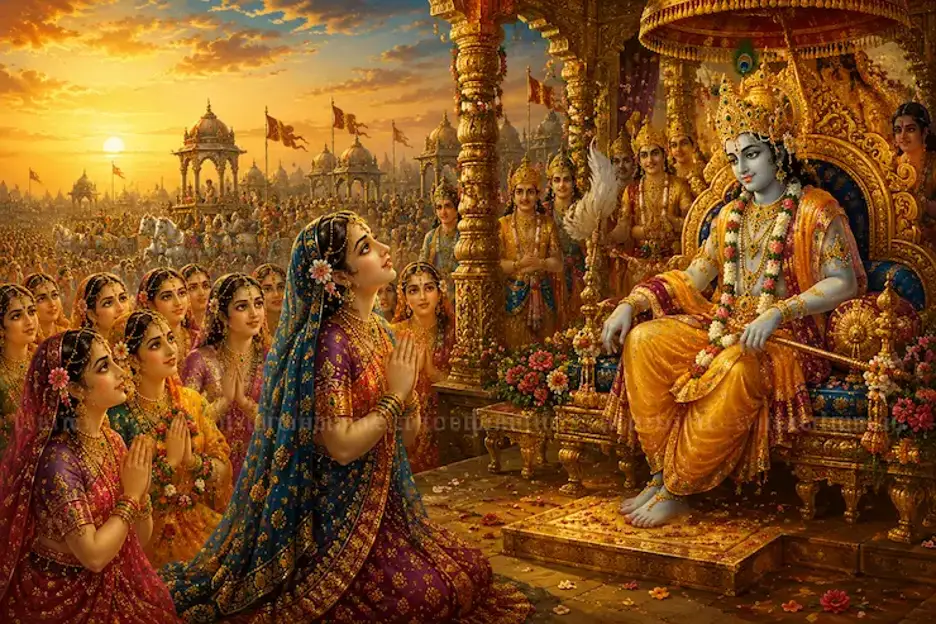
After countless seasons, Radha and the gopis beheld Krishna at Kurukshetra.
He was the same one. The same eyes and the same dark complexion the poets compared to a monsoon cloud. However, He was surrounded now by the full splendor of Dwaraka. Chariots of gold. Queens. Soldiers. The entire architecture of divine sovereignty made visible.
Radha's heart, which had spent those years remembering a peacock feather and a flute and the simple dust of Braj, was not moved by any of it.
With folded hands and hearts overflowing with love, the gopis spoke what words can scarcely contain. In Swami Mukundananda's rendering:
"You are the same Shyamsundar and we are your same devotees. But the atmosphere out here is all different. You are so formal and so majestic. That connection is not being felt the way we experienced in Braj."
Their love did not seek a throne. It longed for the one who had wandered Vrindavan's lanes with a peacock feather in His crown, whose mischievous smile had stolen butter and hearts with equal ease, in whose presence every morning had felt like a different kind of eternity.
The First Ratha Yatra
Moved by the boundless love of the gopis, Krishna agreed.
A chariot was prepared and Krishna, Balarama, and Subhadra ascended it. The gopis took hold of the ropes and began to pull.
The Supreme Lord, whom even the Vedas struggle to describe, willingly allowed Himself to be drawn by the ropes of pure love. Not by philosophical mastery, tapasya or any external achievement, but by love alone.
Swami Mukundananda explains that at that moment Krishna felt such tremendous ecstasy that He went back into the mahabhav samadhi state. That was the first Ratha Yatra.
ये यथा मां प्रपद्यन्ते तांस्तथैव भजाम्यहम् ।
मम वर्त्मानुवर्तन्ते मनुष्या: पार्थ सर्वश: ॥ 11॥
ye yathā māṁ prapadyante tāns tathaiva bhajāmyaham
mama vartmānuvartante manuṣhyāḥ pārtha sarvaśhaḥ
BG 4.11: In whatever way people surrender unto Me, I reciprocate accordingly. Everyone follows My path, knowingly or unknowingly, O son of Pritha.
Not a single gopi pulled that rope asking for something in return. They pulled because He was their everything. The invitation of Ashadibeej is the same. When love becomes our only prayer, the Lord responds with His grace in ways beyond our imagination.
The rope is not made of fiber. It is woven from longing, from remembrance, from a love that knows it belongs to God and will not be satisfied by anything less.
The Srimad Bhagavatam captures the nature of that love in Uddhava's words:
āsām aho caraṇa-reṇu-juṣām ahaṃ syām
“Oh, let me become the dust of the feet of these gopis, whose devotion to the Supreme Lord is unsurpassed.”
— Śrīmad Bhāgavatam 10.47.61
Even Uddhava, the greatest of Krishna's devotees among the learned, saw in the gopis' love something that surpassed all scholarship. Their love was not studied. It was lived.
The Mystery That Even Krishna Desired to Know
But the story does not end at Kurukshetra.
Witnessing Radha's love awakened three profound questions within Krishna Himself. Swami Mukundananda describes them in sequence.
- What is the nature of Radha's love for Me? I am unable to understand it.
- What is it in Me that attracts Her so completely? From every pore of Her body the sound is coming, Shyam, Shyam, Shyam.
- What is the bliss that She experiences in loving Me?
These questions had to be experienced from within. And so Krishna descended as His own foremost devotee, appearing in the loving sentiments of Radha. As Swami Mukundananda explains: "He is Krishna who's come in the sentiment of Radha." This was the avatar of Chaitanya Mahaprabhu.
Chaitanya Mahaprabhu: Dancing Before the Chariot
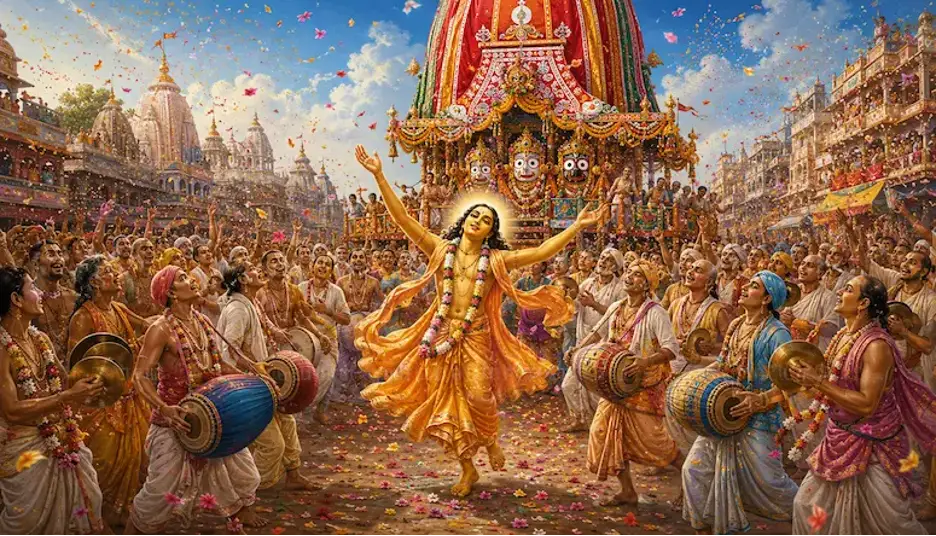
Chaitanya Mahaprabhu came to reside in Jagannath Puri, where the tradition of Ratha Yatra was already established. Once a year Lord Jagannath, Baladev, and Subhadra would be seated on the chariot, and devotees would pull it through a three-kilometer stretch to the Gundicha Mandir.
Mahaprabhu would go for darshan of Lord Jagannath with great yearning, seeing Jagannath as his Krishna. But he would not go close to the deity. Swami Mukundananda explains his reasoning: "If I go close, I may develop dosh buddhi, the intellect of seeing defects. If I notice that some paint has come off, I will lose the absorption of devotion." So he stood far away, beholding only his beloved Shyamsundar.
Yet the intensity of his yearning was such that when he placed his hand on the stone door frame, the temperature of his love melted the stone. Even today, if you go to Puri, you will find the fingerprints of Chaitanya Mahaprabhu pressed into what was once solid stone.
Just before Ratha Yatra, Lord Jagannath's leela would begin. After the sacred Snana Yatra bathing ceremony, the Lord would fall ill. The temple doors would close for seventeen days. During those days Mahaprabhu would feel all lost. He would travel eighteen kilometers to Alarnath and lie down in the feeling of viraha. That stone too would melt.
When the doors finally opened, Mahaprabhu would organize his devotees into eight procession groups, each with eight mridangas, a lead singer, and a kirtan party. He himself would dance before the chariot. His inner sentiment, in Swami Mukundananda's words: just as the gopis took Krishna, Balarama, and Subhadra from Kurukshetra to Braj, we are taking our Krishna from Kurukshetra to Braj, with the divine feeling that I am Radha taking Krishna back to Vrindavan.
Mahaprabhu danced and danced and danced. And that pastime popularized Ratha Yatra further still, until today in thousands of cities across the world the chariot rolls, the Divine Names rise, and devotees reach for the rope with hearts full of something they cannot always name but recognize completely.
Roop Dhyan: Seeing Him as Radha Saw Him
Swami Mukundananda places great emphasis on roop dhyan, the contemplation of Krishna's divine form, as an essential practice of bhakti. See Him as Radha saw Him: the peacock feather catching the early light, the flute at His lips, the gentle fragrance of His garland, the mischievous smile that made the gopis forget every grievance the moment they glimpsed it.
Ask yourself sincerely: When will I hear His flute? When will I serve Him? When will I behold that form and forget myself entirely? These questions, asked with genuine longing, are what the tradition calls param vyakulata, an intense yearning that transforms every spiritual practice from routine into living prayer. Radha held that image in Her heart through all those years without letting it fade. Every practice of devotion we undertake is simply a movement in Her direction.
How to Celebrate Ratha Yatra in the Spirit of the Gopis
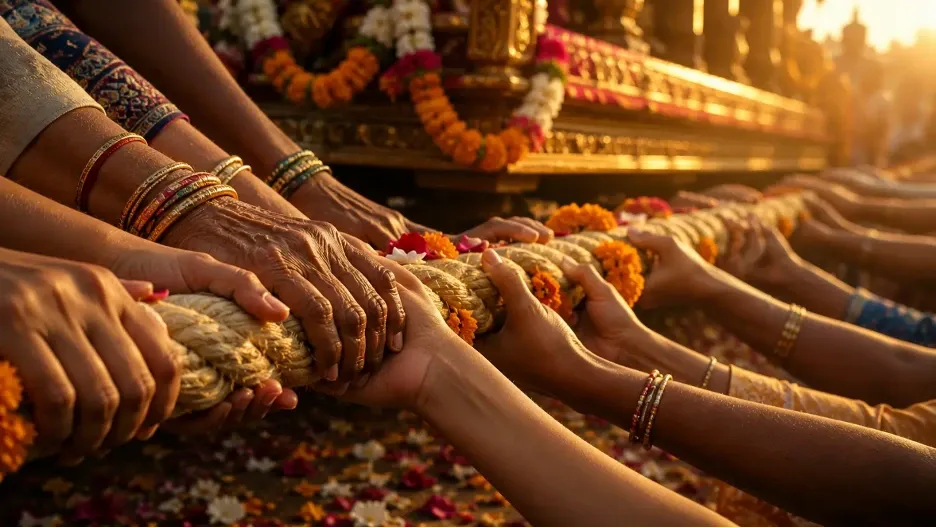
As Swami Mukundananda often reminds us, every festival is ultimately meant to deepen our love for God. After the kirtan fades and the chariot returns, a sincere devotee might ask: what do I actually carry home from this? His teachings offer a clear answer. The outer celebration is the invitation. The inner practice is the festival itself. Imagine yourself performing the follwing actions:
• Pull the rope with prayer. As your hands take hold, let a sincere prayer arise: My Lord, just as the gopis drew You toward Braj, please draw my wandering mind back to Your lotus feet.
• Sing and chant sincerely, not mechanically. Even one Divine Name offered with genuine longing reaches God more directly than hours of distracted repetition.
• Offer flowers with love. Every offering made with a surrendered heart is received by the Lord personally.
• Perform seva. Serve the devotees, the prasadam line, the kirtan. Service offered in the spirit of the gopis is itself a form of drawing Krishna closer.
• Pray for longing rather than worldly desires. Ask not for what the world can give, but for param vyakulata, the yearning the gopis carried, the yearning that drew God Himself.
Taking the Rope in Your Own Hands
Perhaps you know a different kind of forest from Vrindavan.
The forest of a life grown very full of everything except the one thing the heart is actually searching for. Schedules that leave no space for stillness. Prayer offered in the gaps between other things. The Divine Names that once came easily to the lips, now requiring an effort to remember.
This is not a moral failure. The question Ashadibeej asks, quietly and without judgment, is simply this: Where is your Krishna today? Not as a theological concept. As the companion your heart was created for. As Shyamsundar, with His peacock feather and His flute and the smile the gopis could not stop thinking about through all those years of longing.
When the moment comes to take the rope in hand, a prayer forms, not composed but discovered.
My Lord, today I pull this rath with whatever small devotion I carry. Please, with Your grace, pull my wandering mind back to Your lotus feet. I am thirsty. And You are the only water this chatak was made for.
That prayer is bhakti. The living kind. Swami Mukundananda teaches that even one sincere prayer offered with genuine longing reaches God more directly than years of mechanical practice.
Call to Action
Let Ashadhi Beej Become a Journey of the Heart
As the chariots of Lord Jagannath roll through the streets this Ashadhi Beej 2026, take a moment to reflect on the deeper meaning of Rath Yatra. The festival is not merely about witnessing a procession. It is about allowing your heart to be drawn closer to God through love, remembrance, and devotion.
Just as Radha and the gopis pulled Krishna toward Braj with the ropes of pure love, each of us can begin drawing our minds back toward the Divine. Spend a few moments chanting the Holy Names, reading the Bhagavad Gita, reflecting on Krishna's pastimes, or offering a simple prayer from the heart. The Lord does not seek grand offerings: He seeks sincere devotion.
This Ashadhi Beej, ask yourself:
"Am I pulling Krishna closer into my life, or am I allowing worldly distractions to pull me away from Him?"
May the spirit of Jagannath Rath Yatra inspire you to strengthen your relationship with Shree Krishna, deepen your devotion, and experience the joy of walking the path of bhakti. Sometimes the most meaningful journey is not the one taken by a chariot, it is the one taken by the heart toward God.
Frequently Asked Questions (FAQs)
What is Ashadhi Beej?
Ashadhi Beej is a sacred Hindu festival celebrated on the second day (Beej) of the bright fortnight of the month of Ashadha. It is closely associated with the famous Jagannath Rath Yatra, commemorating Lord Jagannath's annual chariot procession.
What is the spiritual significance of Jagannath Rath Yatra?
Jagannath Rath Yatra symbolizes the divine pastime in which Radha and the gopis lovingly drew Krishna from Kurukshetra back to Braj. The festival represents pure devotion, divine longing, and the soul's desire to reunite with God through love.
Why do devotees pull the chariot during Rath Yatra?
Pulling the chariot is an act of devotion and surrender. Spiritually, it symbolizes drawing God into our hearts while praying that He pulls our wandering minds back toward His lotus feet. The rope represents the bond of divine love between the Lord and His devotees.
Who are Jagannath, Baladev, and Subhadra?
Lord Jagannath is a form of Shree Krishna, Baladev (Balarama) is His elder brother, and Subhadra is His beloved sister. Together they ride on the chariot during Rath Yatra, blessing all who participate.
How is Chaitanya Mahaprabhu connected to Rath Yatra?
Chaitanya Mahaprabhu deeply cherished Rath Yatra and popularized its devotional significance. He would dance ecstatically before Lord Jagannath's chariot in Puri, experiencing the mood of Radha drawing Krishna back to Vrindavan through pure love.
Why is the love of the gopis considered so special?
The gopis loved Krishna without expecting anything in return. Their devotion was completely selfless and centered solely on His happiness. The scriptures and saints describe their love as the highest example of pure bhakti (devotion).
What can we learn from Rath Yatra today?
Rath Yatra teaches us to:
- Develop sincere love for God.
- Remember Krishna throughout our daily lives.
- Practice selfless service (seva).
- Chant the Divine Names with devotion.
- Pray for spiritual longing rather than material gains.
How can I celebrate Ashadhi Beej at home?
You can celebrate by:
- Kirtan
- Chanting Krishna's Holy Names.
- Reading the Bhagavad Gita or Srimad Bhagavatam.
- Offering flowers, fruits, or prayers to the Lord.
- Watching or participating in a local Rath Yatra.
- Meditating on Krishna's divine pastimes and the love of Radha and the gopis.
What is the deeper message of Ashadhi Beej?
The deeper message of Ashadhi Beej is that God is not won by power, wealth, or intellectual achievement, but by sincere love and devotion. Just as the gopis drew Krishna with the ropes of love, every soul can draw closer to Him through heartfelt bhakti