
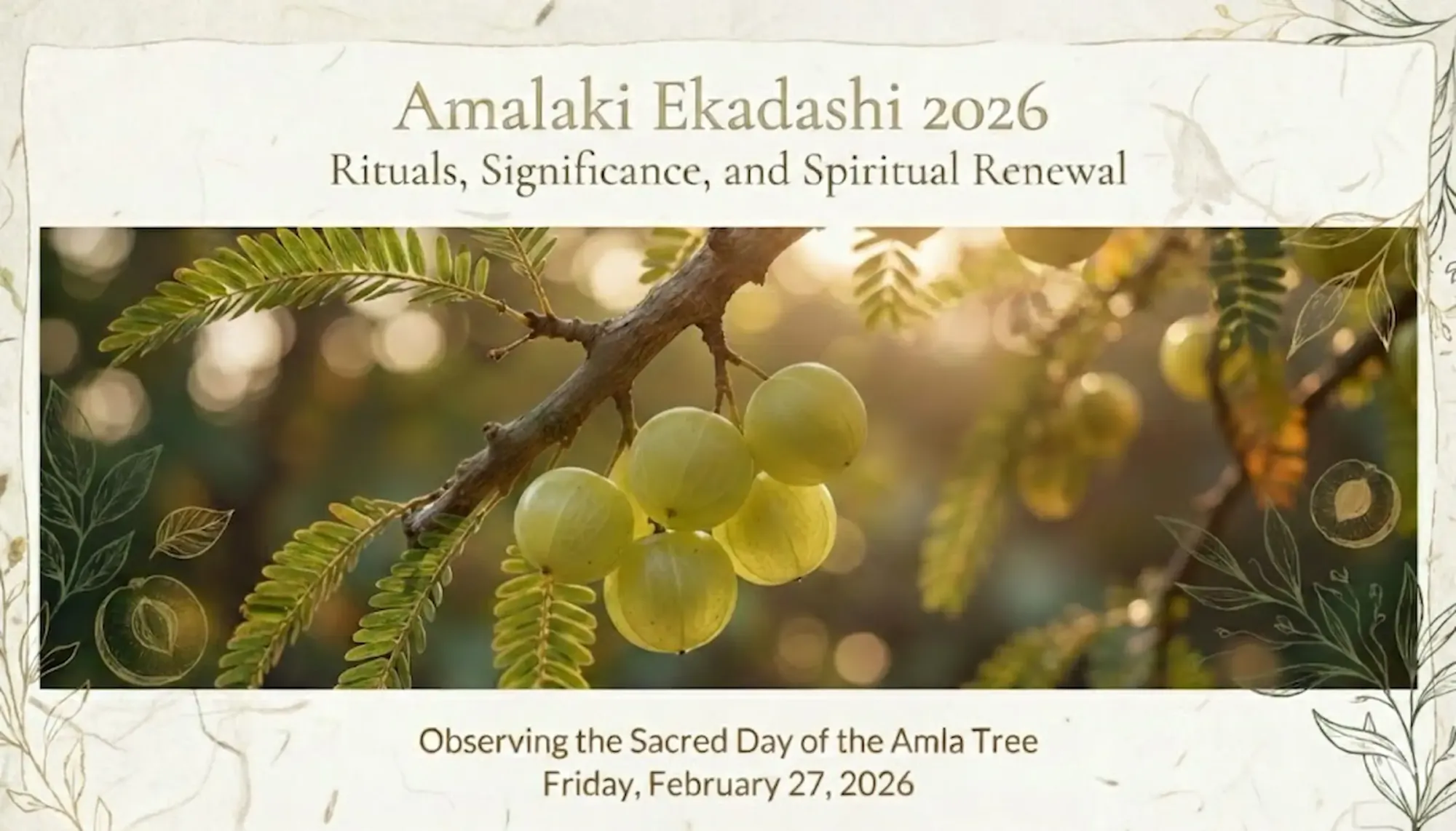
What if a single day could grant you the spiritual merit of gifting a thousand cows?
The Brahmanda Purana describes that the merit gained by observing Amalaki Ekadashi equals the reward of performing Sahasra Gau-dāna [the donation of one thousand cows], one of the highest acts of charity praised in the scriptures. Falling within the sacred month of Phalguna, this Ekadashi is revered for its power to purify the mind and deepen devotion to Lord Vishnu.
It is uniquely associated with the sacred Amla tree, which tradition reveres as an Adi-Vriksha — a primordial sacred tree that embodies divine nourishment, protection, and sustaining grace within creation. Unlike ritual objects placed on an altar, this tree stands rooted in the earth, reminding devotees that divine presence flows through nature itself.
Observed on Friday, February 27, 2026, Amalaki Ekadashi is far more than a routine fasting day. For centuries, devotees have regarded it as a spiritual turning point — a moment that prepares the heart for the outward celebration of Holi while inviting inward purification through discipline and remembrance.
As Swami Mukundanandaji often reminds seekers, sacred observances are not meant to be followed mechanically. They are opportunities to pause from routine living, reflect deeply, and consciously realign the mind with God. Amalaki Ekadashi integrates devotion, symbolism, nature worship, and self-discipline into one complete spiritual practice.
Whether you seek clarity about the rituals, the exact Tithi and Parana timings, the symbolism of the Amla tree, the Ayurvedic value of the fruit, or the deeper message of remembrance emphasized by Swamiji, this blog will help you observe this Ekadashi meaningfully and transform it into a genuine step forward in your spiritual journey.
📅 Amalaki Ekadashi 2026 Date, Tithi and Parana Timings
|
Category |
Details |
|
Observance Date |
Friday, February 27, 2026 |
|
Lunar Month |
Phalguna (season of renewal & spiritual preparation for Holi) |
|
Moon Phase |
Shukla Paksha (Waxing Moon – symbolizing clarity & illumination) |
|
Spiritual Significance |
Ideal for purification, reflection, and devotion |
|
Event |
Date & Time |
|
Ekadashi Begins |
February 27, 2026 – 12:33 AM |
|
Ekadashi Ends |
February 27, 2026 – 10:32 PM |
|
Parana (Fast Breaking Window) |
February 28, 2026 – 6:47 AM to 9:06 AM |
Note on Parana:
Breaking the fast within the Dwadashi window after sunrise is considered an essential part of the fast itself. Honoring sacred time reflects inner discipline and reverence for the cosmic rhythm through which spiritual practices bear fruit.
For devotees, this day becomes a sacred pause — an opportunity to simplify life, withdraw from distraction, and gently bring awareness back toward the Divine.
🌿 What Makes Amalaki Ekadashi Special
Amalaki Ekadashi stands out among the twenty-four Ekadashis because it unites devotion to Lord Vishnu with reverence for nature – a living tree, and reflection on divine presence within creation.
On this sacred day, devotees:
- Worship Lord Vishnu as the sustaining force of the universe.
- Recognizing Him as the source of protection, order, and compassion.
- Honor the sacred Amla tree as a manifestation of divine nourishment.
- Offer Amla fruit, symbolizing surrender of one’s karmic fruits and pray that their life be purified and strengthened just as the fruit nourishes the body.
- Remember Lord Parashurama, Vishnu’s sixth incarnation, who represents the courage required to protect righteousness.
- Reflect on how divine grace operates through creation itself
This Ekadashi expands devotion beyond the temple altar.
What makes this Ekadashi especially meaningful is that it invites devotees to reflect on the Divine not only in sacred images but in creation itself. The Amla tree becomes a visible reminder that divine grace sustains life quietly — through nature, nourishment, and the unseen forces that support existence.
Swami Mukundanandaji teaches that fasting is not meant to create suffering. Its purpose is to reduce sensory overload so the mind becomes available for remembrance of God. When the body is simplified, the mind becomes quieter. When the mind becomes quieter, remembrance deepens.
Amalaki Ekadashi expresses this teaching beautifully – combining discipline, symbolism, gratitude, and devotion into one harmonious observance.
🌿 Amalaki Ekadashi Rituals: How to Observe the Vrat [Fast] Step by Step
Observing the Amalaki Ekadashi vrat consciously aligns body, mind, and intention toward God. Each step carries symbolic meaning and helps shift life from routine activity to spiritual awareness.
Swamiji often explains that when ritual is performed with understanding, it becomes a tool for inner transformation rather than a mechanical habit.
🌅 Morning Preparation and Sankalp
The observance traditionally begins during Brahma Muhurta, the pre-dawn period considered ideal for prayer and reflection. Rising at this time naturally calms the mind and prepares it for spiritual focus.
After bathing, sometimes with a few drops of Ganga Jal or a symbolic addition of Amla juice – devotees sit before their altar and take a Sankalp, a conscious spiritual resolve to observe the fast sincerely.
Swamiji teaches that Sankalp is the heart of observance. Without intention, a fast may remain a physical act. With intention, it becomes an offering. The Sankalp is essentially a conversation with the Divine, in which the devotee inwardly expresses the wish to purify the mind, strengthen remembrance, and dedicate the day to God.
This moment of resolve anchors the entire observance. Just as a seed determines the nature of the tree that grows from it, the sincerity of the Sankalp determines the spiritual fruit of the vrat [fast].
🍃 Fasting Options and Inner Discipline
Devotees may observe the fast in different ways according to their health and capacity:
- Nirjala – no food or water
- Sajala – water only
- Phalahar – fruits and milk
- Ek-bhuk – one simple grain-free meal
Grains, rice, wheat, lentils, and beans are avoided.
Swami Mukundanandaji explains that fasting is not meant as punishment but as training. The senses constantly pull the mind outward through taste, habit, and routine. By voluntarily stepping away from these impulses for a day, the mind becomes lighter and easier to guide toward prayer, chanting, reflection, contemplation, and remembrance.
🌳 Worship of the Sacred Amla Tree
The heart of Amalaki Ekadashi lies in the worship of the sacred Amla tree, which represents nourishment, preservation, and divine grace within creation.
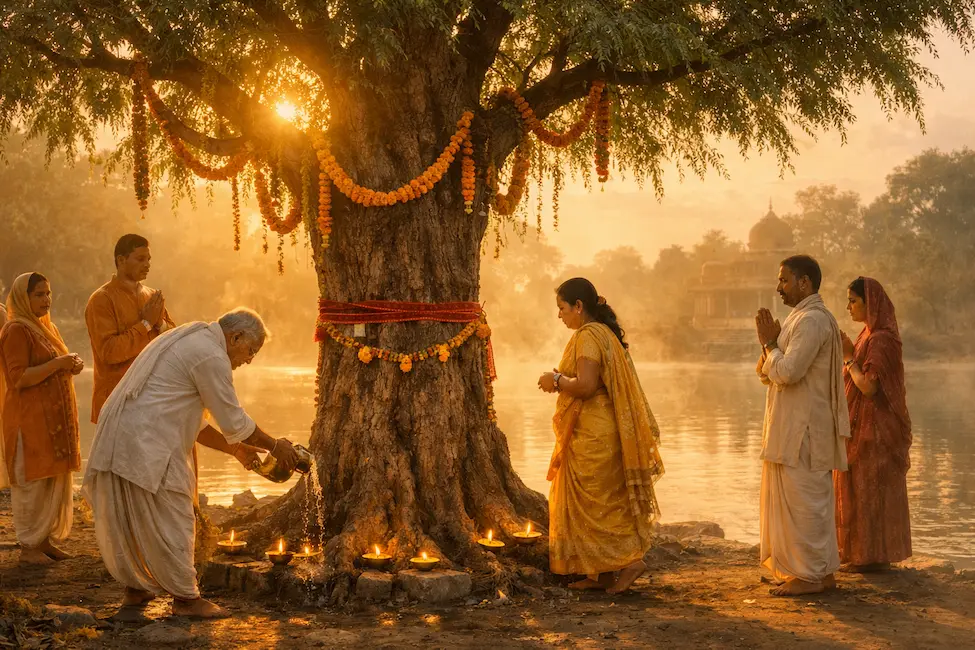
If an Amla tree is accessible, devotees traditionally:
- Clean the area around the tree.
- Offer water at its base.
- Apply sandal paste.
- Offer flowers and incense.
- Light a diya.
- Tie a sacred thread around the trunk.
- Perform seven circumambulations.
- Chant “Om Namo Bhagavate Vasudevaya”
If a tree is unavailable, symbolic worship may be performed at home by offering an Amla fruit before the image of Lord Vishnu and meditating on divine presence within nature.
Meaning of Tying the Sacred Thread
In Vedic tradition, a thread represents commitment and spiritual anchoring. By tying it around the tree, the devotee symbolically expresses a spiritual connection — the intention to remain anchored in dharma, remembrance, and divine guidance.
Swamiji often teaches that spiritual growth requires steadiness. The thread serves as a visible reminder of this steadiness. Just as the thread circles the trunk and holds firm, the devotee inwardly prays that their faith remain steady through changing circumstances.
The act transforms the tree from an external object into a mirror of the inner life.
Meaning of Seven Circumambulations
Walking around the tree seven times also carries deep symbolic meaning. The number seven appears repeatedly in Vedic thought — seven days of the week, seven planes of existence, seven chakras, seven sacred steps in life transitions.
By circumambulating the tree, the devotee symbolically places the Divine at the center of life. Each round can be understood as surrendering one dimension of existence — past, present, future, actions, thoughts, relationships, and destiny — to divine guidance.
Swamiji often explains that true worship is not only standing before God but arranging life around Him. The act of circumambulation expresses this inwardly: “May my life revolve around remembrance rather than distraction.”
📖 Spiritual Study and Remembrance
Throughout the day, devotees are encouraged to engage in spiritual reading, chanting, and reflection.
- Amalaki Ekadashi Vrat [fast] Katha
- Bhagavad Gita
- Vishnu Sahasranama
This helps the mind fast not only from food but from mental noise. Swamiji emphasizes that Ekadashi becomes spiritually effective when remembrance fills the space created by fasting.
🌙 Evening Devotion and Jagran
In the evening, many devotees sings bhajans, chant the Lord’s names, and remain awake in Jagran [vigil], reflecting on divine qualities.
Night vigil is symbolizes alertness of the soul. Just as one stays awake outwardly, the intention is to awaken inwardly – to remain conscious of divine presence rather than slipping back into mechanical living.
🍈 Parana and the Sacred Role of the Amla Fruit
The fast is completed on Saturday, Feb 28, 2026 (6:47–9:06 AM), traditionally beginning with Amla fruit or prasad, followed by a simple sattvic meal.
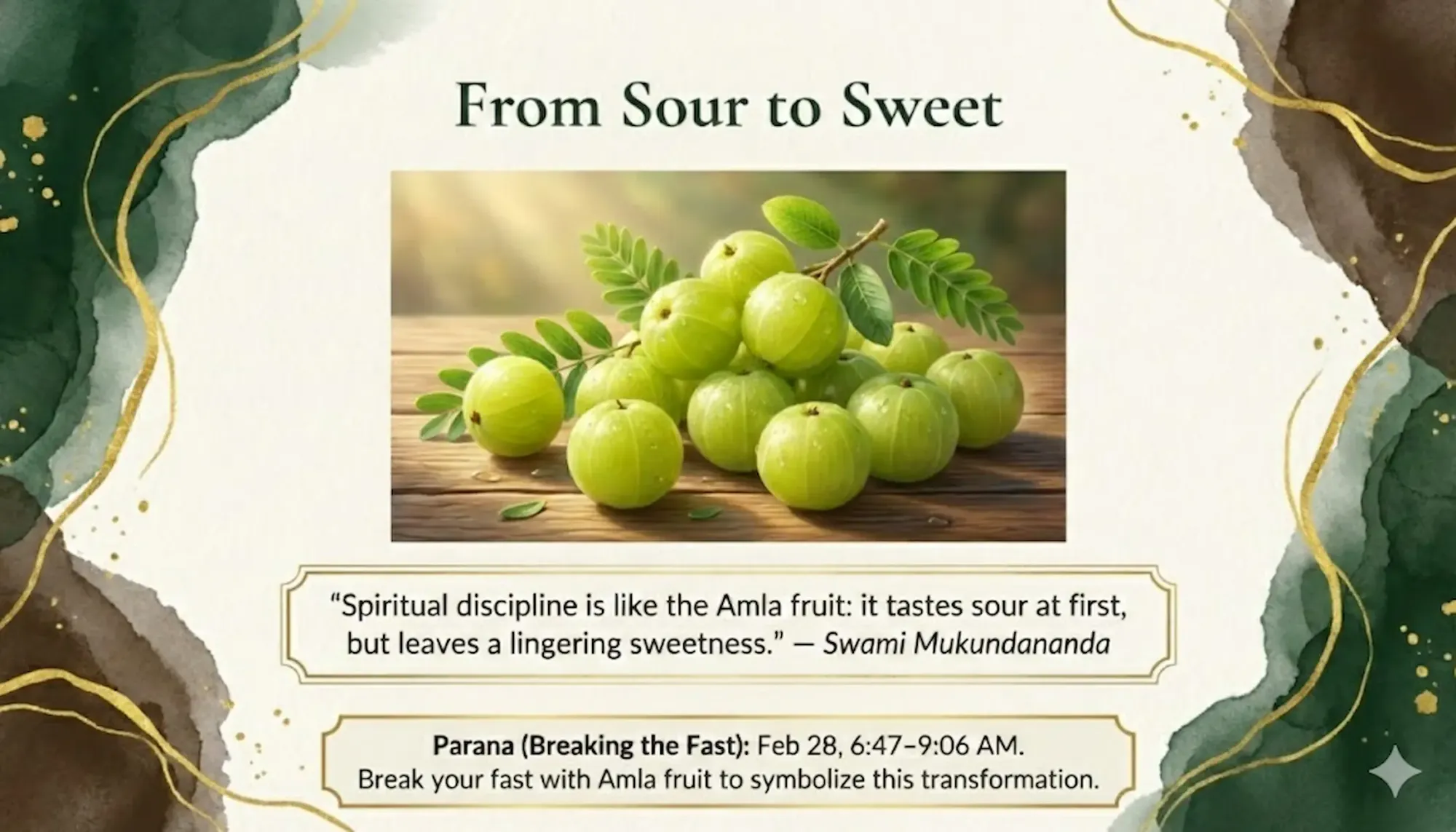
In Ayurveda, Amla is revered as a Rasayana — a rejuvenator rich in Vitamin C and natural antioxidants that strengthen immunity, digestion, and vitality. It restores balance in the body and supports long-term health.
Its role in the Ekadashi observance carries deeper symbolism. Just as the fruit restores the body after fasting, divine remembrance restores the mind after distraction. The fruit therefore represents renewal at both physical and spiritual levels.
Swami Mukundanandaji beautifully compares spiritual discipline to the Amla fruit itself. He explains that Amla tastes sour at first but becomes sweet after a short time. In the same way, spiritual restraint may initially feel difficult, but with patience it transforms into sweetness, peace, and inner strength.
Thus, the Amla fruit represents renewal at both physical and spiritual levels — nourishment for the body and encouragement for the soul.
🌳 Why the Sacred Amala Tree Is Central to Amalaki Ekadashi
The Amla tree is revered as an Adi-Vriksha – a primordial sacred tree representing nourishment, preservation, and divine presence woven into the fabric of creation. Unlike ritual objects that are placed on an altar, the tree stands rooted in the earth, reminding devotees that divine grace is not confined to temples but flows through the natural world itself
🌧 Divine Origin: Tars of Grace
Scripture offers two beautiful narrations regarding the tree’s origin, both centered on the concept of divine emotion:
· The Compassion of Lord Vishnu: Some traditions recount that as Lord Vishnu beheld the beauty of creation, tears of compassion fell to the earth, and from these sanctified drops, the first Amla tree emerged.
· The Joy of Lord Brahma: Other Puranic accounts explain that while Lord Brahma was absorbed in deep meditation on the Supreme Truth, tears of spiritual ecstasy [Ananda] flowed from his eyes, manifesting as the sacred tree.
Though the details differ, the spiritual message is the same. The Amla tree is a living embodiment of divine compassion and sustaining grace. It symbolizes the truth that all of creation is nourished by the silent, compassionate presence of the Divine.
🌌 Cosmic Symbolism: The Tree of Life
Vedic traditions view the Amla tree as a visible meditation on the entire cosmic order, with different deities residing in its form:
- The Roots [Lord Vishnu], representing the foundation and the source from which all life springs.
- The Trunk [Lord Shiva], symbolizing the strength, stability, and the pillar of transformation.
- The Branches [Lord Brahma], reflecting the vast expansion and diversity of creation.
- The Fruit [Goddess Lakshmi], representing nourishment, prosperity, and the sweetness of divine grace.
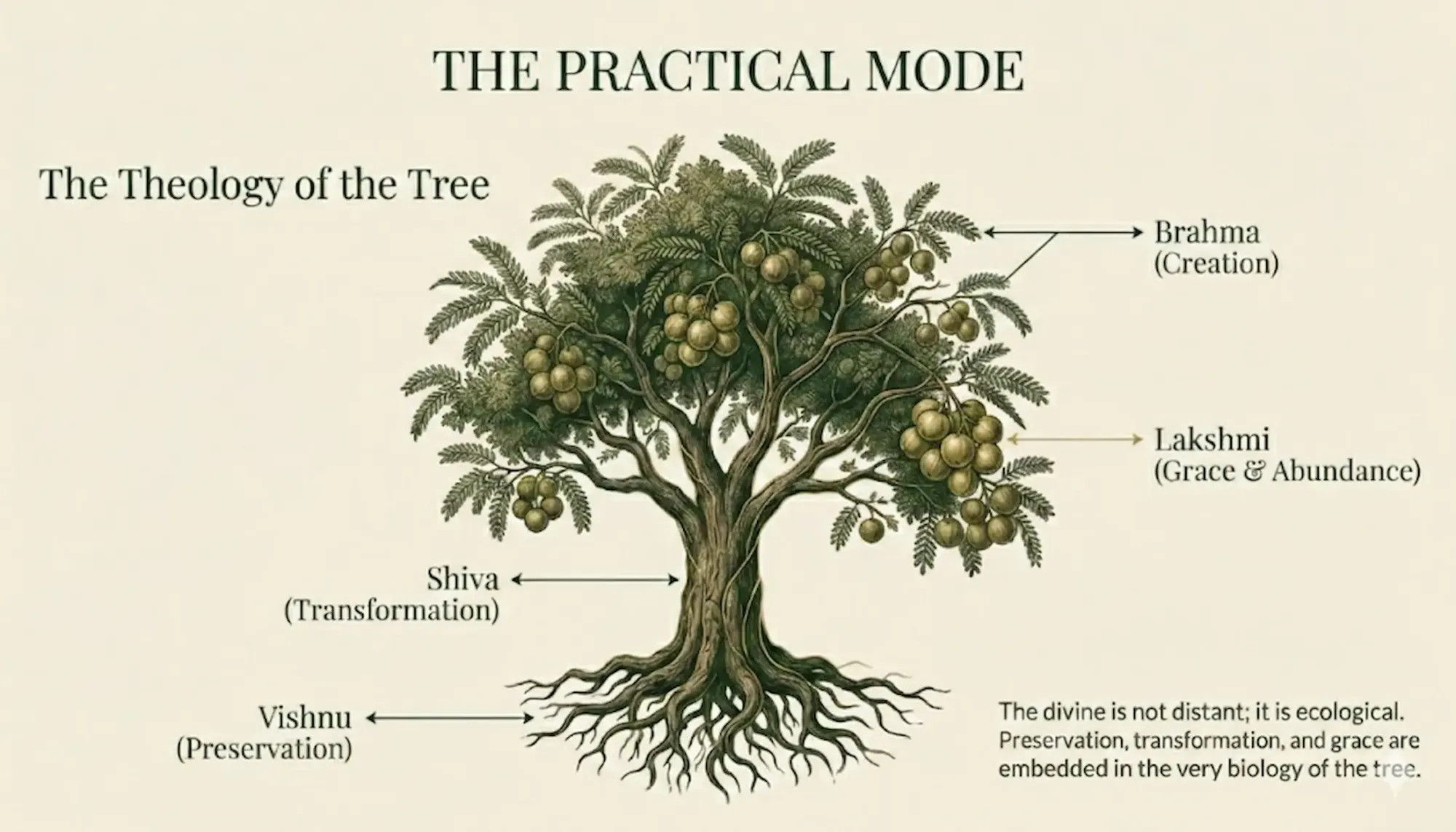
When you worship the Amla tree on this day, you are contemplating the entire cycle of existence – recognizing that your own life is held upright by these same forces of creation, preservation, and renewal.
The Spiritual “Blueprint” of the Amla Tree
The tree serves as a “spiritual blueprint” for the devotee’s own journey.
1. Evergreen Leaves: Symbolize a steady faith that remains vibrant regardless of changing seasons or life’s hardships.
2. Deep Roots: Reflect unseen protection, even when the world is turbulent, the soul remains anchored in God.
3. Silent Growth: Reflects the nature of progress; spiritual evolution is often quiet and gradual, yet it eventually yields the sweetest fruit.
Worshipping the tree on Amalaki Ekadashi reminds us that just as the tree sustains itself through hidden roots, our lives are sustained by a quiet, continuous flow of Grace that we must learn to recognize and honor.
Why Lord Parashurama Is Worshipped on Amalaki Ekadashi
Alongside the worship of the sacred tree, Amalaki Ekadashi is also associated with Lord Parashurama, the sixth incarnation of Vishnu. His remembrance adds another dimension to the observance.
If the Amla tree represents nourishment and inner growth, Lord Parashurama represents the strength required to protect that inner purity. He is remembered not merely as a warrior but as a symbol of disciplined power used in the service of righteousness.
He represents:
- The courage to stand for dharma.
- The removal of arrogance and ego.
- The restoration of balance when disorder spreads.
- Strength guided by devotion rather than anger.
Spiritual life requires both nourishment of the heart and firmness of character.
The Sacred Story of Amalaki Ekadashi: The King and the Hunter

The spiritual power of Amalaki Ekadashi is beautifully illustrated in the Brahmanda Purana, through the story of King Chitraratha and a humble hunter,
King Chitraratha ruled the prosperous kingdom of Vaidisha, a land where devotion to Lord Vishnu was woven into the fabric of everyday life. On the day of Amalaki Ekadashi, the king and his citizens gathered on a riverbank to worship a sacred Amla tree. They adorned it with flowers and lamps, placing a water pot at its base to invite the presence of Lord Vishnu. Together, they observed a strict fast and spent the night singing hymns, their hearts fixed on the Divine.
That same evening, a poor hunter, weary from a day of unsuccessful hunting, stumbled upon the gathering. Exhausted and hungry, he sat quietly at the edge of the crowd. Though he was unaware of the Ekadashi rituals or its significance, the peaceful atmosphere held him there. He stayed awake the entire night, listening to the sacred chants and watching the flickering lamps – unknowingly completing both a fast and a vigil [Jagran].
Years later, the hunter was reborn as the noble King Vasuratha. One day, while hunting in a dense forest, he lost his way and fell into a deep sleep under a tree. A group of bandits discovered the sleeping King and attempted to attack him with spears and swords.
Miraculously, as they struck, their weapons turned into flower petals, and a radiant divine presence emerged from the King’s body to protect him. When the King awoke to find the bandits defeated, a celestial voice revealed that he had been saved by the Punya [spiritual merit] of the Amalaki Ekadashi he had observed in his previous life.
This story conveys a profound spiritual truth: God respond not only to elaborate rituals but to sincere association. Even an unintentional connection with a sacred atmosphere can redirect the entire course of a soul’s journey.
As Swami Mukundanandaji beautifully explains, the essence of any Vrat [fast] is not merely the physical act of fasting, but the redirection of the mind. Swamiji teaches that “Ekadashi” literally means the eleventh day, but spiritually, it signifies withdrawing the ten senses and the mind form the world and placing them at the feet of God.
In the case of the hunter, even though his participation was accidental, his mind was momentarily stilled by the Satsang [holy company] of the King and the devotees. This illustrates a core principle Swamiji often emphasizes: Divine Grace is always flowing. Just as a magnet naturally attracts iron, the Lord’s grace is naturally drawn to anyone - knowingly or unknowingly - who steps into the sphere of His remembrance.
Amalaki Ekadashi remains a powerful reminder that the Divine notices even the smallest, most quiet step taken toward Him. It is an invitation to move beyond “mechanical” observance and, as Swamiji encourages, use these sacred days to consciously realign our intellect with the will of God.
Spiritual Benefits of Observing Amalaki Ekadashi
Scriptures describe this Ekadashi as cultivating:
- Purification of karmic impressions.
- Protection from negative tendencies.
- Clarity of mind.
- Growth of devotion.
- Harmony of body and mind.
The greatest fruit is inner steadiness. When fasting and remembrance unite, spiritual progress becomes natural.
🌿 The Living Message of Amalaki Ekadashi

What began with the promise of the merit of gifting a thousand cows ultimately reveals something even more powerful: the transformation of the heart.
Amalaki Ekadashi teaches that devotion is not measured by the complexity of the ritual, but by the depth of our awareness. The sacred Amla tree stands as a living reminder that divine grace sustains us quietly and continuously, just as unseen roots support the tree through every season. Whether we notice it or not, that grace is always present.
· When we fast, we are not merely abstaining from food; we are learning to withdraw the senses from distraction.
· When we take a Sankalp [sacred resolve], we are choosing conscious direction over unconscious habit.
· When we tie a thread around the tree, we are tying our life to dharma.
· When we walk seven times around it, we are declaring that our life revolves around the Divine.
And when we break the fast with the sacred Amla fruit — which tastes sour at first, but leaves a lingering sweetness — we remember Swami Mukundanandaji’s teaching: discipline may feel difficult in the beginning, but when sustained with sincerity, it matures into sweetness, clarity, and inner strength.
The story of the hunter reminds us that even one sincere moment of remembrance can redirect destiny. Divine grace does not overlook effort. It magnifies it.
Amalaki Ekadashi is therefore not just a date on the calendar. It is an invitation to purify, to realign, and to nourish devotion that we must then protect with courage.
If observed with sincerity, even a single Ekadashi can become a life-changing turning point.
Perhaps that is the true meaning behind the promise of “a thousand cows” — not external reward, but the attainment of an infinite inner wealth.
May this sacred day nourish your body, steady your mind, and bring your heart one step closer to God.
Call To Action: Explore More Ekadashi Wisdom and Stay Connected

 RKT Blog Team
Vijaya Ekadashi 2026
RKT Blog Team
Shattila Ekadashi 2026
Frequently Asked Questions
1. Can fruits be eaten on Amalaki Ekadashi?
Yes. Fruits, milk, nuts, and Ekadashi foods are allowed.
2. Is Amla tree worship necessary?
No, but it deepens the symbolic meaning of the Ekadashi.
3. What if I cannot fast fully?
Do partial fasting. Devotion matters more than austerity.
4. Why is this Ekadashi powerful?
It combines Vishnu worship, nature symbolism, and dharma reflection.
5. When should the fast be broken?
On Dwadashi morning within the Parana time.