
The 5000-Year-Old Biohack for the Soul in a Self-Centered Age

The room was silent except for the rhythmic clink of stainless steel.
A young lady volunteer had stayed back after a large spiritual retreat. Hundreds had attended. The crowds had gone. The wisdom had been shared. The bhajans had faded. Now, the hall was an empty shell of its former energy.
In the kitchen, she stood alone before a mountain of work. Her hands were pruned from hours in water. Her back ached. Her clothes were splattered with grease as she scrubbed the heavy iron pots that had fed hundreds.
No applause.
No spotlight.
Just the quiet reality of what most people call “menial” labor.
Suddenly, a shadow fell across the sink.
The Guru entered quietly.
He didn’t offer a lecture.
He didn’t ask for a report.
He simply rolled up his sleeves, picked up a scrub brush, and began scouring a greasy pot beside her.
She froze.
“Swamiji… please. This is my work. You shouldn’t be here.”
The Guru smiled, his hands still covered in soap.
“No,” he said gently.
“This is not work. This is the doorway to God.”
That one sentence contains the entire philosophy of the Bhagavad Gita.
Because the Gita does not teach us merely how to pray; it teaches us how to serve.
This is the core of the Bhagavad Gita’s teaching on selfless service.
The Bhagavad Gita begins from this very insight. It does not present service as a social duty but as the natural function of the soul itself. Shree Krishna explains that no one can remain without action even for a moment {Bhagavad Gita 3.5}. The real question is not whether we serve but whom we serve.
According to Swami Mukundanandaji, Seva means selfless service offered to God without expectation — a central teaching of the Bhagavad Gita’s path of Karma Yoga.
Perhaps that is why something remarkable is happening in the modern world.
We live in the most comfortable age in history, yet many people feel strangely restless — successful but exhausted, connected yet lonely, surrounded by convenience yet searching for meaning.
In our hyper-connected yet deeply isolated era, we have perfected the art of “self-care.” Too often, it is reduced to temporary pampering and material consumption. Yet despite our unprecedented wealth, modern society suffers from a profound poverty of purpose.
In response, doctors, psychologists, and public-health researchers are beginning to prescribe what they call “Social RX” — a social prescription for service. Instead of only medicine, people are encouraged to volunteer, help others, and engage in meaningful contribution. Studies increasingly suggest that regular acts of service improve emotional wellbeing, strengthen relationships, and support long-term health.
In other words, modern science is slowly rediscovering what Shree Krishna revealed five thousand years ago:
👉 The human heart heals not only by receiving, but by giving.
The Bhagavad Gita, as beautifully explained by Swami Mukundanandaji, reveals a radical truth:
- Service is not just charity; it is transformation.
- Service is not a chore; it is a spiritual technology.
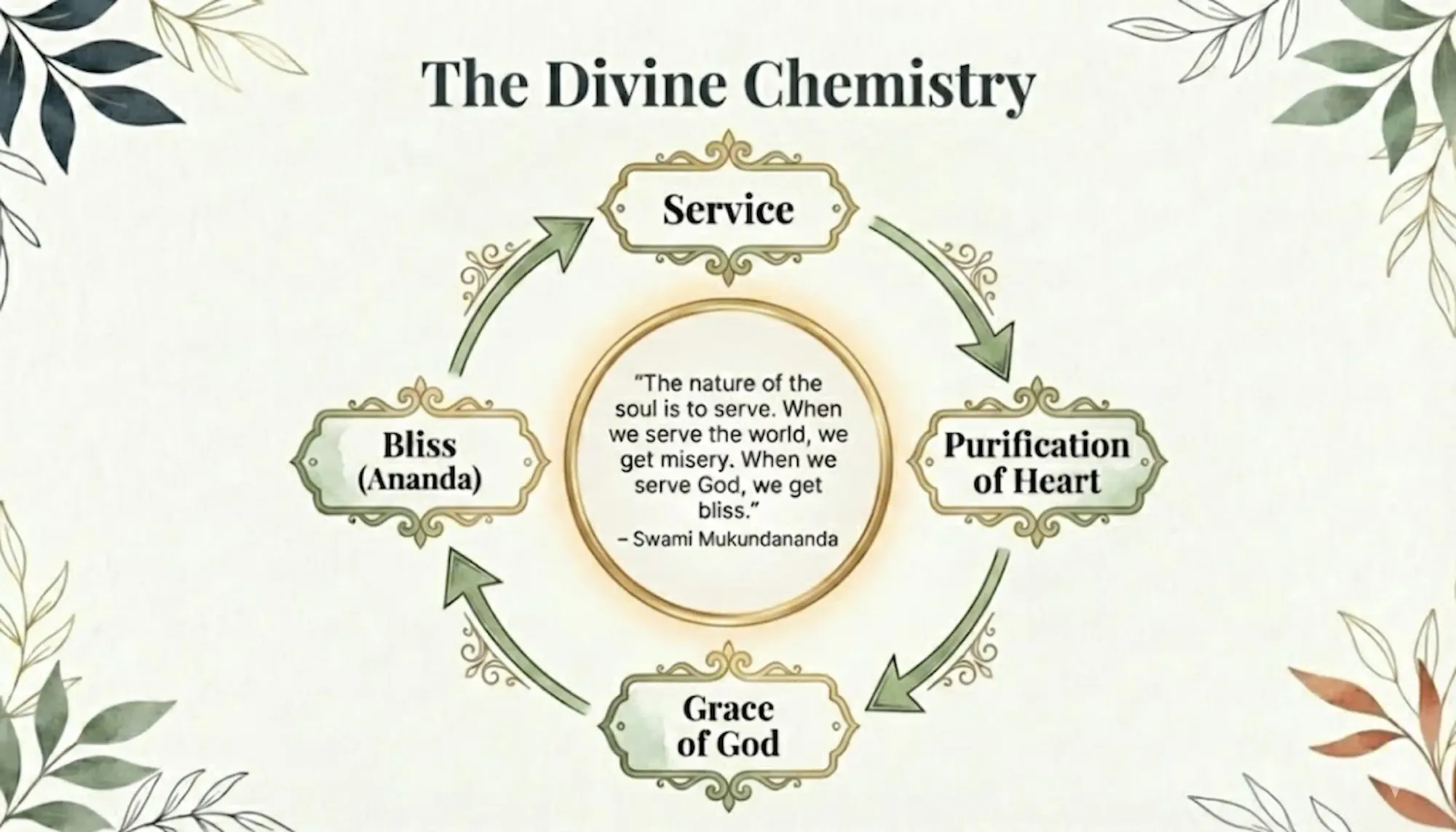
- Service purifies the mind, softens the ego, and invites divine grace.
While modern self-care focuses on the external shell, the Bhagavad Gita offers soul-care. By shifting from consumption to contribution, we reset our inner life and move from the friction of ego to the quiet peace of offering.
In this blog, we will uncover what Shree Krishna truly teaches about charity and service, how intention determines the spiritual power of giving, why selfless service purifies the heart faster than philosophy, and how ancient wisdom and modern insight point to the same conclusion:
The soul does not find peace in being served.
It finds peace in becoming a servant.
From Charity to Seva: What the Bhagavad Gita Actually Teaches
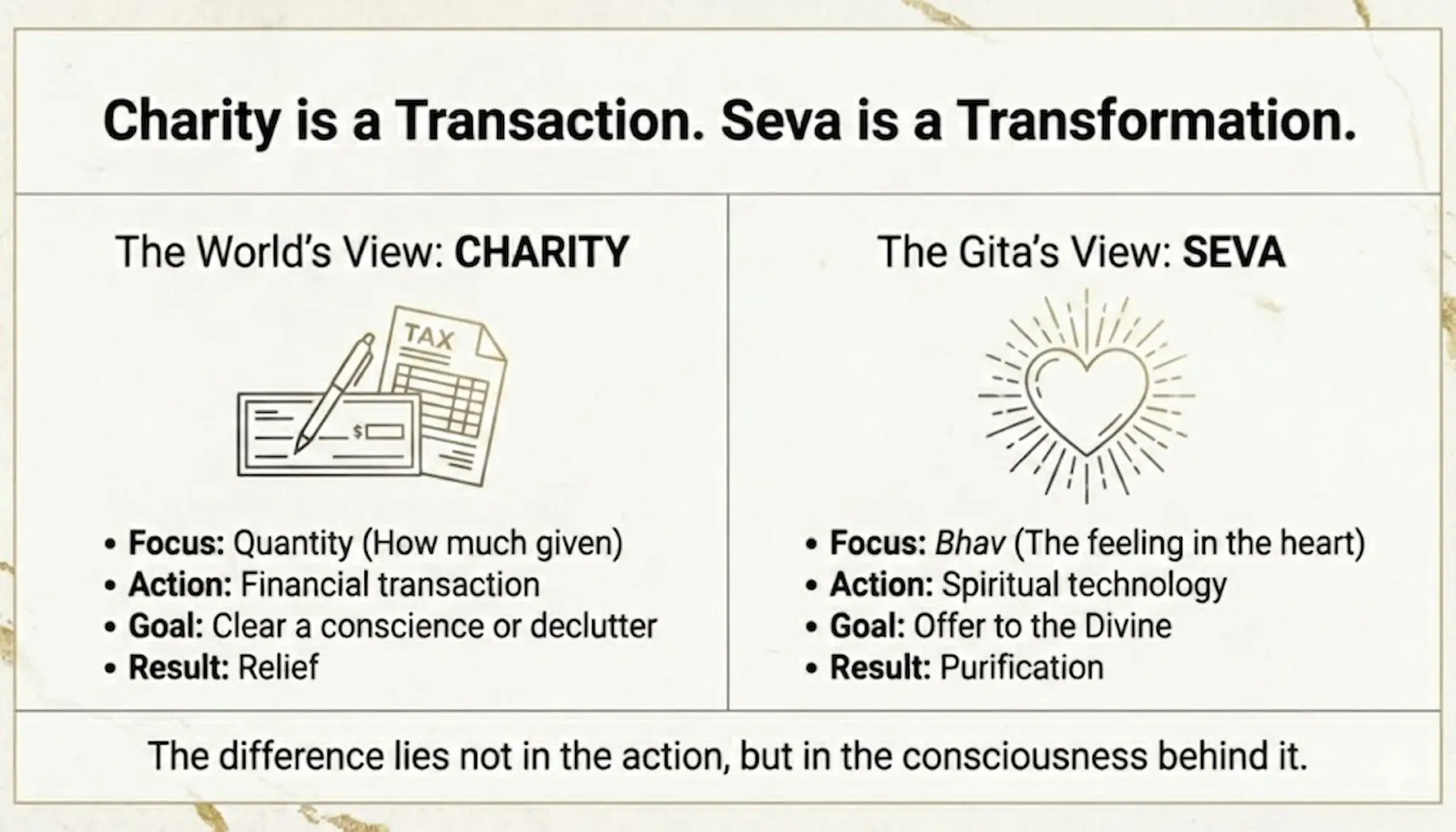
Modern society uses the word charity in a financial sense — a tax-deductible transaction, a check written to clear a conscience, or a bag of clothes donated to declutter a closet.
To the world, charity is measured by how much is given.
To Shree Krishna, charity is measured by what happens to the micro-chemistry of the heart while giving.
Thus, the difference lies not in the action, but in the consciousness (bhav) behind it.
As Shree Krishna teaches:
"Whatever you do, whatever you eat, whatever you offer as oblation to the sacred fire, whatever you bestow as a gift, and whatever austerities you perform, O son of Kunti, do them as an offering to Me."
{Bhagavad Gita 9.27}
This is why Swami Mukundanandaji speaks of serving through Tan, Man, and Dhan — through the body {our actions}, the mind {our inner attitude}, and dhan {our resources}. The outer act may be identical; the inner intention determines whether it binds or liberates the soul.
The Gita’s Audit: Why Your Intentions Matter
In Chapter 17 {17.20-22} of the Bhagavad Gita, Shree Krishna presents a sophisticated framework for auditing our motives. Charity exists in three distinct modes, shaped by the three gunas of nature:
· Sattva – purity and clarity
· Rajas – restless desire and ego
· Tamas – ignorance and insensitivity
Shree Krishna does not merely say “be generous.”
To understand the sacred science of giving, we must first understand these three modes.
1. Sattvic Charity – Giving That Purifies the Heart
Shree Krishna defines the highest form of charity in verse 17.20:
"Charity given to a worthy person simply because it is right to give, without consideration of anything in return, at the proper time and in the proper place, is stated to be in the mode of goodness." (Bhagavad Gita 17.20)
This is the gold standard of giving.
Sattvic charity is offered quietly, respectfully, and with a sense of sacred responsibility.
The giver does not feel superior.
The giver does not calculate reward.
The giver does not dwell on the act afterward.
Swami Mukundanandaji explains that this kind of giving directly aids chitta shuddhi – purification of the mind because it shifts the center of identity from “What do I get?” to “How may I serve?”
Swamiji calls this the Trustee Mindset: we are returning God’s resources to God’s children.
When we “give and forget,” we perform a surgical strike on the ego.
2. Rajasic Charity – Giving That Feed the Ego
Shree Krishna then describes the second form in verse 17.21:
"But charity given with reluctance, with the hope of a return or in expectation of a reward, is said to be in the mode of passion." (Bhagavad Gita 17.21)
This is the kind of charity most common in modern life. It is a “subtle barter.”
It may look generous outwardly, but inwardly it carries calculation. It may carry thoughts like:
- Will this improve my image?
- Will people notice?
- Will I get influence or recognition?
- Will this help me later?
- Will my name appear somewhere?
The act may benefit others, but it does not transform the giver.
Instead of dissolving ego, it subtly strengthens it.
Swami Mukundanandaji explains that such charity may produce punya (temporary merit), but it does not bring deep inner purification, because the sense of doership and self-importance remain intact.
Even giving to God can be Rajasic if it becomes a transaction: “Lord, I will give this much if You solve my problem.”
You may gain merit but you do not gain peace.
3. Tamasic Charity – Giving That Causes Harm
Finally, Shree Krishna describes the lowest form in verse 17.22:
"And that charity, which is given at the wrong place and wrong time to unworthy persons, without showing respect, or with contempt, is held to be of the nature of nescience.” (Bhagavad Gita 17.22)
Tamasic charity is not only ineffective — it can be spiritually harmful.
It includes giving:
- without discernment
- without respect
- to support harmful behavior
- with irritation or arrogance
- simply to get rid of responsibility
Throwing a coin at a beggar while feeling disgusted by them, supporting destructive habits, or giving carelessly without thought – all fall into this category.
It is a wasted opportunity that strengthens the “I am superior” delusion.
So instead of uplifting the mind, such giving reinforces ignorance and insensitivity.
Thus, Shree Krishna’s insight is profound:
Giving is not a social act; it is a spiritual discipline.
Charity becomes Seva only when:
- the ego softens
- the intention purifies
- the act is mentally offered to God
- and the heart remains humble

Why Seva Purifies the Mind Faster Than Philosophy
If knowledge alone were enough, the world would already be enlightened.
We live in an age overflowing with spiritual information. Books, lectures, podcasts, scriptures, and commentaries are available instantly. Yet intellectual understanding does not automatically transform the heart.
The Gita acknowledges this gap.
Knowledge illuminates the path.
Selfless Seva removes the inner obstacles that prevent us from walking it.
Here is the difference:
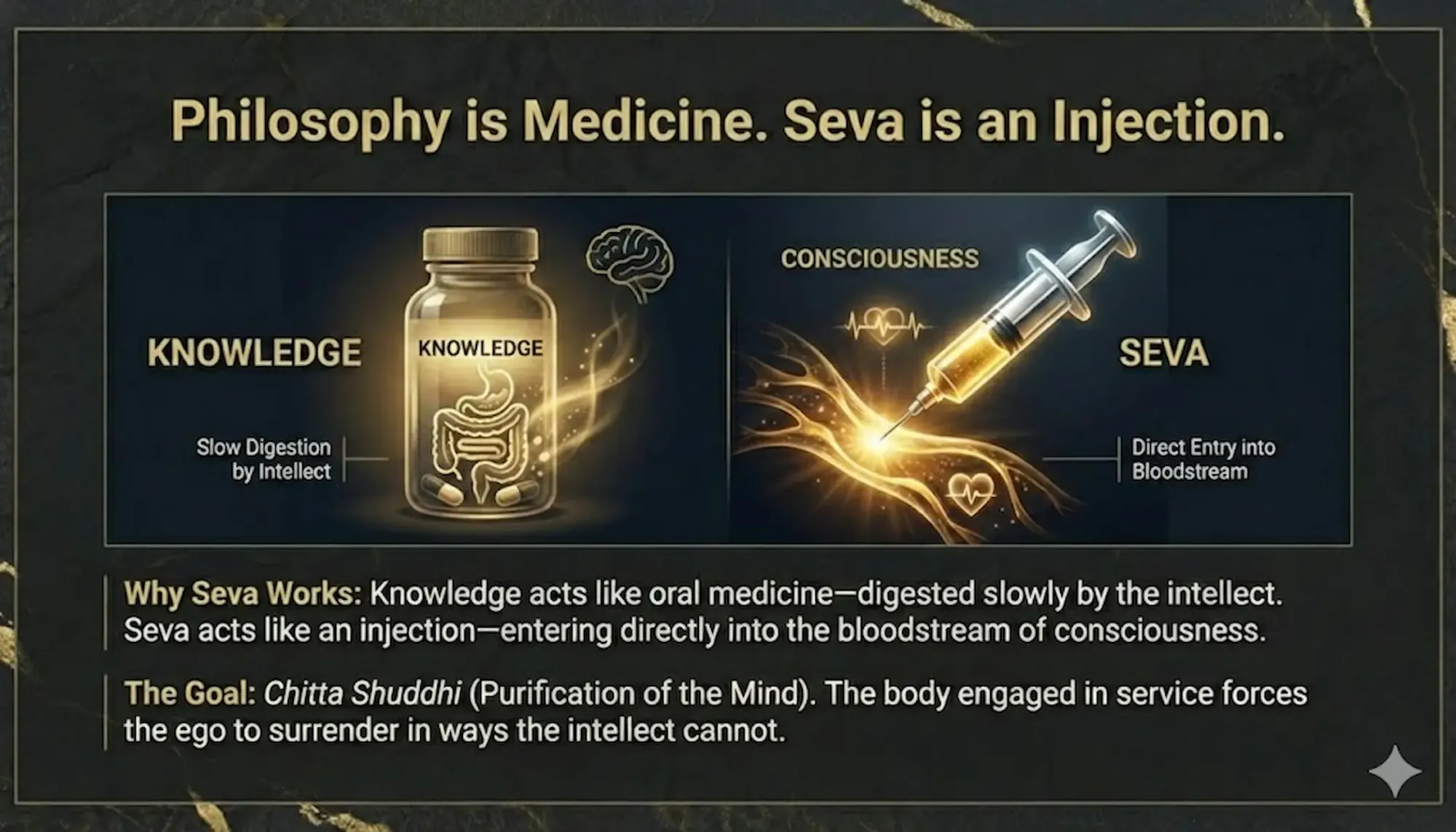
Dry philosophy is like medicine taken orally.
It must be digested slowly before it affects the system.
Seva is like a spiritual injection.
It enters directly into the bloodstream of consciousness.
That is why seekers often find that sincere service changes them faster than study alone.
Philosophy explains truth.
Seva makes us live it.
The Gita’s Hidden Teaching on Service
The strategic goal of seva is chitta shuddhi, the purification of the mind.
This internal detox is far more vital than external reputation because it addresses the root of our misery – the ego [Ahankar].
The mind may argue, “I am too important for this.”
But the body engaged in humble service forces the ego to surrender.
There is no greater lesson in the mood of service than the Rajasuya Yagna of King Yudhisthir.
At a grand assembly of kings and sages, Yudhisthir, out of deep love, asked Shree Krishna to choose any department of the yagna to supervise.
Shree Krishna, the Supreme Personality of Godhead, chose two tasks:
1. Washing the feet of the arriving guests.
2. Cleaning the leaf-plates [pattals] after the guests had finished their meals.
Think about this deeply: The hands that create galaxies were scrubbing away the dust from the feet of mortals. The Lord was not doing this because He had to; He was doing it to show us that no service is menial when it is done for the pleasure of the Divine.
The Inner Journey of Seva: From Effort to Transformation
If selfless service purifies the mind, a deeper question naturally arises:
How does it actually transform us?
And just as importantly:
Why does it sometimes feel uplifting and at other times exhausting?
The Bhagavad Gita does not present seva as a moral instruction.
It presents it as a process of inner transformation.
To understand this, we must first look at what truly blocks spiritual growth.
The Hidden Barrier: Ego, Not Ignorance
Most seekers assume their greatest obstacle is lack of knowledge.
But the Gita reveals something subtler.
The real barrier is ego.
That quiet sense of:
- I am the doer
- My effort should be recognized
- My comfort matters most
- Things should go my way
“The Doer” syndrome.
Symptoms of Ego in Seva
This ego expresses itself in small daily reactions:
- irritation when unappreciated
- resistance to inconvenience
- comparison with others
- desire for control
- need to feel important
These tendencies do not disappear by reading scriptures.
They dissolve only when they are challenged in real life.
And that is precisely what seva does.
Seva does not merely teach humility.
It produces it.
The mind functions through habit.
For years, it revolves around one central calculation:
What do I get from this?
Selfless service interrupts that pattern.
Each time we act without expectation:
- the habit of self-calculation weakens
- the identity shifts from taker to giver
- attention slowly moves from self toward the Divine
Swami Mukundanandaji explains that this is why seva produces chitta shuddhi, purification of the mind.
It retrains the mind to live in offering rather than acquisition.
At first this feels effortful.
But gradually, the mind becomes lighter.
And when the mind stops revolving around itself, peace begins to arise naturally.
Why Seva Sometimes Feels Heavy
Even good service can sometimes feel exhausting.
This does not mean seva is ineffective.
It means something subtle has shifted inside us.
Service feels heavy when ownership replaces offering.
Instead of thinking,
“I am serving,”
the mind begins to think,
“I am the one doing so much.”
And once ownership enters, expectation quietly follows:
- appreciation
- fairness
- recognition
- visible results
When these do not come, fatigue replaces joy.
The burden is not from effort.
It is from doership.
1. We Secretly Want Recognition
Even sincere seekers may carry hidden expectations:
“May someone notice.” “May I be appreciated.”
2. We Start Choosing Service Based on Status
The ego quietly asks:
“Does this suit my education? My position? My image?”
3. We Compare Our Seva With Others
Comparison turns devotion into competition.
The moment we think:
“I do more.”
“They don’t help enough.”
joy disappears.
4. We Focus on People’s Faults Instead of the Value of Service
When others are careless or create extra work, resentment grows.
5. We Forget Whom We Are Serving
The deepest reason Seva becomes heavy is simple: the heart loses its connection.
Shree Krishna’s solution is direct:
"Performing all works as an offering unto Me, constantly meditate on Me as the Supreme. Become free from desire and selfishness, and with your mental grief departed, fight!” (Bhagavad Gita 3.30)
When the mind reconnects —
“I am serving God” —
the same task becomes joyful again.
When we serve God, we feel peaceful.
Offer all your actions to God.
The Turning Point: When Effort Becomes Offering
The Bhagavad Gita gives a simple but profound instruction:
"Whatever you do, whatever you eat, whatever you offer as oblation to the sacred fire, whatever you bestow as a gift, and whatever austerities you perform, O son of Kunti, do them as an offering to Me.” {Bhagavad Gita 9.27}
This is the moment seva shifts from labor to devotion.
When we claim the work, it weighs on us.
When we offer the work, it lifts us.
The action may be identical.
The inner experience changes completely.
Offering dissolves the ego’s grip.
And once the ego loosens, peace begins to flow.
Why Seva Transforms Us From Within
Spiritual knowledge tells us we are not the center of life.
Seva makes us live that truth.
Knowledge speaks of compassion.
Service makes us practice it.
Knowledge explains surrender.
Service demands it in real time.
Meditation becomes steadier, prayer feels more heartfelt, reactions soften, and gratitude grows. Not because they forced spiritual change, but because seva quietly removed what was blocking it.
At its deepest level, seva works because it aligns us with our true nature.
The Gita teaches that the soul is meant to love and serve the Divine. When we live only for ourselves, friction arises within us. But when we serve — even in small ways — we move into harmony with that nature. The result is a quiet inner rightness, a peace that does not depend on outcomes.
As Swami Mukundanandaji beautifully says:
“When we serve the ego, we feel restless. When we serve the Divine, we feel peaceful.”
The transformation of seva unfolds slowly and almost invisibly. Pride softens. Comparison weakens. Patience grows. Devotion becomes natural. These changes cannot be forced by willpower; they arise when the heart repeatedly practices offering.
This is the real science of seva.
It does not merely change what we do.
It quietly changes who we become.
The Seva Protocol: A Practical Framework for Living Seva
Spiritual insight changes life only when it becomes practice.
Swami Mukundanandaji teaches that growth comes from steady engagement, not occasional inspiration. Just as the body needs nourishment, the soul needs consistent service.
To integrate Seva into modern life, follow these four spiritual prescriptions:
1. The 10% Principle: From Ownership to Trusteeship
The Skanda Purana advises offering one-tenth of one’s income to a higher cause. Spiritually, this is not charity — it is trusteeship.
Swamiji reminds us that everything belongs to God. Offering a portion back shifts us from ownership to stewardship, purifies our relationship with money, and softens greed.
It trains the mind to remember:
“I am not the owner. I am the custodian.”
2. Anonymous Seva: Protecting the Heart From Ego
Recognition weakens the power of service. That is why Swamiji encourages invisible seva.
Give quietly.
Help privately.
Serve without leaving your name behind.
When praise disappears, service stays Sattvic — and its ability to purify the heart deepens.
3. Yukta Balance: Making Seva Sustainable
In Bhagavad Gita 6.17, Krishna teaches Yukta — balanced effort.
Service works best as a rhythm, not a surge.
Research suggests 2–4 hours per week is enough to create real wellbeing benefits without burnout.
Consistency matters more than intensity.
Seva transforms when it becomes a habit.
4. Divine Vision: Seeing God in the Recipient
The deepest shift is in perception. Swami Mukundanandaji calls this Hari-Guru Priti — serving with awareness that the Divine lives in every being.
Serve a person → you help externally.
Serve God within them → you grow internally.
The action stays the same.
The consciousness turns it into devotion.

Key Takeaways: The Bhagavad Gita’s Timeless Science of Seva
- Service is not measured by the action but by the intention.
The same act can bind or liberate depending on the consciousness behind it. - True seva purifies the mind (chitta shuddhi).
It reduces ego, softens attachment, and prepares the heart for devotion. - The Gita’s three modes of charity reveal why some giving transforms while other giving drains.
Sattvic service purifies. Rajasic service agitates. Tamasic service harms. - Seva works because it aligns us with our true nature.
The soul finds peace not in being served, but in serving the Divine. - Serve through Tan, Man, and Dhan.
Offer your effort, your inner attitude, and your resources in a spirit of trusteeship. - Consistency matters more than scale.
Small, regular acts of offering transform the heart more deeply than occasional dramatic gestures.
Call to Action

Conclusion: The Doorway to Peace
The Bhagavad Gita does not ask us to renounce action.
It asks us to renounce the ego within the action.
In a world that glorifies accumulation, Shree Krishna teaches offering.
We are not empty vessels meant to endlessly collect experiences, wealth, or recognition.
We are not stagnant reservoirs; we are meant to be channels through which Divine Grace flows to the world.
The modern “poverty of purpose” cannot be cured by a better vacation, a higher salary, or a more expensive “self-care” routine. It is healed by the Gita’s “Social RX”. It is healed when we realize that the soul does not find peace in being served; it finds its greatest strength, deepest health, and highest joy in becoming a servant.
When service is offered purely for God’s happiness, it becomes the fastest purifier of the heart.
So today, look for a plate to wash.
Because when you roll up your sleeves to serve the world, you may discover that the Lord is already there, scrub brush in hand, waiting beside you.

FAQ
1. What is the difference between charity and seva?
Charity is external giving. Seva is giving as an offering to God.
2. Can daily duties be seva?
Yes — when performed sincerely and offered to the Divine.
3. Why does seva bring peace?
Because it aligns us with the soul’s natural function of loving service.
4. How can beginners start?
Begin small. Offer one action daily without expectation.
5. Does God care about the size of service?
No. Shree Krishna accepts even a small offering given with love {Gita 9.26}.
The Spiritual References:
- Bhagavad Gita: The Song of God – Commentary by Swami Mukundananda ji
·