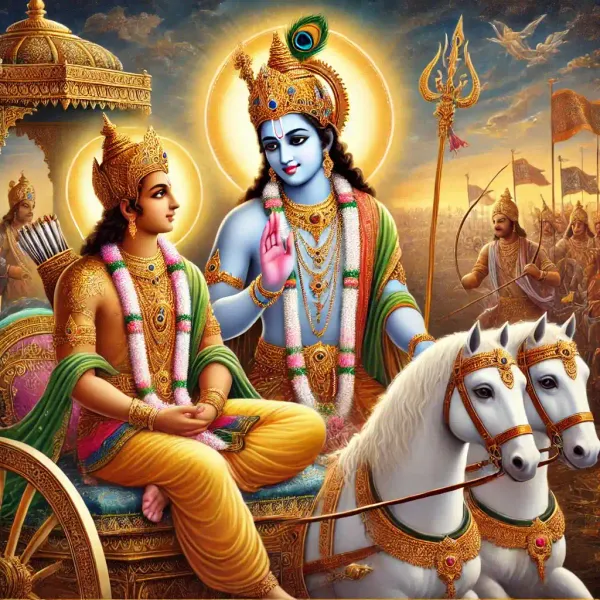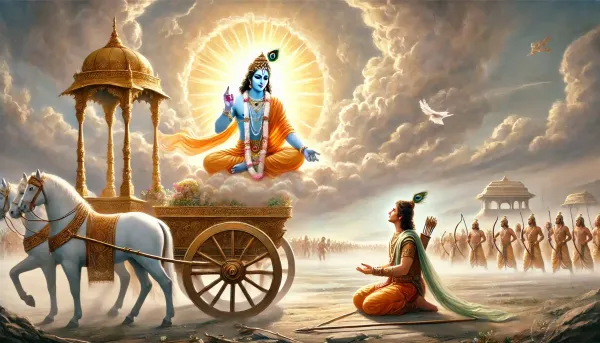
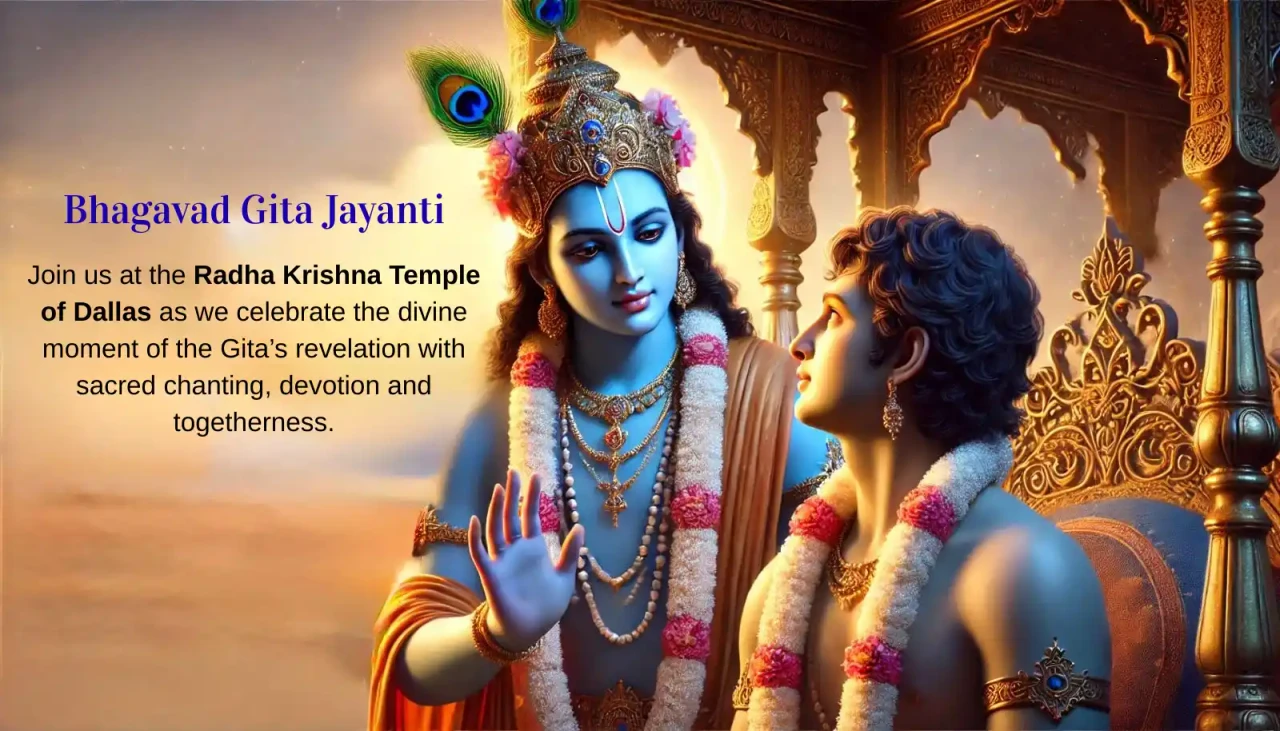
Gita Jayanti is a sacred day when we commemorate the divine discourse given by Lord Krishna to Arjuna on the battlefield of Kurukshetra. As we mark Gita Jayanti on December 1st, 2025, let’s pause to immerse ourselves in more than 50 hand‑picked verses (in English) from the translation and commentary by Swami Mukundananda 'Holy Bhagavad Gita – The Song of God'. Through these quotes we will touch on key themes of life, karma and devotion.
Whether you’re a seasoned student of the Gita or someone newly drawn to its message, this collection is intended to inspire you to internalise its wisdom this Gita Jayanti and beyond. Each verse is accompanied by a link to the Holy Bhagavad Gita website and will take you directly to the verse with Swami Mukundananda's commentary.
Key Summary Points
Before diving into the quotes, here are some of the major themes you’ll encounter:
- Dharma & Duty: The Gita places emphasis on performing one’s prescribed duties with right attitude, while seeing beyond ego and results.
- Self‑Knowledge & the Soul: The immortal nature of the soul, and how recognising that reality frees us from fear and sorrow.
- Action without Attachment: The yog of action (karm yoga) teaches how to act, but not be bound by the fruits of action.
- Devotion & Surrender: Bhakti‑yoga and the call to surrender to the Divine, trusting His grace and wisdom.
- Sattva, Rajas, Tamas: Understanding how the three modes of nature influence us, and the path to transcend them.
- Vision of the Divine: The cosmic form, the infinite glories of the Divine, and the invitation to merge with that consciousness.
- Renunciation & Liberation: How true renunciation isn’t escapism but transformation of motive; liberation emerges when we realise our identity in the eternal.
As you read the verses below, you may want to note which themes resonate most strongly for you now, and how you might apply them in your personal life this year.
Chapter 1: Arjun Vishad Yog (Lamenting the Consequences of War)
1.1 - Dhritarashtra said: O Sanjay, after gathering on the holy field of Kurukshetra and desiring to fight, what did my sons and the sons of Pandu do?
1.21-1.22 - Arjun said: O Infallible One, please take my chariot to the middle of both armies, so that I may look at the warriors arrayed for battle, whom I must fight in this great combat.
1.32-1.33 - O Krishna, I do not desire victory, kingdom, or the happiness accruing to it. Of what avail will be a kingdom, pleasures, or even life itself, when the very persons for whom we covet them, are standing before us for battle?
Chapter 2: Sankhya Yog (The Yog of Analytical Knowledge)
2.7 - I am confused about my duty and am besieged with anxiety and faintheartedness. I am Your disciple and surrendered to You. Please instruct me for certain what is best for me.
2.11 - The Supreme Lord said: While you speak words of wisdom, you are mourning for that which is not worthy of grief. The wise lament neither for the living nor for the dead.
2.13 - Just as the embodied soul continuously passes from childhood to youth to old age, similarly, at the time of death, the soul passes into another body. The wise are not deluded by this.
Chapter 3: Karm Yog (The Yog of Action)
3.4 - One cannot achieve freedom from karmic reactions by merely abstaining from work, nor can one attain perfection of knowledge by mere physical renunciation.
3.7 - But those karm yogis who control their knowledge senses with the mind, O Arjun, and engage the working senses in working without attachment, are certainly superior.
3.8 - You should thus perform your prescribed Vedic duties, since action is superior to inaction. By ceasing activity, even your bodily maintenance will not be possible.
Chapter 4: Jnana Karm Sanyas Yog (The Yog of Knowledge and the Disciplines of Action)
4.3 - The same ancient knowledge of Yog, which is the supreme secret, I am today revealing unto you, because you are My friend as well as My devotee, who can understand this transcendental wisdom.
4.7 - Whenever there is a decline in righteousness and an increase in unrighteousness, O Arjun, at that time, I manifest Myself on earth.
4.8 - To protect the righteous, to annihilate the wicked, and to re-establish the principles of dharma, I appear on this earth, age after age.
Chapter 5: Karm Sanyas Yog (The Yog of Renunciation)
5.2 - The Supreme Lord said: Both the path of karm sanyas (renunciation of actions) and karm yog (working in devotion) lead to the supreme goal. But karm yog is superior to karm sanyas.
5.3 - The karm yogis, who neither desire nor hate anything, should be considered always renounced. Free from all dualities, they are easily liberated from the bonds of material energy.
5.5 - The supreme state that is attained by means of karm sanyas is also attained by working in devotion. Hence, those who see karm sanyas and karm yog to be identical, truly see things as they are.
Chapter 6: Dhyan Yog (The Yog of Meditation)
6.1 - The Supreme Lord said: Those who perform prescribed duties without desiring the results of their actions are actual sanyasis (renunciates) and yogis, not those who have merely ceased performing sacrifices, such as Agnihotra Yajna or abandoned bodily activities.
6.2 - What is known as sanyas is non-different from Yog, for none become yogis without renouncing worldly desires.
6.5 - Elevate yourself through the power of your mind and not degrade yourself, for the mind can be the friend and also the enemy of the self.
Chapter 7: Jnana Vijnana Yog (Yog through the Realization of Divine Knowledge)
7.1 - The Supreme Lord said: Now listen, O Arjun, how, with the mind attached exclusively to Me and surrendering to Me through the practice of bhakti yog, you can know Me completely, free from doubt.
7.2 - I shall now reveal unto you fully this knowledge and wisdom, knowing which, nothing else remains to be known in this world.
7.3 - Amongst thousands of persons, hardly one strives for perfection; and amongst those who have achieved perfection, hardly one knows Me in truth.
Chapter 8: Akshar Brahma Yog (The Yog of the Eternal God)
8.6 - Whatever one remembers upon giving up the body at the time of death, O son of Kunti, one attains that state, being always absorbed in such contemplation.
8.7 - Therefore, always remember Me and also do your duty of fighting the war. With mind and intellect surrendered to Me, you will definitely attain Me; of this, there is no doubt.
8.14 - O Parth, for those yogis who always think of Me with exclusive devotion, I am easily attainable because of their constant absorption in Me.
Chapter 9: Raja Vidya Yog (Yog through the King of Sciences)
9.2 - This knowledge is the king of sciences and the most profound of all secrets. It purifies those who hear it. It is directly realizable, in accordance with dharma, easy to practise, and everlasting in effect.
9.3 - People who have no faith in this dharma are unable to attain Me, O conqueror of enemies. They repeatedly come back to this world in the cycle of birth and death.
9.13 - But the great souls, who take shelter of My divine energy, O Parth, know Me, Lord Krishna, as the Origin of all creation. They engage in My devotion with their mind fixed exclusively on Me.
Chapter 10: Vibhuti Yog (Yog through Appreciating the Infinite Opulences of God)
10.4-10.5 - From Me alone arise the varieties of qualities in humans, such as intellect, knowledge, clarity of thought, forgiveness, truthfulness, control over the senses and mind, joy and sorrow, birth and death, fear and courage, non-violence, equanimity, contentment, austerity, charity, fame, and infamy.
10.8 - I am the Origin of all creation. Everything proceeds from Me. The wise who know this perfectly worship Me with great faith and devotion.
10.9 - With their mind fixed on Me and their life surrendered to Me, My devotees remain ever content in Me. They derive great satisfaction and bliss in enlightening one another about Me and in conversing about My glories.
Chapter 11: Vishwaroop Darshan Yog (Yog through Beholding the Cosmic Form of God)
11.3 - O Supreme Lord, You are precisely what You declare Yourself to be. Now I desire to see Your divine cosmic form, O Greatest of persons.
11.8 - But you cannot see My cosmic form with these physical eyes of yours. Therefore, I grant you divine vision. Behold My majestic opulence!
11.52-11.53 - The Supreme Lord said: This form of Mine that you are seeing is exceedingly difficult to behold. Even the celestial gods are eager to see it. Neither by the study of the Vedas, nor by penance, charity, or fire sacrifices, can I be seen as you have seen Me.
Chapter 12: Bhakti Yog (The Yog of Devotion)
12.1 - Arjun inquired: Between those who are steadfastly devoted to Your personal form and those who worship the formless Brahman, whom do You consider to be more perfect in Yog?
12.2 - The Lord said: Those who fix their mind on Me and always engage in My devotion with steadfast faith, I consider them to be the best yogis.
12.6-12.7 - But those who dedicate all their actions to Me, regarding Me as the Supreme goal, worshipping Me and meditating on Me with exclusive devotion, O Parth, I swiftly deliver them from the ocean of birth and death, for their consciousness is united with Me.
Chapter 13: Kshetra Kshetrajna Vibhag Yog (Yog through Distinguishing the Field and the Knower of the Field)
13.2 - The Supreme Divine Lord said: O Arjun, this body is termed as kṣhetra (the field of activities), and the one who knows this body is called kṣhetrajña (the knower of the field) by the sages who discern the truth about both.
13.3 - O scion of Bharat, I am also the knower of all the individual fields of activity. The understanding of the body as the field of activities, and the soul and God as the knowers of the field, this I hold to be true knowledge.
13.6 - The field of activities is composed of the five great elements, the ego, the intellect, the unmanifest primordial matter, the eleven senses (five knowledge senses, five working senses, and the mind), and the five objects of the senses.
Chapter 14: Guna Traya Vibhag Yog (Yog through Understanding the Three Modes of Material Nature)
14.5 - O mighty-armed Arjun, material energy consists of three gunas (modes)—sattva (goodness), rajas (passion), and tamas (ignorance). These modes bind the eternal soul to the perishable body.
14.6 - Amongst these, sattva guna, the mode of goodness, being purer than the others, is illuminating and full of well-being. O sinless one, it binds the soul by creating attachment for a sense of happiness and knowledge.
14.7 - O Arjun, rajo guna is of the nature of passion. It arises from worldly desires and affections and binds the soul through attachment to fruitive actions.
Chapter 15: Purushottam Yog (The Yog of the Supreme Divine Personality)
15.1 - The Supreme Divine Personality said: They speak of an eternal ashvatth tree with its roots above and branches below. Its leaves are the Vedic hymns, and one who knows the secret of this tree is the knower of the Vedas.
15.2 - The branches of the tree extend upward and downward, nourished by the three gunas, with the objects of the senses as tender buds. The roots of the tree hang downward, causing the flow of karma in the human form.
15.3-15.4 - The real form of this tree is not perceived in this world, neither its beginning, nor end, nor its continued existence. But this deep-rooted ashvatth tree must be cut down with a strong axe of detachment. Then one must search out the base of the tree, which is the Supreme Lord, from Whom streamed forth the activity of the universe a long time ago. Upon taking refuge in Him, one will not return to this world again.
Chapter 16: Daivasura Sampad Vibhag Yog (Yog through Discerning the Divine and Demoniac Natures)
16.1-16.3 - The Supreme Divine Personality said: O scion of Bharat, these are the saintly virtues of those endowed with a divine nature—fearlessness, purity of mind, steadfastness in spiritual knowledge, charity, control of the senses, sacrifice, study of the sacred books, austerity, and straightforwardness; non-violence, truthfulness, absence of anger, renunciation, peacefulness, restraint from fault-finding, compassion towards all living beings, absence of covetousness, gentleness, modesty, and lack of fickleness; vigour, forgiveness, fortitude, cleanliness, bearing enmity towards none, and absence of vanity.
16.4 - O Parth, the qualities of those who possess a demoniac nature are hypocrisy, arrogance, conceit, anger, harshness, and ignorance.
16.7 - Those possessing a demoniac nature do not comprehend which actions are proper and which are improper. Hence, they possess neither purity, nor good conduct, nor even truthfulness.
Chapter 17: Shraddha Traya Vibhag Yog (Yog through Discerning the Three Divisions of Faith)
17.7 - The food that people prefer is according to their dispositions. The same is true for sacrifice, austerity, and charity they are inclined (or predisposed) to. Now hear of the distinctions from Me.
17.8 - Persons in the mode of goodness prefer foods that promote lifespan, and increase virtue, strength, health, happiness, and satisfaction. Such foods are juicy, succulent, nourishing, and naturally tasteful.
17.11 - Sacrifice that is performed according to scriptural injunctions without expectation of rewards, with the firm conviction of the mind that it is a matter of duty, is of the nature of goodness.
Chapter 18: Moksha Sanyas Yog (Yog through the Perfection of Renunciation and Surrender)
18.5 - Actions based upon sacrifice, charity, and penance should never be abandoned; they must certainly be performed. Indeed, acts of sacrifice, charity, and penance are purifying even for those who are wise.
18.7 - Prescribed duties should never be renounced. Such deluded renunciation is said to be in the mode of ignorance.
18.19 - Knowledge, action, and the doer are declared to be of three kinds in the Sankhya philosophy, distinguished according to the three modes of material nature. Listen, and I will explain their distinctions to you.
Further Study of the Bhagavad Gita
- The Holy Bhagavad Gita with Swami Mukundananda's Commentary
- Swami Mukundananda's YouTube channel on the Holy Bhagavad Gita