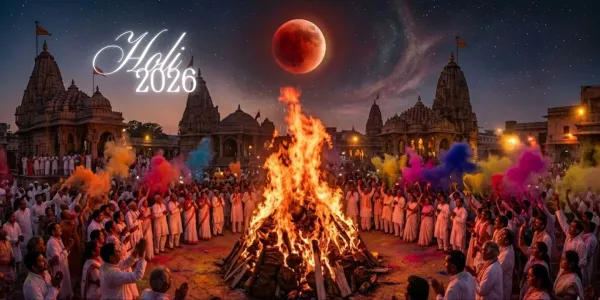
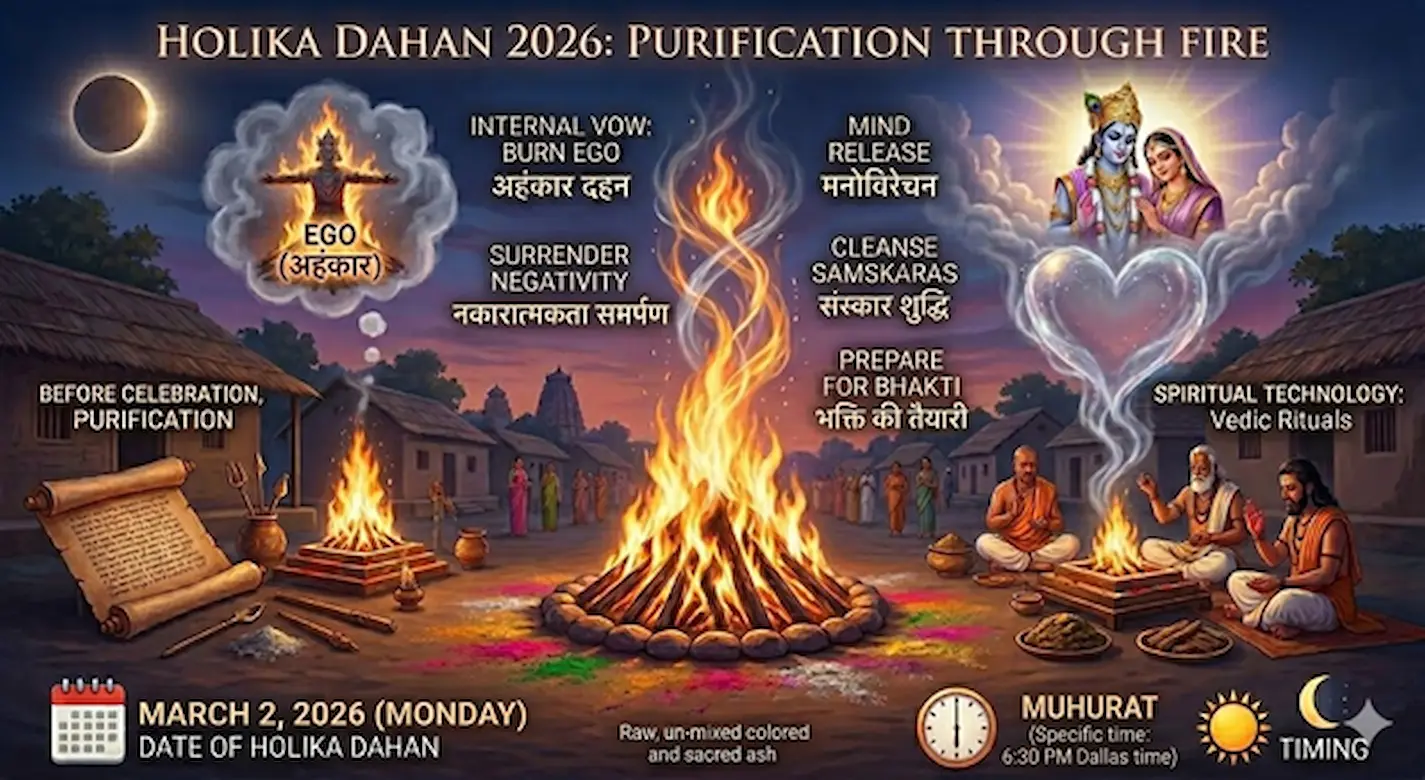
Spring in Sanatana Dharma does not begin with color; it begins with fire. Before the soft hues of gulal decorate the atmosphere, Holika Dahan 2026, also known as Chhoti Holi, invites us to stand before the sacred flames and make a quiet internal vow:
“Let the Holika of my own ego burn first.”
Before celebration, there is purification.
Before joy, there is surrender.
Before color, there is fire.
In the profound teachings of Swami Mukundanandaji, Holika Dahan is not folklore for children. It is Spiritual Technology—a carefully designed Vedic ritual that helps the mind release fear, ego, bitterness, negativity, and deep-rooted samskaras. It is meant to cleanse the heart so it becomes a fit vessel for Radha Krishna Bhakti.
The 2026 Convergence: Fire and Eclipse
In 2026, this night of purification carries extraordinary depth because it coincides with a rare celestial event. A Total Lunar Eclipse occurs on March 3, 2026. This “shadow on the moon” becomes a living metaphor for the inner shadow we seek to burn away. This eclipse serves as a cosmic invitation to eclipse our material identity so the soul’s light, in the mood of Bhakti Upasana, may finally re-emerge
Holika Dahan 2026: Date and Timing
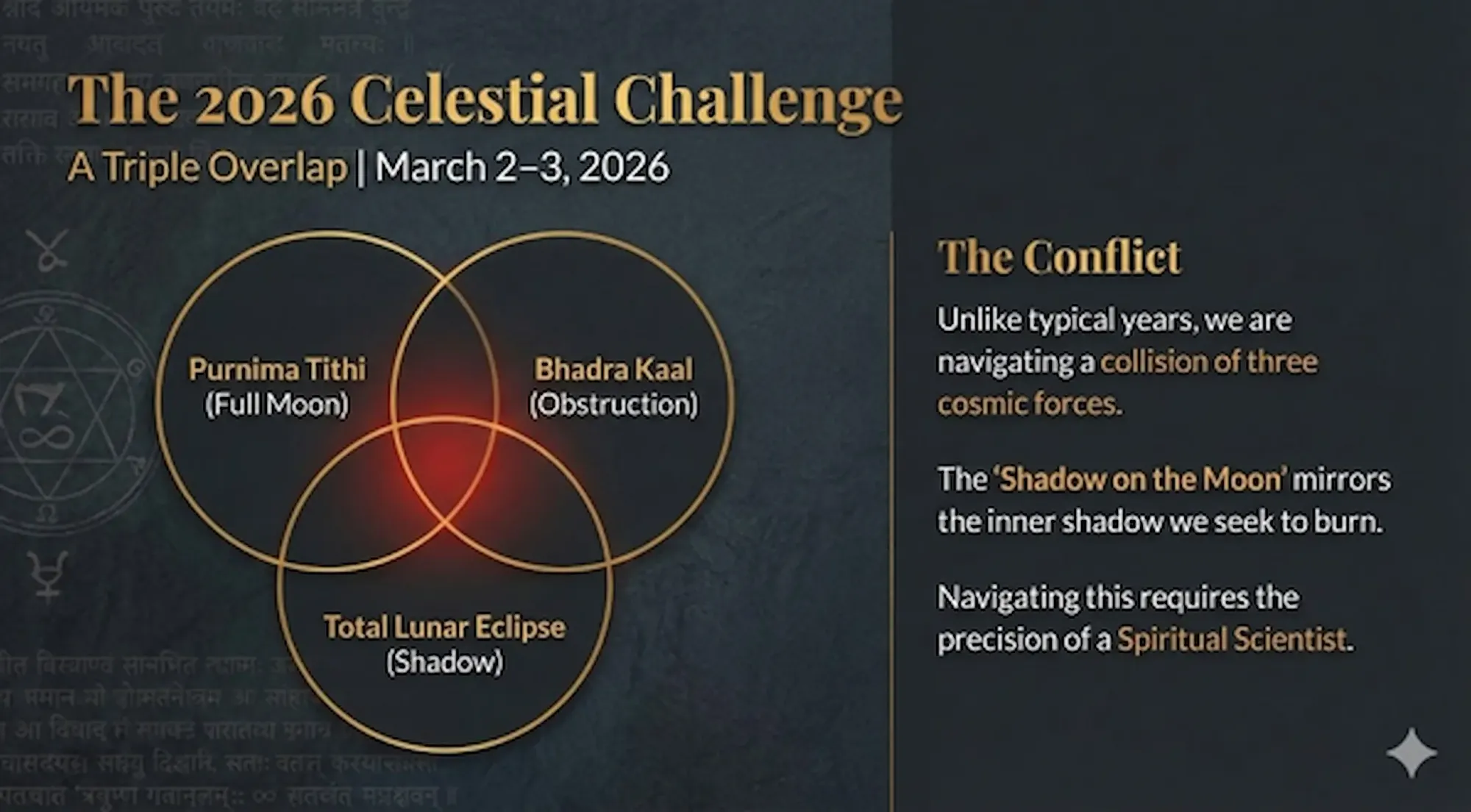
Understanding the 2026 Celestial Challenge: Navigating the “Triple Overlap”
In most years, the timing of Holika Dahan feels simple. We wait for the Full Moon [Purnima] of Phalguna, gather after sunset, and ignite the bonfire in remembrance of Prahlad’s devotion and the victory of divine protection over tyranny.
Performing Holika Dahan with integrity this year requires the precision of a spiritual scientist. We are faced with three cosmic forces colliding:
- Purnima Tithi: The necessary lunar phase.
- Bhadra Kaal: A heavy, inauspicious astrological shadow.
- Total Lunar Eclipse (Chandra Grahan): Triggering the restrictive Sutak period.
1. Bhadra Kaal: The Invisible Obstruction
Vedic astrology teaches that time has gunas, qualities. Some windows of time feel like fertile soil, and some feel like a parched desert. Bhadra Kaal is like a parched desert where auspicious seeds cannot grow. It is traditionally avoided for auspicious undertakings, especially sacred fire rituals like Holika Dahan.
According to the Puranas, Bhadra is the volatile daughter of Surya Dev. Lord Brahma confined her to particular segments of the lunar calendar. He decreed that during her “Kaal,” sacred fires would face obstacles.
As Swamiji explains, ignoring these laws is a sign of spiritual pride. Even the great Ravana fell because he believed his ego could override the cosmic order. In 2026, Bhadra begins to dominate the late evening of March 2nd, creating an unusually specific timing window.
2. The Lunar Eclipse and Sutak
On the morning of March 3, 2026, the Total Lunar Eclipse begins. In Vedic tradition, a Grahan is a moment when the lunar energy which governs our mind is obscured. It is preceded by Sutak, a 9-hour period of spiritual “stoppage.”
- Temples close their doors.
- Fire rituals (Dahan) are avoided due to “heavy” energy.
- The mind is encouraged to move from external rituals to internal chanting.
Swami Mukundanandaji’s lens reframes sutak beautifully. When external light is shadowed, the invitation is to turn inward. When worldly rhythms pause, the seeker has a rare opportunity to deepen sadhana. In this way, the eclipse is a spiritual amplifier.
3. Pradosh Kaal: The Sanctuary of Twilight
This is where Pradosh Kaal—the “Window of Grace”—saves our celebration. Pradosh means evening. It is the twilight junction surrounding sunset, a sacred hinge between day and night, is the moment Lord Narasimha appeared to protect Prahlad. By lighting the fire during Pradosh, we step into the “In-Between” space where miracles happen.
The Holika Dahan 2026 Golden Window: Monday, March 2
For the Dallas community and surrounding regions, a narrow window of perfect alignment emerges.
|
Factor |
Status at 6:30 PM
(March 2) |
|
Purnima Tithi |
Active (Fully present) |
|
Bhadra Kaal |
Minimal (Before the peak
disruptive phase) |
|
Sutak/Eclipse |
Clear (Has not yet
begun) |
|
Pradosh Kaal |
Perfect (The sun has just
set) |
The most auspicious time to light the bonfire is 6:30 PM on Monday, March 2, 2026. Choosing this time is an act of discipline. It tells the ego:
“I will not act by convenience; I will act in alignment.”
Holika Dahan 2026 Rituals and Puja Vidhi
A Step-by-Step Guide with Inner Meaning
Once you know the Holika Dahan 2026 date and the Holika Dahan 2026 muhurat, the ritual becomes intimate. Because the real question is not only “When do I light the fire?” The real question is, “What do I do with my mind when I stand before it?”
Swami Mukundanandaji’s teachings help us understand that Holika Dahan is not a performance in front of a bonfire. On the path of bhakti, objects are never merely things. They are vessels for sentiment. During Holika Dahan, physical elements trigger inner transformation. When performed with consciousness, the ritual becomes purification you can actually feel.
Part 1: The Essential Samagri
The Seven Offerings of Holika Dahan
In the path of Bhakti, objects are vessels for our sentiments. Holika Dahan uses tangible materials to awaken invisible inner shifts. Each item acts like a symbolic lever, moving the mind away from ego and toward surrender. When you understand the samagri [items], your hands stop doing ritual mechanically and begin doing sadhana consciously.
Swamiji teaches that we use physical elements to trigger tectonic shifts in our consciousness.
In Vedic symbolism, seven often represents complete coverage of human experience. We live through the five elements, and we interpret life through mind and intellect. The seven offerings become a prayer that every layer of the self be purified, not just behavior, but the inner structure from which behavior emerges.
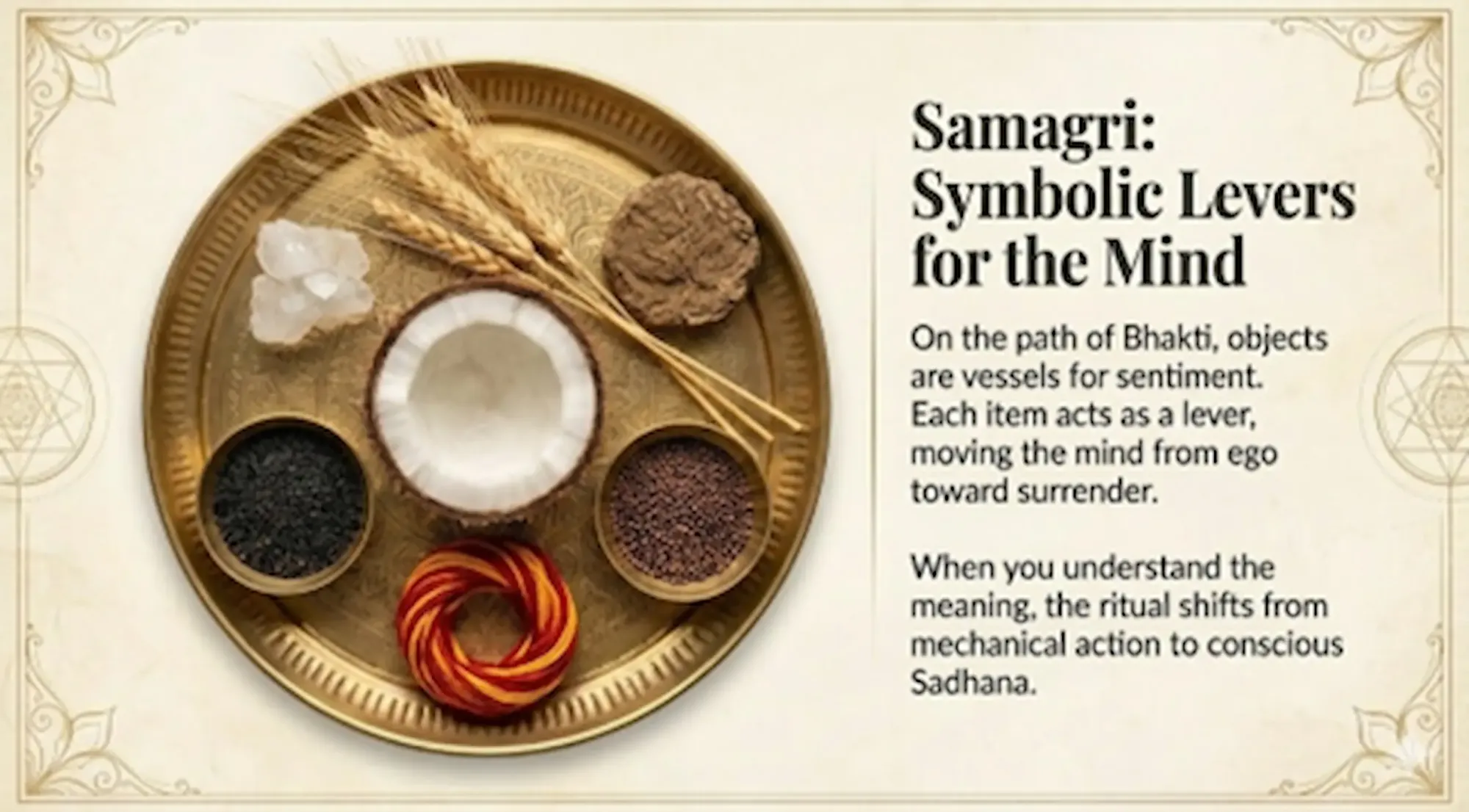
1. The Coconut: The Breaking of Ego
The Offering That Cracks the Hard Shell of “I”
The coconut contains an entire philosophy inside one object. Externally it is rough, hard, sealed. Internally it holds sweetness. That makes it a perfect mirror of the human condition.
Swami Mukundanandaji teaches that the biggest obstacle to bhakti is not lack of intelligence. It is the hard shell of identity. The sense of “I am the doer,” “I deserve,” “I know,” “I am right.” In other words, ahankāra.
When the coconut enters fire, it becomes a visible dramatization of what must happen spiritually. The casing must crack before the sweetness can flow.
If you offer it casually, it remains a gesture. If you offer it as surrender, it becomes a declaration:
“Lord, break the part of me that resists You.”
When the coconut cracks, the flames preach: ego does not soften by negotiation. Ego softens by sacrifice. This is why the coconut is the king of offerings. It teaches the central truth of Holika Dahan:
Ego burns. Bhakti remains.
2. Black Sesame Seeds: Roasting the Seeds of Karma
The Offering for the Seeds of Past Karma
Seeds represent future consequences. Even when you cannot see karma yet, it exists like a seed waiting for the right season. That is why black sesame becomes the offering of karmic purification.
When sesame is offered into fire, it is not magic removal. It is intention:
“May the seeds of past negativity be roasted before they sprout into suffering.”
Swami Mukundanandaji reminds seekers that spiritual life is not only about adding virtue. It is about neutralizing tendencies that keep repeating. Sesame symbolizes those subtle imprints. Offering sesame is saying:
“I am done carrying hidden burdens into the next season.”
In Chhoti Holi 2026, that prayer becomes even more poignant. Spring is a new cycle, and sesame is the vow that the new cycle will not be haunted by old patterns.
3. Mustard Seeds: Shattering Internal Doubt
The Offering for Doubt, Negativity, and the Inner Evil Eye
Many traditions describe mustard seeds as protection against the evil eye. Swamiji’s insight makes it deeply personal: the greatest evil eye is not outside. It is inside. The eye of doubt, cynicism, suspicion, and negativity.
Mustard seeds are tiny, but they dominate taste. That is how doubt behaves. One small doubt can disturb an entire spiritual life. One insecurity can poison a relationship. One resentment can tighten the heart for years.
When mustard seeds are offered into the Holika fire, they crackle and pop. That sound becomes metaphor. It is the sound of doubts being shattered.
So when you offer mustard during Holika Dahan 2026, offer the thoughts that keep your devotion complicated: the constant suspicion, the inner narrative of bitterness, the habit of negativity. The prayer becomes:
“Let my negativity burn so my devotion becomes simple again.”
4. Raw Cotton Thread (Moli): Winding the Soul’s Orbit
The Offering That Unties the Knots of Attachment
The thread is profound because it involves movement. You wrap it, circle after circle, as though your life itself is being placed into divine orbit.
It symbolizes bond and surrender. Life feels unsafe when we rely only on control. Life becomes steady when we rely on divine shelter. The thread becomes your prayer in physical form:
“My only true security is my relationship with Krishna. Even when circumstances burn, this bond remains.”
Thread also symbolizes entanglement. Our life is held together by threads of duty, identity, expectations, attachments, fears. Some threads are sacred. Some are bondage. Swami Mukundanandaji teaches that the mind is restless because it is tied to too many anchors. The thread ritual becomes an embodied prayer:e
“May my life be tied to God, not tied to ego.”
The seven rounds can also be understood as the layers of material covering: the five elements, mind, and intellect. As the thread burns, you are asking the Lord to untie the knots of the heart.
5. Wheat Stalks: Turning Work into Prasad
The Offering That Turns Karma Into Prasad
Grains represent work, livelihood, harvest, and the fruits of karma we cling to. That is why they are offered before being eaten.
Swami Mukundanandaji’s karma yoga teaching becomes living here. We work, strive, plan, achieve. But the moment we think “this result is mine,” pride grows, anxiety grows, possessiveness grows, and joy shrinks.
When grains are offered into the Holika fire, it becomes a sacred reset. You acknowledge:
“Everything I earn and receive is ultimately Krishna’s grace.”
This transforms ordinary food into prasad and ordinary effort into devotion. It makes the ritual feel satisfying because it is not just a bonfire. It is life being offered back to the Source.
6. Camphor: The Path of Total Surrender
The Offering That Teaches Complete Surrender
Camphor burns completely and leaves no residue. That makes it one of the purest symbols of surrender.
Swami Mukundanandaji teaches that surrender is not merely obedience. It is dissolution of ego. Even spiritual ego wants credit. “I did sādhanā.” “I sacrificed.” “I am devoted.” Camphor leaves nothing behind that says “I burned.” It becomes fragrance and disappears.
That is the prayer:
“Lord, let my devotion burn like this, cleanly, without residue of ‘I’.”
In Holika Dahan 2026, camphor becomes a training in selfless devotion. A bhakti that does not advertise itself, does not demand recognition, does not keep score.
7. Cow Dung Cakes: Burning the Vasanas
The Offering That Purifies Both Mind and Atmosphere
Cow dung cakes are not only fuel. They are offered intentionally because they carry two meanings: inner purification and seasonal cleansing.
Traditionally, they burn with steady heat and less aggressive sparking than random wood. Symbolically, they represent the burning of vāsanās, stored tendencies that keep returning. Anger that reappears. Jealousy that resurfaces. Pride that regrows. Offering them becomes a prayer:
“Lord, burn not only my actions, but the hidden fuel that produces those actions.”
And there is a second prayer here. Not for pride or superstition, but for purity:
“May the atmosphere around me become clean, and may the atmosphere inside me become clean.”
Today, many communities adapt Holika Dahan with eco-awareness, but the inner intention remains the same. The fire is meant to cleanse, not to pollute. The devotee’s role is to uphold responsibility while honoring tradition.
Part 2: Step-by-Step Puja Vidhi for Holika Dahan 2026
Step 1: Preparation, Inner and Outer
Arrive before sunset so preparation is unhurried. Keep the space clean and safe. Arrange the wood and samagri with calm attention.
But the most important preparation happens inside.
Swami Mukundanandaji teaches that Holika represents arrogance of assets, the misuse of power, intellect, position, or strength against dharma. Before the fire is lit, identify your inner Holika. Ask honestly: what quality in me harms devotion?
Is it anger?
Is it control?
Is it pride?
Is it bitterness?
Is it jealousy?
Is it harsh speech?
Now hold that quality in the mind as if you are holding it in your palm. The ritual becomes powerful when you know exactly what you are burning.
Step 2: Sankalpa, The Sacred Resolve
The Power of Intention
Stand near the unlit pyre and take a few slow breaths. Hold a little water and rice grains if you wish, then speak your intention clearly. The exact words matter less than the inner truth.
Swami Mukundanandaji teaches: “The power of the mind is unlocked through focus.” A ritual without sankalpa becomes a physical exercise. Tell your mind why you are here.
“Today I am burning resentment.”
“Today I am burning pride.”
“Today I am burning fear.”
Instead of only praying for problems to disappear, adopt Prahlad’s mindset. Prahlad did not negotiate with fire. He anchored the mind in God. So your sankalpa can be:
“Lord, let my mind remain at Your lotus feet even when life becomes intense. Let this Holika Dahan strengthen my bhakti.”
Step 3: Offering Before Ignition
Honoring the Test
Before lighting the fire, traditional practice includes offering water, turmeric, kumkum, and flowers to the unlit pyre. This is not worship of evil. It is honor of purification.
Why offer respect before burning? Because the mature spiritual mind learns to respect even the trials that cleanse it. Swami Mukundanandaji reframes tests beautifully: they are not punishments. They are invitations to deepen surrender. This step trains the heart to stop resisting purification and to start welcoming it as mercy.
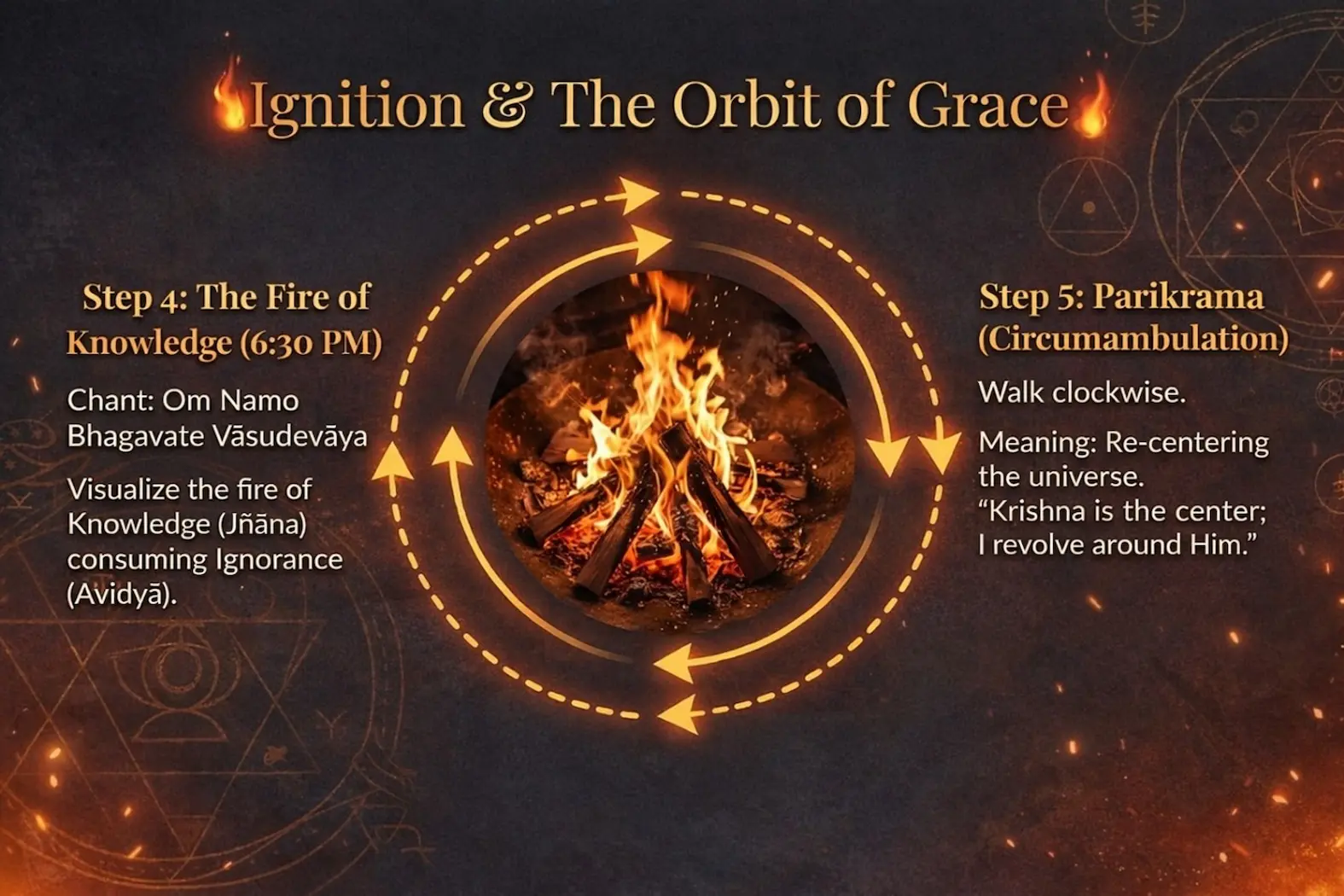
Step 4: Lighting the Fire, Holika Dahan
The Flame of Knowledge
Light the fire during the aligned muhurat. For Dallas timing, many will honor 6:30 PM on Holika Dahan March 2, 2026 as the key ignition point.
As you ignite the wood, chant a mantra such as:
Om Namo Bhagavate Vāsudevāya
or
Om Narsimhāya Namah
The goal is not perfect pronunciation. The goal is devotional focus.
Now offer the coconut and grains into the flames with feeling. As you offer the coconut, visualize ego cracking. As you offer grains, visualize the fruits of your labor returning to God.
Swami Mukundanandaji teaches that fire represents jñāna, divine knowledge. Just as light removes darkness effortlessly, the fire of knowledge removes avidyā, ignorance. As the wood turns to ash, visualize your Hiranyakashipu-like arrogance being reduced to nothing.
Swamiji also explains there are two fires in life.
The fire of desire burns us with comparison, dissatisfaction, and restlessness.
The fire of devotion burns impurities and leaves peace behind.
As you feel heat on your face, silently choose:
“Let me live by the fire of devotion.”
Step 5: Parikrama, Circumambulation
Re-centering Your Universe
Walk clockwise around the fire three, five, or seven times. Keep awareness gentle and inward. Parikrama is not a formality. It is the physical enactment of a life principle: Krishna is the center, and I revolve around Him.
Swami Mukundanandaji teaches mind management through re-centering. Most people revolve around problems, image, anxiety, resentment. Parikrama flips the orbit. It teaches the mind: God is central. Everything else becomes secondary.
If you practice roop-dhyan, this becomes a moving meditation. As you walk, visualize Prahlad safe in the fire, protected because consciousness is absorbed in the Lord. Parikrama becomes embodied surrender.
Step 6: Vibhuti, The Ash of Humility
After the fire settles, or the next morning, take a small amount of ash and apply it to the forehead.
Ash is not depressing. It is liberating. It is the final statement of the ritual: everything material becomes ash, but devotion does not burn. It remains.
Swami Mukundanandaji emphasizes that humility is not self-hatred. Humility is right-sizing the ego. When you touch the ash, remind yourself:
“I am not the body. I am not the doer. I am a servant of the Divine.”
This is why Holika Dahan must come before the colors of Holi. The joy of Holi becomes sweeter when the heart has been cleaned first.
The Regional Tapestry: One Flame, Infinite Perspectives
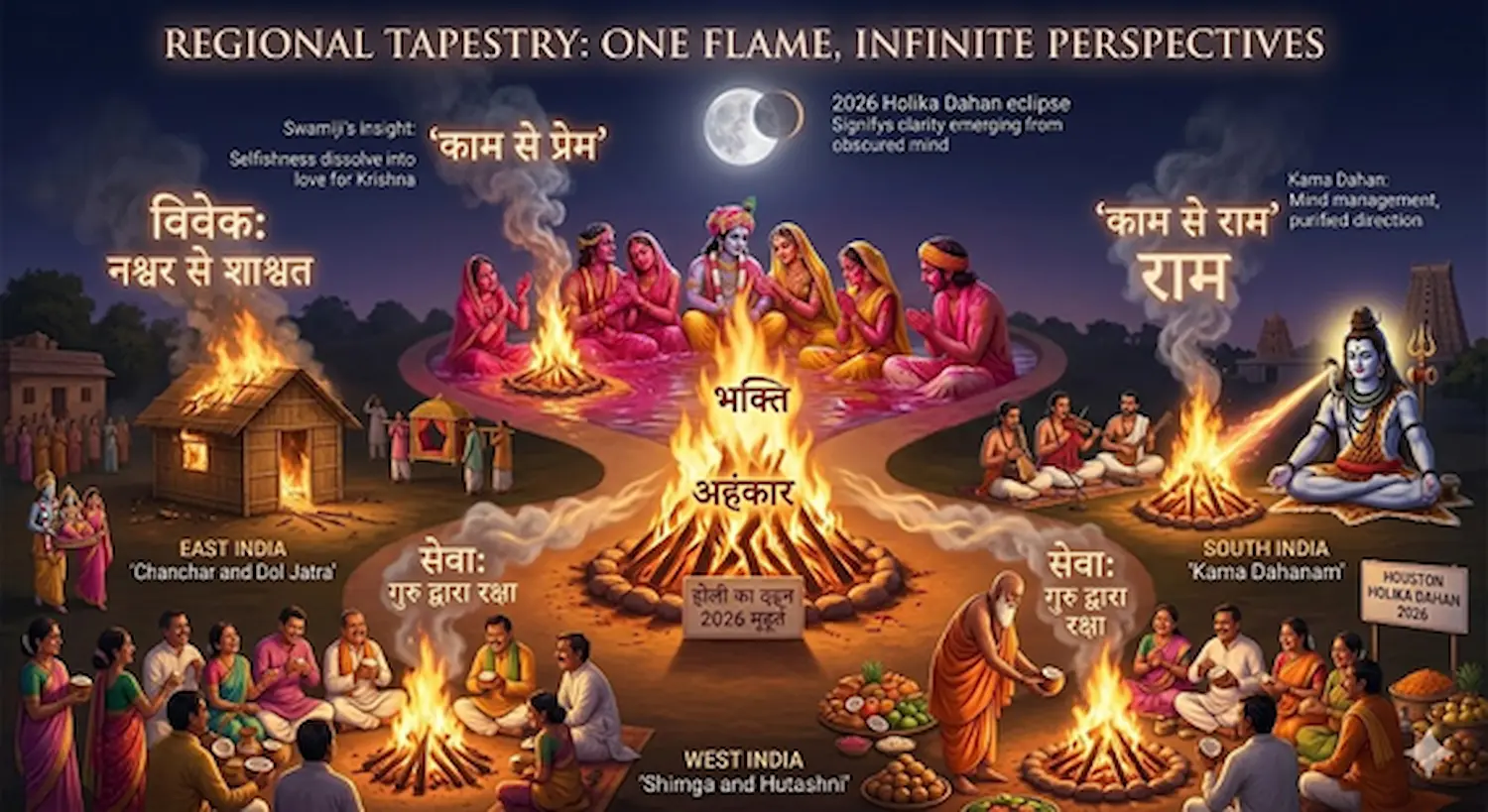
As Swami Mukundanandaji teaches, “The Truth is one, but it expresses itself in infinite ways.” In the spiritual landscape of Sanātan Dharma, Holika Dahan becomes unity in diversity, where different regions view the same flame through unique cultural lenses.
As we reflect on the Holika Dahan 2026 date and prepare for the Holika Dahan 2026 muhurat, it becomes clear that this is not a ritual bound to geography. Wherever one participates, the inner purpose remains identical: ego must burn so devotion can rise.
1. North India: The Braj Tradition
The Invitation to Love
In the devotional culture of Mathura and Vrindavan, Holika Dahan carries an intimate tone. The atmosphere is soaked in bhāv. Here, the ritual feels less like the destruction of a demon and more like the ignition of longing, viraha.
Swamiji’s insight brings the essence into focus: in Braj consciousness, the fire represents the transition from kāma, selfish desire, to prema, selfless love. The gopis did not desire liberation or mystic powers. They desired only to please Krishna. The burning wood becomes a metaphor for the burning heart, where selfishness is consumed and love remains.
For those reflecting on Chhoti Holi 2026, this mood offers a profound meditation: let the night of fire be the night when self-interest dissolves quietly.
2. South India: Kama Dahanam
The Purification of Desire
In regions such as Tamil Nadu and Karnataka, Holika Dahan aligns with the story of Lord Shiva burning Kamadeva, the god of desire, through the third eye of discernment. The emphasis shifts from emotional longing to disciplined transcendence.
Swamiji explains this as mind management: the mind cannot be silenced by force. Lower thoughts must be displaced by higher absorption. Kama Dahanam is not about destroying love. It is about purifying direction. Desire that pulls outward becomes devotion that pulls upward. Kāma transforms into Rāma.
In the context of the Holika Dahan eclipse 2026, this lens becomes even stronger. The eclipse symbolizes shadowing of the mind. The fire symbolizes awakening of clarity. When desire is purified, the mind regains steadiness even when outer conditions feel obscured.
3. West India: Shimga and Hutashni
The Community Cleaning
In Maharashtra and Gujarat, Holika Dahan often carries a communal tone. People gather not only to witness the fire but to participate together. Offerings are shared, songs are sung, and in some places a coconut is placed within the pyre and symbolically retrieved.
Swamiji’s insight highlights seva. Bhakti is not meant to remain private. It expands. The coconut retrieval becomes a metaphor for the Guru rescuing the soul from samsāra, material entanglement.
For those preparing for Holika Dahan Dallas 2026, this dimension is especially meaningful. Even outside the Indian subcontinent, the gathering itself becomes sacred. The bonfire becomes a shared center around which hearts align.
4. East India: Chanchar and Dol Jatra
The Lesson in Detachment
In Bengal and Odisha, small huts made of bamboo and straw are constructed and burned the night before Holi. The ritual appears simple, but its symbolism is profound.
Swamiji teaches viveka, discernment between the temporary and the eternal. The hut represents the body, fragile and temporary. We often treat the body and material world as permanent. Burning the hut reminds us that everything material is transitory, but the soul’s relationship with God is eternal.
Thus Holika Dahan becomes not only purification, but philosophical awakening.
Call To Action
Celebrate Holika Dahan 2026 with the community at the Radha Krishna Temple of Dallas. Join your fellow devotees as we ignite the sacred fire at exactly 6:30 PM on Monday, March 2nd. Come experience the power of community kirtan, witness the Puja Vidhi led by our priests, and prepare your heart for the joy of Holi.

%20(1).webp)
 JKYog Team
 JKYog Team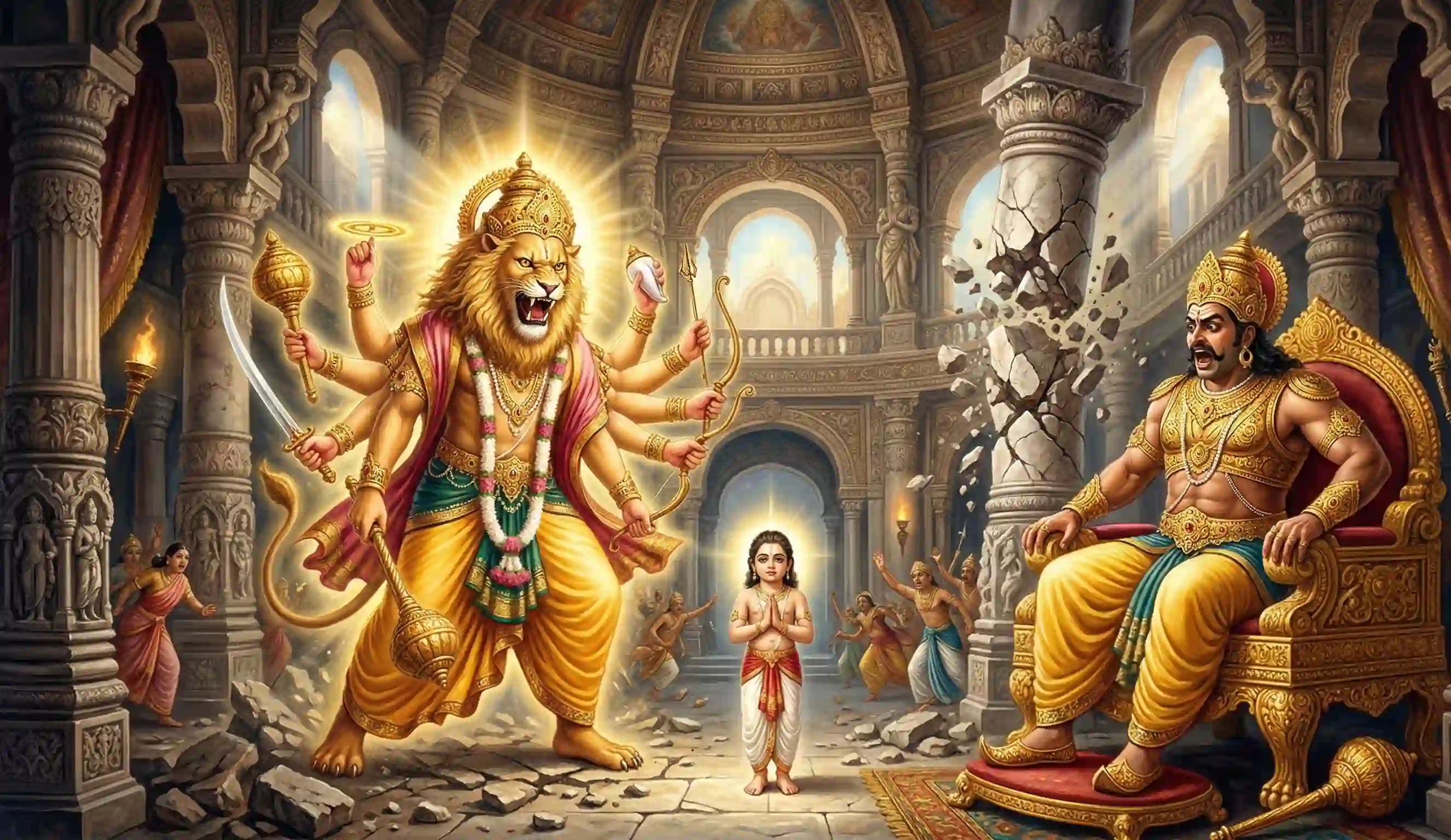
The 2026 Celestial Paradox: Opportunity in the Shadow
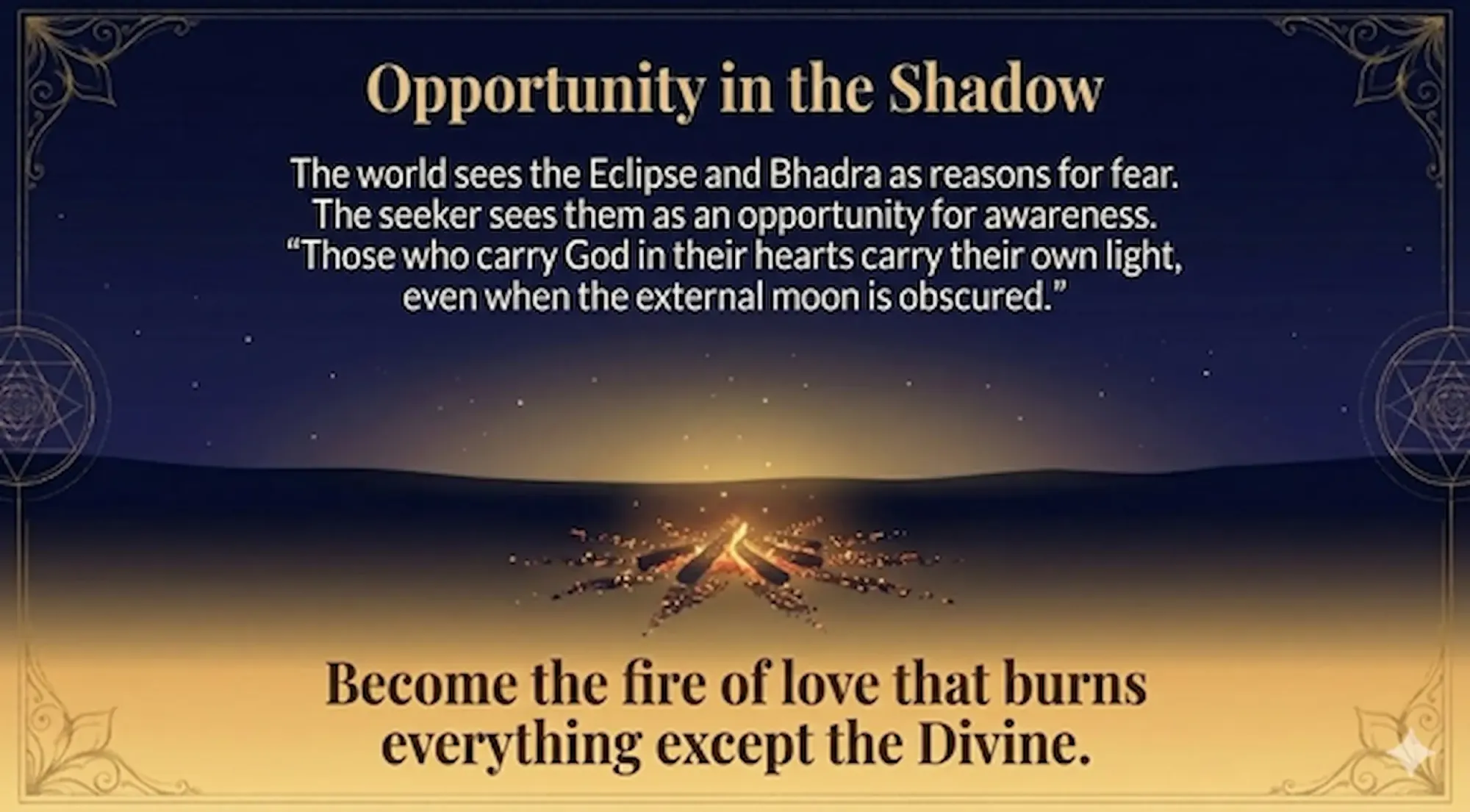
To conclude, let us look at the celestial paradox of March 2026. While the world may see eclipse and Bhadra as reasons for fear, a student of Swamiji sees them as opportunities for awareness.
The Fire of Discernment, Viveka-Agni
Holika relied on a material shawl for protection. Prahlad relied on spiritual grace. This contrast becomes the central meditation of Holika Dahan 2026.
Use the fire to burn your shawl of false security, the belief that money, reputation, health, or status are ultimate protectors. The true shelter is divine grace. The fire becomes viveka-agni, separating illusion from truth.
The Eclipse Strategy
The moon is associated with the mind. During an eclipse, the moon appears shadowed, and symbolically the mind can feel heavy, uncertain, restless.
Swami Mukundanandaji teaches that great progress is often made when the wind is against us. The aligned timing, such as Holika Dahan March 2 2026 at the Dallas window, becomes a declaration of faith: those who carry God in their hearts carry their own light, even when the external moon is obscured.
The eclipse does not diminish devotion. It tests it.
The Fire of Repentance
Holika Dahan is also the night of forgiveness. Swamiji often says holding a grudge is like drinking poison and expecting someone else to suffer.
As the flames rise, mentally cast resentments into the fire. Let old anger burn. Let bitterness dissolve. Begin the new season with a heart as light as the ash left behind.
A Closing Reflection
As the wood turns to ash and the sky prepares for the Total Lunar Eclipse of March 3, 2026, may your heart remain like Prahlad’s: cool, calm, and absorbed in the Name of God.
The ash placed upon the forehead the next morning is not a symbol of loss. It is the signature of freedom. Ego has burned. Attachment has softened. Fear has loosened its grip.
This year, do not merely watch the fire. Become the fire.
Become the fire of discernment that burns illusion.
Become the fire of repentance that burns resentment.
Become the fire of love that burns everything except the Divine.
Ego burns. Bhakti remains.
Frequently Asked Questions
1. When is Holika Dahan 2026?
Holika Dahan 2026 will be observed on Monday, March 2, 2026, after sunset during the Full Moon (Purnima) of Phalguna.
2. What is the Holika Dahan 2026 muhurat in Dallas?
For the Dallas area, the most auspicious time is 6:30 PM on March 2, 2026, during Pradosh Kaal.
3. How does the lunar eclipse affect Holika Dahan 2026?
A Total Lunar Eclipse occurs on March 3, 2026. Therefore, Holika Dahan should be performed before eclipse restrictions (sutak) begin.
4. What is the meaning of Chhoti Holi 2026?
Chhoti Holi 2026 refers to Holika Dahan, the night of purification before the festival of colors. It symbolizes burning ego, negativity, and past karma.
5. Can I celebrate Holika Dahan at home?
Yes. You may perform a simple version at home with a small safe fire or lamp, sincere prayer, and symbolic offerings, focusing on inner purification.