Understanding the Historical Background of the Bhagavad Gita
The Mahabharat, one of the grandest epics of ancient India, stands as a timeless record of human emotions, conflicts, duty, and righteousness. At its heart lies the profound Bhagavad Gita, a divine dialogue between Lord Krishna and the warrior prince Arjun, revealing timeless spiritual truths. But why did the Mahabharat War — the Kurukshetra War — occur in the first place? And how did this monumental event set the stage for the message of the Bhagavad Gita?
In this blog, we will delve into the historical background of the Mahabharat War, explore the causes that led to this fratricidal battle, and uncover how these events culminated in the profound teachings of the Bhagavad Gita.
The Setting of the Mahabharat: A Prelude to Conflict
The Mahabharat was not merely a story of kingdoms; it was a battle of dharma (righteousness) against adharma (unrighteousness). The seeds of the war were sown over generations of rivalry, ambition, jealousy, and injustice among the royal families of Hastinapur — chiefly between the Pandavas and the Kauravas.
The Pandavas — Yudhishthir, Bhim, Arjun, Nakul, and Sahadev — were the five virtuous brothers, sons of King Pandu. The Kauravas — a hundred brothers led by Duryodhan — were the sons of King Dhritarashtra, Pandu’s blind elder brother. Despite familial ties, the relationship between the two factions grew increasingly hostile due to succession disputes, deceit, and humiliation.
The Main Causes Behind the Mahabharat War
The Mahabharat war was not triggered overnight. It was the result of deep-seated jealousy, hatred, and a series of betrayals.
1. Struggle for the Throne of Hastinapur

The right to the throne was the primary cause of the conflict. After King Pandu renounced the throne and retired to the forest, his elder brother Dhritarashtra, although blind, assumed kingship. However, the rightful heir was Yudhishthir, the eldest Pandava, as he was Pandu's son.
When the time came, Dhritarashtra, influenced by his son Duryodhan, denied Yudhishthir his rightful claim. Duryodhan harbored a deep jealousy toward the Pandavas, fearing their superiority and virtue.
2. The Burning of the Lakshagraha

After the Pandavas' rising fame and popularity in Hastinapur, Duryodhan grew fearful of losing his claim to the throne. With Shakuni’s advice, he hatched a plot to kill the Pandavas secretly.
A grand palace made of lac — a highly flammable material — was built for them in Varnavat. The plan was to burn them alive during the night. As described in the Mahabharat, Adi Parva, Sections CXLIV–CXLV, the minister Purochan was assigned to execute the plot.
However, with Vidur’s secret warning, the Pandavas dug an underground tunnel and escaped. They set fire to the palace themselves, making it appear they had perished.
"Those heroic Pandavas and Kunti secretly escaping from the town of Varanavata took with them their cook and expert in mining, and also their priest."
— Mahabharat, Adi Parva, Section CXLV
This incident marked the beginning of open hostility between the Kauravas and Pandavas.
3. Duryodhan’s Jealousy at the Rajasuya Yagya

Even after surviving assassination, the Pandavas flourished. Yudhishthir performed the Rajasuya Yagya, establishing his imperial authority. Duryodhan, attending the event, was deeply humiliated when he slipped into a pool of water in the magical palace built by Maya.
Bhima, Arjun, Krishna, and others laughed aloud at the sight:
"Beholding the illustrious Duryodhana so fallen into the water, Bhima laughed aloud..."
— Mahabharat, Sabha Parva, Section XLVIII
The humiliation stung Duryodhan deeply. He complained bitterly to his father Dhritarashtra:
"I am being consumed by envy like a flame fed by clarified butter."
— Mahabharat, Sabha Parva, Section L
His wounded pride and jealousy pushed him towards the infamous dice game and ultimately to the war at Kurukshetra.
4. The Game of Dice

Perhaps one of the most infamous incidents that exacerbated tensions was the deceitful game of dice. Duryodhan, with his cunning uncle Shakuni, invited Yudhishthir to a rigged gambling match. In his sense of honor and adherence to dharma, Yudhishthir could not refuse.
In the course of the game, Yudhishthir lost his kingdom, his brothers, himself, and even their wife Draupadi. Draupadi’s humiliation in the court, where Dushasan attempted to disrobe her, was a deep moral outrage that demanded redress.
(Reference: "Bhagavad Gita: 2.31") — Krishna reminds Arjun of the duty of a warrior to fight for righteousness, stemming from such grievous acts of adharma.
5. Unyielding Pride and Refusal of Peace
Years after the exile, when the Pandavas returned, they sought a peaceful settlement. Lord Krishna himself went as a messenger of peace to the Kaurava court. He offered a compromise: instead of restoring their full kingdom, grant them just five villages.
However, Duryodhan arrogantly refused, famously declaring he would not give them even land equal to the tip of a needle.
(Reference: "Bhagavad Gita: 2.33") — Krishna elucidates how refusing to uphold one’s righteous duty results in dishonor and downfall, a fate chosen by the Kauravas.
The Immediate Build-Up to the War
The Call to Arms
With no alternative left, the Pandavas assembled an army. Warriors and kings across Bharatvarsha (ancient India) took sides, aligning either with the Pandavas or Kauravas based on loyalty, righteousness, or political strategy.
Among the prominent warriors were Bhishma, Dronacharya, Karna, and Kripacharya with the Kauravas, while Lord Krishna, although personally neutral, pledged his divine counsel to Arjun and sent his army (Narayani Sena) to Duryodhan.
(Reference: "Bhagavad Gita: 1.1") — The first verse itself sets the scene where King Dhritarashtra inquires about the battlefield events at Kurukshetra.
Why Was the War Unavoidable?
Despite numerous attempts at reconciliation, the Mahabharat War became inevitable because:
- The Kauravas, led by Duryodhan, embodied adharma — driven by greed, envy, and ego.
- The Pandavas were bound by dharma to reclaim justice not just for themselves but for the people suffering under Duryodhan's oppressive rule.
- The cosmic plan orchestrated by the Divine intended to establish dharma through this decisive war, purging the earth of corrupt rulers.
(Reference: "Bhagavad Gita: 4.7–4.8" and "4.8") — Krishna reveals his divine purpose: to protect the righteous, destroy the wicked, and reestablish dharma.
The Historical Context of the Bhagavad Gita
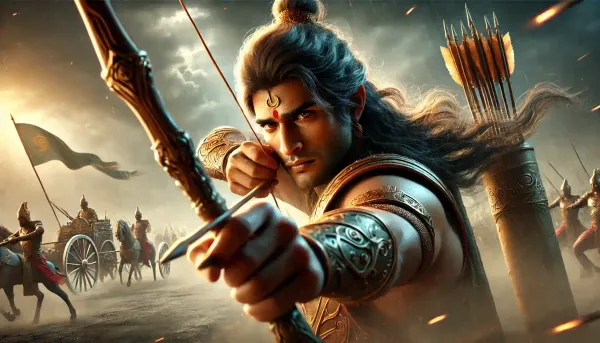
The Bhagavad Gita emerges at the very onset of the battle. As armies stand poised for conflict, Arjun, the Pandava prince and a supreme archer, undergoes a profound moral and emotional crisis.
Arjun’s Dilemma

Seeing his kinsmen — revered elders like Bhishma and teachers like Dronacharya — arrayed against him, Arjun is overwhelmed by compassion, sorrow, and fear. He questions the very purpose of the war and contemplates abandoning the battlefield.
(Reference: "Bhagavad Gita: 1.28-30") — Arjun’s heartache and trembling reflect the human side of moral dilemmas.
Arjun lays down his Gandiva bow, refusing to fight.
Lord Krishna’s Divine Counsel: The Essence of the Bhagavad Gita
Recognizing Arjun’s internal conflict, Lord Krishna imparts spiritual wisdom that transcends the battlefield. The Gita addresses fundamental themes:
- The Nature of the Soul: The soul is eternal and cannot be destroyed by weapons, fire, water, or wind ("Bhagavad Gita: 2.23").
- Duty and Righteous Action: One must act according to one's dharma without attachment to results ("Bhagavad Gita: 2.47").
- Selfless Devotion: Surrendering to God with faith ensures liberation ("Bhagavad Gita: 9.22").
- The Vision of the Universal Form: Krishna reveals his cosmic form to Arjun, demonstrating the vastness and inevitability of divine will ("Bhagavad Gita: 11.10-11.11").
Ultimately, Krishna instructs Arjun to rise and fulfill his duty as a warrior without succumbing to sorrow or hesitation.
(Reference: "Bhagavad Gita: 18.66") — Krishna’s final teaching: surrender completely to Him, transcending all varieties of dharma.
Lessons from the Mahabharat War and the Bhagavad Gita
1. Righteousness Over Blood Ties
Despite the emotional difficulty, dharma had to be upheld. Standing against injustice sometimes means standing against one’s own family.
2. Duty Above Personal Emotion
Arjun’s initial reluctance is symbolic of every individual’s internal struggles. Krishna’s counsel emphasizes that performing one's righteous duty selflessly leads to spiritual evolution.
3. The Transient Nature of the World
The Mahabharat War also serves as a reminder that material attachments — even to family, possessions, or the body — are temporary. True focus must be on the eternal soul.
4. Divine Providence at Work
Often, situations that appear tragic or chaotic are part of a greater divine plan. Krishna orchestrated the war not out of cruelty but to reestablish righteousness.
Conclusion
The Mahabharat War was not a mere political struggle for land or power — it was a cosmic event engineered for the restoration of dharma. It serves as a vivid backdrop to the profound teachings of the Bhagavad Gita, offering timeless guidance for humanity.
Through Krishna's divine counsel, we understand that the battles of life, though painful, are opportunities for spiritual awakening. By aligning with righteousness, acting selflessly, and surrendering to the Divine, we fulfill our highest purpose.
As Krishna declares:
"Wherever there is Krishna, the Lord of Yog, and Arjun, the supreme archer, there will certainly be opulence, victory, prosperity, and sound morality."
(Reference: "Bhagavad Gita: 18.78")
The Mahabharat may be an ancient story, but its truths continue to illuminate our paths even today.
Sources and References:
Complete Bhagavad Gita verses and explanations
FAQs on Reasons for Mahabharat War
1. What role did Lord Krishna play in the Mahabharat War?
Lord Krishna played a crucial role by guiding Arjun through his moral crisis, offering divine counsel in the Bhagavad Gita, and serving as a strategist for the Pandavas, although he remained personally neutral in the conflict.
2. What lessons from the Mahabharat War are still relevant today?
The Mahabharat War teaches lessons about standing for righteousness, the importance of fulfilling one's duty without attachment to outcomes, and the need for spiritual wisdom to navigate life’s moral dilemmas, all of which remain relevant in today's world.
3. Is it bad to keep the Mahabharat book at home?
No, it is not bad to keep the Mahabharat at home. In fact, it is a revered text in Hindu tradition, filled with profound teachings on righteousness (dharma), duty, morality, and the nature of life. It is important, however, to treat the Mahabharat with respect. Keep it in a clean, respectful place, and approach it with a mindset of learning and reflection. Many people keep the Mahabharat at home for spiritual guidance and educational purposes, making it a valuable source of wisdom.
- Why did Bhishma fight on the side of the Kauravas in the Mahabharata war?
Bhishma did not fight for the Kauravas out of personal support for their actions, especially Duryodhana's. He fought on their side because of his vow of loyalty to the throne of Hastinapur. As the grand-uncle of both the Kauravas and Pandavas, Bhishma had sworn to serve whoever sat on the throne of Hastinapur, regardless of personal judgment. Since Duryodhana was the ruling prince at the time of the war, Bhishma was duty-bound to lead the Kaurava army.
However, Bhishma’s heart was with dharma. He gave the Pandavas moral support in many ways, even offering Yudhishthira advice on how to defeat him in battle. His role is a complex one, reflecting the deep conflict between personal dharma (truth and conscience) and svadharma (duty to one's role in society).