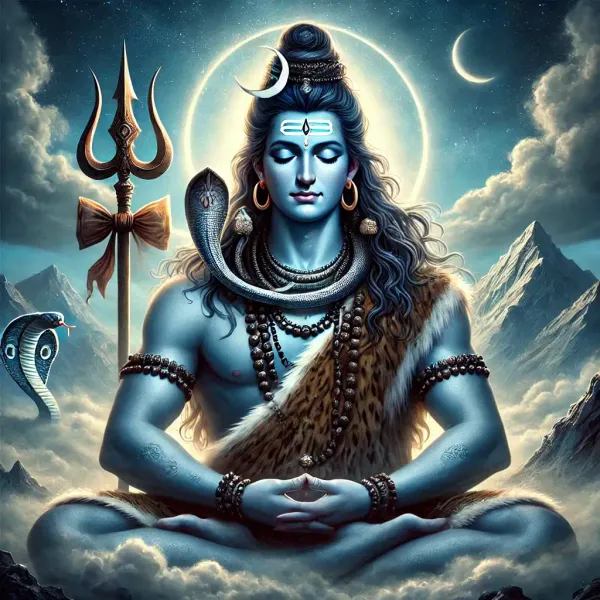
Maha Shivratri is not merely a night of fasting or ritual observance; it is a sacred pause in the spiritual calendar that invites reflection on one of the deepest truths of Sanātana Dharma, the power of union. Celebrated in the stillness of night, Shivratri symbolizes a moment when the noise of the outer world recedes, and the seeker is gently guided inward. It is a night dedicated to Lord Shiva, the embodiment of pure consciousness, whose presence calls the mind toward silence, discipline, and higher awareness.
At its heart, Maha Shivratri points to harmony, between stillness and movement, renunciation and responsibility, silence and devotion. It reminds us that spiritual life is not about rejecting the world, but about aligning inner consciousness with higher purpose. This sacred night prepares the ground for understanding a profound divine event: the union of Shiva and Parvati, a union that is not merely mythological, but deeply symbolic of inner balance and spiritual completeness.
The Bhagavad Gita repeatedly emphasizes this principle of inner alignment, where discipline steadies the mind and devotion lifts the soul toward the Divine. Maha Shivratri, observed in awareness and restraint, becomes a living expression of this teaching, opening the path to explore the deeper meaning of divine union that this festival represents.
The Sacred Story of the Divine Marriage
Lord Shiva dwelt on Mount Kailasa as the supreme ascetic, absorbed in meditation, indifferent to comfort or acclaim, untouched by the world’s pull. He was complete in himself, established in pure consciousness, free from desire and dependency. To many, Shiva appeared remote and unapproachable, a yogi whose silence spoke of transcendence rather than relationship.
Parvati, the daughter of the mountain king Himavan, saw Shiva differently. She perceived not his outer austerity, but his inner truth. To her, Shiva was not a renunciate who had withdrawn from life, but the highest reality itself, unchanging, eternal, and worthy of total surrender. With quiet resolve, she chose him as her divine goal and undertook intense tapasya to purify her love and align herself with his consciousness.
Her penance was not impulsive devotion, but disciplined surrender. She endured hardship, relinquished comfort, and remained unwavering through time and trial. Parvati’s tapasya was an inner refinement, a devotion strengthened by patience and guided by clarity.
Observing her steadfastness, Shiva did not immediately reveal himself. Instead, he tested the depth of her resolve. He sent his nine Yogeshwars to Parvati, instructing them to dissuade her. They questioned her choice, pointing to Shiva’s ascetic appearance, his unconventional ways, and his seeming indifference to world. They urged her to consider a more suitable, socially admired partner.
Parvati listened calmly, unmoved. With quiet dignity, she replied that she did not seek outer form, status, or comfort. Her devotion was anchored in truth, not appearance. Shiva, she declared, was her chosen Lord, not because he possessed worldly attributes, but because he embodied the highest reality. No persuasion, argument, or warning could alter her inner certainty.
This unwavering response revealed the maturity of her devotion. It was not emotional attachment, but conscious surrender. Through this test, Parvati demonstrated that her love was grounded in discernment, strengthened by discipline, and purified of ego.
Recognizing this depth, Shiva accepted her, not as a concession, but as a recognition of perfect alignment. The ascetic acknowledged devotion as his equal. Their marriage was then celebrated as a cosmic event: the union of stillness and energy, consciousness and creation, renunciation and engagement. The devas rejoiced, for balance was restored—not only in the universe, but in the spiritual ideal itself.
Thus, the divine marriage of Shiva and Parvati solemnized on the fourteenth day of Krishna Paksha in the Hindu calendar of phalgun month (February/ March) stands not merely as a sacred narrative, but as a timeless truth: when devotion is unwavering and disciplined, even the highest consciousness responds. This is the deeper spirit that Maha Shivratri invites us to contemplate.

Symbolism of the Divine Marriage (With Scriptural Anchors)
Shiva — Pure Consciousness and Inner Mastery
Shiva represents pure consciousness—silent, detached, and established in self-mastery. As the supreme ascetic, he symbolizes the higher self that has transcended inner conflict and rests in awareness. His stillness reflects the state where the mind is no longer an obstacle, but an ally on the spiritual path.
Bhagavad Gita 6.5
उद्धरेदात्मनाऽत्मानं नात्मानमवसादयेत् ।
आत्मैव ह्यात्मनो बन्धुरात्मैव रिपुरात्मनः ॥
Elevate yourself through the power of your mind, and not degrade yourself, for the mind can be the friend or the enemy of the self.
Parvati — Disciplined Devotion and Steadfast Resolve
Parvati embodies devotion refined through tapasya. Her love is not emotional attachment, but unwavering surrender supported by clarity and patience. When Shiva’s attendants attempt to dissuade her, she remains unmoved, demonstrating a mind firmly aligned with truth rather than external opinion.
Bhagavad Gita 6.6
बन्धुरात्मात्मनस्तस्य येनात्मैवात्मना जितः ।
अनात्मनस्तु शत्रुत्वे वर्तेतात्मैव शत्रुवत् ॥
For those who have conquered the mind, the mind is the best of friends; for those who have failed to do so, the mind remains the greatest enemy.
The Marriage — Union of Practice and Detachment
When Shiva finally accepts Parvati, it signifies not a compromise of renunciation, but its fulfillment. This marriage represents the union of stillness and effort, awareness and devotion. Consciousness embraces disciplined love, completing the spiritual ideal.
Bhagavad Gita 6.35
असंशयं महाबाहो मनो दुर्निग्रहं चलम् ।
अभ्यासेन तु कौन्तेय वैराग्येण च गृह्यते ॥
The mind is restless and difficult to control, but by practice and detachment it can be mastered.
The Divine Union—Surrender and Devotion
Shiva represents detachment (vairāgya), Parvati represents practice (abhyasa) and their divine marriage is a living expression of this eternal teaching. This restless mind can only be controlled by detachment and practice of austerities.

Swami Mukundananda Ji’s Core Teachings on Maha Shivratri
- Shivratri as Inner Awakening – Maha Shivratri is a night of conscious vigilance, where staying awake symbolizes rising above inertia and cultivating awareness of the mind.
- Shiva as the Ideal Yogi – Lord Shiva represents mastery over the mind and senses, reminding seekers that detachment is inner freedom, not withdrawal from life.
- Tapasya Strengthens Bhakti – Goddess Parvati’s penance shows that devotion matures through patience, restraint, and perseverance.
- Divine Marriage as Balance – The union of Shiva and Parvati symbolizes harmony between vairāgya (detachment) and bhakti (loving devotion).
- Fasting and Abhishek as Tools – These observances help weaken sensory pull and offer the purified mind at the feet of the Divine.
- Shivratri as Spiritual Checkpoint – The festival invites seekers to reflect on inner progress, discipline, and devotion.
Swami Mukundananda explains that Maha Shivratri is not merely a ritual observance but a powerful opportunity for inner awakening and mind mastery. Lord Shiva, the supreme yogi, represents complete control over the mind and senses, an ideal the seeker is called to emulate. True devotion, he emphasizes, must be supported by discipline, tapasya, and restraint, just as Parvati’s unwavering penance purified her love and aligned it with divine consciousness. The divine marriage of Shiva and Parvati thus symbolizes the perfect union of detachment and devotion, reminding seekers that when bhakti is steady and supported by self-discipline, divine grace naturally descends.

Practices and Observances
On Maha Shivratri, devotees express this inner spirit through simple yet meaningful observances. The night-long vigil symbolizes alertness of consciousness, a resolve to remain awake to higher truth rather than slipping into mental inertia. Fasting reflects voluntary restraint, helping loosen the grip of the senses and quiet the mind. Abhishek becomes an act of inner cleansing, an offering of ego, restlessness, and impurities at the feet of the Divine. Chanting and silent prayer steady the wandering mind, while moments of stillness echo Shiva’s own state of absorption. When performed with understanding, these observances are not rituals alone, but gentle disciplines that guide the seeker toward inner clarity, devotion, and balance.
A Quiet Reflection for Our Times
In a time when relationships are often shaped by outward appearances, achievements, and material comfort, the divine marriage of Shiva and Parvati offers a gentle pause for reflection. Parvati was not drawn to what was visible or conventional, but to the deeper truth Shiva embodied. Her devotion looked beyond form, while Shiva’s acceptance recognized inner steadiness rather than external perfection. Seen this way, their union quietly reminds us that lasting harmony grows from patience, understanding, and shared inner values. Without rejecting the world, it invites us to look a little deeper, beyond what is seen, to what truly sustains love and commitment.
Conclusion
Maha Shivratri gently draws us toward stillness, reflection, and inner balance. The divine marriage of Shiva and Parvati reminds us that true union, whether cosmic or personal, arises when devotion is steady and the mind is disciplined. Beyond rituals and narratives, Shivratri becomes an invitation to look inward, to quiet the restless mind, and to nurture values that endure beyond appearances. When observed with awareness and sincerity, this sacred night allows us to reconnect with what is timeless within us, where faith deepens, understanding matures, and divine grace is quietly felt.
Key Takeaways
- Maha Shivratri celebrates inner union, the harmony of stillness and devotion, discipline and love.
- The divine marriage of Shiva and Parvati symbolizes balance, where pure consciousness embraces devoted effort.
- Parvati’s tapasya shows that true devotion matures through patience, clarity, and perseverance.
- Shiva represents mastery over the mind, reminding seekers that inner discipline is essential for spiritual growth.
- Shivratri observances gain meaning when practiced with understanding and awareness.
- Lasting harmony arises when we look beyond appearances to inner values and purpose.
Frequently Asked Questions (FAQs)
1. Why is Maha Shivratri associated with the marriage of Shiva and Parvati?
Maha Shivratri commemorates the divine union of Lord Shiva and Goddess Parvati, symbolizing the harmony of consciousness and devotion. This sacred marriage represents inner balance, where discipline, surrender, and grace come together on the spiritual path.
2. What is the deeper spiritual meaning of Shiva and Parvati’s marriage?
The marriage of Shiva and Parvati is a symbolic union of stillness and energy, renunciation and engagement. It teaches that true spiritual fulfillment arises when disciplined effort is guided by loving devotion.
3. How does Parvati’s tapasya inspire devotees today?
Parvati’s penance reflects unwavering devotion supported by patience and self-discipline. Her example reminds seekers that sincere effort, clarity of purpose, and inner strength prepare the heart to receive divine grac
4. How does the Bhagavad Gita connect with Maha Shivratri?
The Bhagavad Gita emphasizes mastery of the mind through discipline, practice, and detachment. These teachings align closely with the symbolism of Maha Shivratri, where inner awareness and devotion are central to spiritual growth.
5. What is the significance of fasting and night vigil on Maha Shivratri?
Fasting and night vigil are symbolic practices that encourage self-restraint and mental alertness. When observed with understanding, they help quiet the mind, reduce distractions, and deepen one’s connection with the Divine.
6. What message does Maha Shivratri offer for modern life?
Maha Shivratri gently reminds us to look beyond external appearances and cultivate inner values. The divine marriage of Shiva and Parvati encourages balance, patience, and shared purpose—qualities that remain relevant in all times.
Call to Action

As devotees offer their prayers at the sacred Shivlinga, through abhishek, lamps, flowers, and heartfelt devotion, we are reminded that Maha Shivratri is best experienced in collective worship and remembrance of Lord Shiva. This sacred night becomes even more meaningful when celebrated together as a community, immersed in prayer, chanting, and inner reflection.
Devotees are warmly invited to participate in the Maha Shivratri celebrations at the Radha Krishna Temple, Allen, featuring a special 12 Jyotirlingas Pooja. This rare and sacred observance offers an opportunity to worship all twelve Jyotirling manifestations of Lord Shiva under one roof, accompanied by powerful Vedic chants and a deeply devotional atmosphere.
Dates: February 15–16, 2026
Venue: Radha Krishna Temple, Allen
🔗 https://RadhakrishnaTemple.net/mahashivratri
References & Citations
- Bhagavad Gita:
- Useful for the symbolic explanation of the marriage as a Divine union:
- BG 6.5 — Holy-Bhagavad-Gita.org
https://www.holy-bhagavad-gita.org/chapter/6/verse/5/ - BG 6.6 — Holy-Bhagavad-Gita.org
https://www.holy-bhagavad-gita.org/chapter/6/verse/6/ - BG 6.35 — Holy-Bhagavad-Gita.org
https://www.holy-bhagavad-gita.org/chapter/6/verse/35/ - Swami Mukundananda — Discourses and satsangs on Maha Shivratri.
- When Mahadev Tested Parvati Maa (Shivratri Special) — https://www.youtube.com/watch?v=84DAaG8VUXg
- Story of Mahashivratri — Divine Leelas of Lord Shiva — https://www.youtube.com/watch?v=nidOODfZM8A
https://www.youtube.com/@swamimukundananda - Temple Reference — Radha Krishna Temple, Allen (JKYog)
https://RadhakrishnaTemple.net/mahashivratri