Introduction: The Eternal Knot of Love and Responsibility
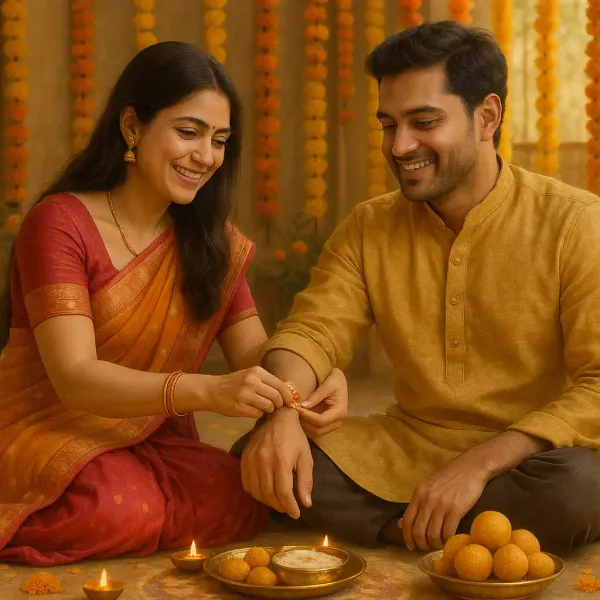
In the grand tapestry of Hindu festivals, Raksha Bandhan also known as Rakhi stands as a radiant thread—woven with love, trust, protection, and duty. While it’s widely celebrated as a day where sisters tie a rakhi around their brothers’ wrists in return for promises of safety and care, the essence of Raksha Bandhan transcends familial boundaries.
Beyond gifts and rituals, Raksha Bandhan is a celebration of sacred vows—between siblings, between the divine and the devotee, and between individuals and society. Its roots are deeply embedded in the scriptures like the Mahabharat, Vishnu Purana, and the spiritual ethos of Sanatana Dharma, where protection (raksha) is not merely physical—it is emotional, moral, and spiritual.
This blog dives deep into the broader spiritual and historical dimensions of Raksha Bandhan. You’ll discover stories of warriors and saints, goddesses and kings, and how the simple act of tying a thread symbolizes universal values that are needed now more than ever.
The Origins of Raksha Bandhan: More Than a Sibling Festival
Many scholars trace Raksha Bandhan’s roots back thousands of years. The concept of tying a protective thread (raksha sutra) appears in Vedic rituals, where priests would tie sacred threads on the wrists of warriors before battle. It wasn’t limited to siblings—it was an invocation of divine protection, offered with the power of mantras.

According to the Bhavishya Purana, on the day of Shravan Purnima, Brahmins would conduct yajnas for the welfare of society, tying raksha threads on their patrons' wrists as symbols of divine blessings.
Thus, Raksha Bandhan began not as a gendered ritual, but as a universal act of love and spiritual commitment.
Raksha Bandhan Across Different Relationships
Protection in the Spirit of Dharma
In the Mahabharat, the relationship between Yudhishthir and his subjects is one of mutual dharma. Though not a Raksha Bandhan story in form, the principle holds: the king vows to protect his people, and in return, they uphold loyalty and righteousness.
This expands the idea of Raksha Bandhan to society itself. It’s not just about one-on-one bonds—it’s about the collective responsibility to protect truth, virtue, and the vulnerable.
Sage Suta and the Raksha Sutra in Yajnas
The Vedic tradition speaks of raksha sutras being tied by rishis during yajnas for the spiritual and physical protection of participants. The sacred thread was charged with mantras and energy, meant to guard against harm and inner disturbances.
This reflects an important truth: protection is not only from outside dangers—it is also about shielding our minds from ignorance, greed, and illusion.
Symbolism of the Thread: A Sankalp of Protection and Purity
The rakhi is no ordinary thread. In spiritual terms, it’s a knot of sankalp (intention). The act of tying a rakhi represents a mutual vow:
- To stand by each other in times of difficulty.
- To uphold each other’s dignity.
- To walk together on the path of truth.
Even in temples, priests tie protective threads (kalava) to devotees’ wrists during rituals—a sacred gesture of divine protection. This echoes the same symbolic spirit as Raksha Bandhan.
Divine Archetypes of Protection in Hindu Texts
Lord Ram: Guardian of Dharma
In the Ramayan, Lord Ram is seen as the epitome of maryada purushottam—the ideal being who protects righteousness. He upholds promises and protects the dignity of others at great personal cost.
Sita’s faith in Lord Ram’s protection, even when separated, symbolizes trust in dharma as the highest raksha.
Lord Narasimha and Prahlad
In the Bhagavatam, the story of Prahlad and Narasimha is a timeless example of divine protection. Despite his father Hiranyakashipu's cruelty, Prahlad’s unwavering devotion ensures Lord Vishnu appears in his fierce Narasimha form to protect him.
“kshipram bhavati dharmatma shashvach-chhantim nigachchhati
kaunteya pratijanihi na me bhaktah pranashyati”
—Bhagavad Gita 9.31
“Quickly they become virtuous, and attain lasting peace. O son of Kunti, declare it boldly that no devotee of Mine is ever lost.”
👉 Read Verse 9.31 with commentary
This is the divine version of Raksha Bandhan—when the devotee offers love, God ties the thread of eternal protection.
Goddess Durga and Her Shakti

While Raksha Bandhan often focuses on brothers protecting sisters, Hindu dharma also celebrates goddesses as protectors. From Durga slaying Mahishasura to Kali destroying ignorance, Shakti protects creation itself.
This flips the narrative: the feminine can also be the guardian. Sisters, mothers, and women everywhere carry the power to protect—not only physically, but through wisdom, strength, and compassion.
Raksha Bandhan and the Five Kinds of Protection
Rakhi can be understood through the lens of five layers of raksha:

1. Physical protection – from danger and harm."
2. Emotional protection – from loneliness, neglect, and trauma.
3. Moral protection – guiding others to walk the path of dharma.
4. Spiritual protection – helping one remember God in times of trouble.
5. Social protection – defending the dignity and rights of others in society.
A true rakhi embodies all five.
Raksha Bandhan and Bhakti: The Soul’s Ties to God
In bhakti yoga, the soul is seen as the eternal beloved of God. The jiva (individual soul) is bound by illusion and fears—but when it surrenders, God assumes the role of protector.
“tesham satata-yuktanam bhajatam priti-purvakam
dadami buddhi-yogam tam yena mam upayanti te”
— Bhagavad Gita 10.10
“To those whose minds are always united with Me in loving devotion, I give the divine knowledge by which they can attain Me.”
👉 Read Verse 10.10 with commentary

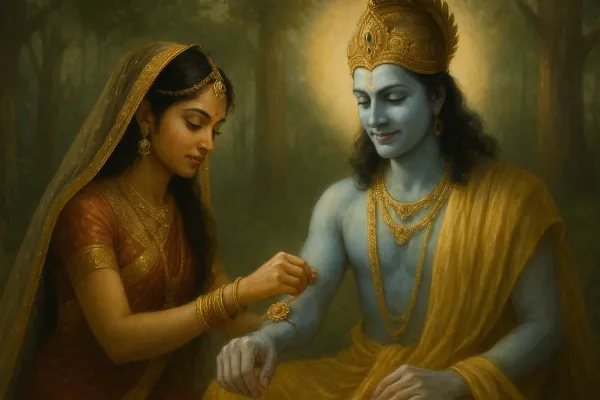
In this light, tying a rakhi to God—as devotees often do to Shree Krishna or Shiva—is symbolic of the soul’s prayer to be remembered, guided, and safeguarded.
Swami Mukundananda: The Internal Meaning of Raksha
Spiritual teacher Swami Mukundananda often reminds devotees that the ultimate raksha is liberation from ignorance and ego. True protection is when we’re rescued not from the world, but from our lower tendencies.
He teaches:
“If we truly wish to be protected, we must surrender—not just our problems, but our pride and attachments. The Divine then takes charge.”
Tying a rakhi to the Lord, or chanting prayers on Raksha Bandhan, becomes a symbolic act of spiritual dependence—where we ask God not just for safety, but for elevation.
The Changing Face of Raksha Bandhan in the Modern World
Today, Raksha Bandhan has evolved beautifully in several directions:
- Sisters tie rakhis to sisters, friends, mentors, even soldiers.
- Children tie rakhis to trees, cows, and rivers—symbolizing vows to protect the environment.
- People use the festival to reflect on how they can be protectors of peace, justice, and compassion.
This evolution shows that while the form of the ritual may change, its core remains timeless—commitment, selflessness, and spiritual love.
Raksha Bandhan at the Radha Krishna Temple of Dallas
Each year, Radha Krishna Temple of Dallas celebrates Raksha Bandhan as both a cultural and spiritual festival. Devotees gather to:
- Tie rakhis not only to family but also to Shree Krishna, symbolizing their faith in His protection.
- Participate in bhajans, discourses, and seva activities.
- Reflect on how they can embody the values of love, loyalty, and dharma.
This year’s celebration promises to be a joyful, heartwarming, and deeply spiritual experience.
Conclusion: A Festival of Light and Loyalty
Raksha Bandhan is more than a sweet exchange—it is a spiritual pledge. Whether it’s Shree Krishna protecting Draupadi, Lakshmi tying rakhi to Bali, or Humayun defending a queen—each story reflects the eternal vow to stand by what is right.
As you tie or receive a rakhi this year, may you feel not just the warmth of tradition, but the touch of divine grace. May you be both protected—and a protector.
Happy Raksha Bandhan!🌸 Let the thread you tie today become a spiritual promise that lasts forever.
Call to Action: Be a Protector in Thought, Word, and Deed
This Raksha Bandhan, pause for a moment and reflect:
- Who are you responsible for protecting—not just in family, but in society?
- Can you be a rakshak (protector) of values like honesty, compassion, and humility?
- Will you allow God to protect you by surrendering your ego and trusting the divine plan?
✨ You’re warmly invited to celebrate Raksha Bandhan at the Radha Krishna Temple of Dallas!
Join us for a soul-uplifting day of spiritual bonding, rakhis, cultural celebration, and divine connection. Come tie a rakhi to Shree Krishna and deepen your vow of surrender and protection.
📍 Visit www.radhakrishnatemple.net for schedule and details.
🔗Register Online
Let this be more than a ritual—let it be a renewal of your sacred vows to love, protect, and uplift.
References
1. Mahabharat, Sabha Parva – Narratives of Draupadi and divine protection.
2. Vishnu Purana – Incarnations of Lord Vishnu and stories of divine intervention.
3. Bhavishya Purana – Yajnas and raksha sutra origins.
4. Swami Mukundananda. Bhagavad Gita: The Song of God (Commentary).
🔗 Read Online
5. Swami Mukundananda. Spiritual Secrets from Hinduism: Essence of the Vedic Scriptures
🔗 Buy on Amazon
❓FAQs
Q1: Can Raksha Bandhan be celebrated between friends or spiritual siblings?
Yes. Raksha Bandhan honors any bond based on trust, respect, and responsibility. Many friends and spiritual seekers exchange rakhis to signify sacred support.
Q2: Is it appropriate to tie a rakhi to a deity like Shree Krishna
Absolutely. Many devotees offer a rakhi to Shree Krishna as a sign of their surrender and devotion. It symbolizes seeking divine protection and guidance.
Q3: What if someone has no brother or sister?
You can tie a rakhi to a friend, a spiritual mentor, or even offer it to yourself or to nature as a vow to protect your values and the world around you.
Q4: Is there a specific prayer to recite while tying rakhi?
Yes, the traditional mantra is:
“Yena baddho balee raajaa daanavendro mahaabalah
Tenatvaamabhibadhnaami rakshe maa chala maa chala”
It invokes divine protection and is ideal to chant while tying the thread.
Q5: How can I make Raksha Bandhan more meaningful?
Reflect on how you can protect others emotionally or spiritually. Consider tying rakhi to those in need, performing seva, or committing to a personal virtue for the year ahead.
🛕 Celebrate Raksha Bandhan at Radha Krishna Temple of Dallas

Join us for a blissful evening of devotion, prayer, and family bonding during the sacred occasion of Raksha Bandhan and the Satyanarayan Katha. Experience spiritual upliftment through rituals, rakhi tying, and inspiring satsang.
📅 Program Schedule – August 8, 2025 (Friday)
-
🕉️ Satyanarayan Pooja:
5:00 PM – 7:00 PM
Participate in a sacred pooja for blessings of peace, prosperity, and well-being.
Bring: Fruits, flowers, and prasad -
🎀 Tie Rakhi to Krishna:
5:00 PM – 7:00 PM
Tie rakhi to Lord Krishna as a symbol of divine protection and surrender.
Bring: Fruits, flowers, and prasad -
🧘♂️ LTP Lecture by Swamiji:
7:15 PM onwards
Transform your life with Swamiji’s wisdom, practical insights, and spiritual elevation.
📍 Venue: 1450 North Watters Road, Allen, TX
🙏 Sponsorship Opportunities
Support the sacred celebration and become a part of the divine seva.
📩 For questions, visit radhakrishnatemple.net/rakshabandhan