The timeless wisdom of the Bhagavad Gita holds profound insights into the nature of karm and freedom from its binding consequences. In his illuminating discourse, Swami Mukundananda explains a powerful secret embedded in the Gita and Ishopanishad—that one can perform action without being bound by it. How? The key lies in the mindset, not the action.
Let us unpack this liberating knowledge, drawing deeply from the Gita, scriptures, and practical illustrations shared by Swamiji.
What Is True Renunciation?

"sannyāsas tu mahā-bāho duḥkham āptum ayogataḥ
yoga-yukto munir brahma na chireṇādhigachchhati"
(Bhagavad Gita 5.6)
Translation: Perfect renunciation (karm sanyās) is difficult to attain without performing work in devotion (karm yog), O mighty-armed Arjun, but the sage who is adept in karm yog quickly attains the Supreme.
Read here
True renunciation (sannyas) is not about abandoning work, but surrendering the desire for its fruits. As Swamiji says, anyone can claim, "I’m doing this for God,” but the test lies in how we respond when the results don’t match our expectations.
If our efforts do not succeed and we become disturbed, that disturbance is proof we were inwardly attached to the results. Hence, Shree Krishna teaches the path of karm yog: engaging in action without attachment.
Why Do We Fear Death?

Swamiji next addresses a philosophical and practical question: why do all living beings fear death?
This fear arises because the soul, being a part of God, is eternal. Although our inner soul desires eternal life, our consciousness is tied to the perishable body, creating the illusion of death. A worldly person clings to enjoyment, and death appears as a terrifying separation from everything dear.
But a devotee, Swamiji explains, embraces life for a different reason—to make the most of this brief opportunity to serve God. Thus, both want to live but for different reasons.
Swamiji emphasizes the teaching of this profound verse from the Ishopanishad:
"kurvanneveha karmāṇi jijīviṣhechchhatam samāḥ evam tvayi nānyatheto ’sti na karma lipyate nare"
(Ishopanishad Verse 2)
Translation: Human beings should aspire to live a hundred years while performing their duties with the proper attitude. Work done for the pleasure of God will not result in karmic bondage. In fact, there is no simpler means for getting rid of the bonds of karm.
This verse beautifully supports the essence of karm yog. It tells us that continued engagement in selfless action is not a hindrance to spiritual progress, but rather a path to liberation. In fact, action itself is not the problem—attachment to the fruits of action is. When actions are done in a spirit of service, without personal greed or selfish expectation, they lose their binding capacity.
The Ishopanishad affirms that there is no other way for a human being. We must act, but act with the awareness that the results do not belong to us. The desire to live for a hundred years is not condemned here; rather, it is sanctified when aligned with dharmic, purposeful action. Such work purifies the soul, deepens devotion, and breaks the cycle of karm.
Hence, this Upanishadic wisdom resonates deeply with the Bhagavad Gita’s central message: do your duty with detachment, and you will transcend the karmic web.
The Three Types of Karm: Understanding the Mechanism

To explain how karm works and how to be free of it, Swamiji brings in a fundamental classification of actions:
- Sanchit Karm: The accumulated karm of countless lifetimes.
- Prarabdh Karm: The portion of karm allotted for our current life, much like Scrabble letters we have to play with.
- Kriyaman Karm: The fresh karma we create through our free will in this life.
It is this third type—Kriyamana Karma—that offers the possibility of spiritual evolution or further bondage.
But here's the crux: how we perform this karma determines whether it binds us or liberates us.
Karm, Vikarm, and Akarm

Swamiji then expounds on three terms central to karm philosophy:
- Karm: Actions in line with scriptural injunctions.
- Vikarm: Forbidden actions that lead to sin.
- Akarm: Action that leaves no karmic imprint.
This third category is crucial. Shree Krishna explains:
"karmaṇyakarma yaḥ paśhyed akarmaṇi cha karma yaḥ
sa buddhimān manuṣhyeṣhu sa yuktaḥ kṛitsna-karma-kṛit"
(Bhagavad Gita 4.18)
Translation: Those who see action in inaction and inaction in action are truly wise amongst humans. Although performing all kinds of actions, they are yogis and masters of all their actions.
Read here
This seemingly paradoxical verse points to a deeper truth. Someone may appear inactive externally but be mentally bound by desires and attachments. Such a person is not truly inactive.
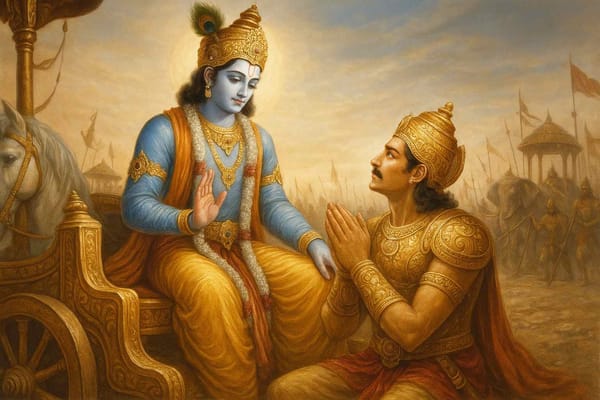
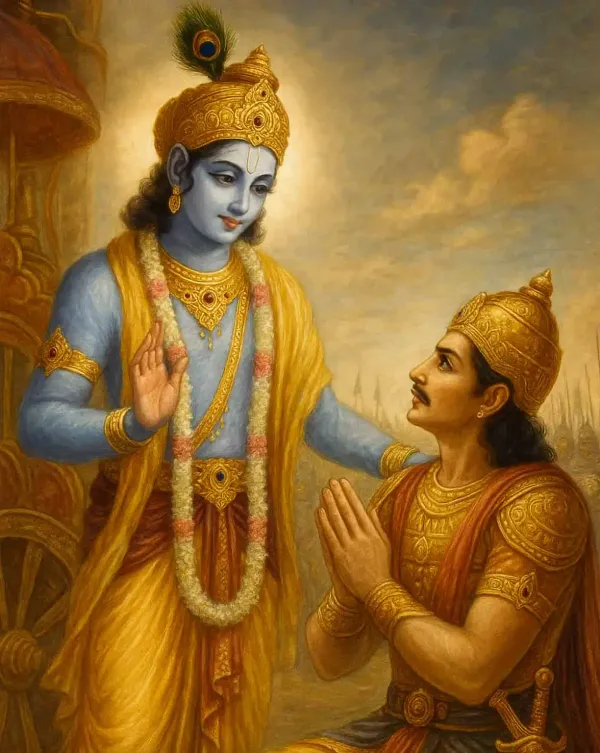
On the other hand, someone like Arjun—fighting a war without attachment, as a duty to God—is performing akarm, despite engaging in intense activity.
The Soldier Analogy: Karm Without Consequences

Swamiji shares a beautiful analogy: A soldier who follows the general’s orders and kills in battle is not considered a murderer by law. Likewise, if we act on God's command and offer the results to Him, we are not bound by karm.
This is why Shree Krishna urges Arjun:
"tasmād asaktaḥ satataṁ kāryaṁ karma samāchara
asakto hyācharan karma param āpnoti pūruṣhaḥ"
(Bhagavad Gita 3.19)
Translation: Therefore, giving up attachment, perform actions as a matter of duty because by working without being attached to the fruits, one attains the Supreme.
Read here
Acting without desire for results liberates us from karmic consequences. It transforms our action into a divine offering.
How Do You Know You Are Detached?

Swamiji offers a brilliant litmus test:
- If the outcome disturbs you, you were attached.
- If the outcome doesn't disturb you, you are detached.
Swamiji narrates a true story about two devotees who were sent by Maharajji to collect donations. After repeated rejections, they were disheartened. When they called Maharajji, he simply laughed.
They understood: The real seva was not the money, but the inner development—humility, tolerance, and surrender. Success would have bloated their ego; failure polished their devotion.
This reflects another teaching of the Gita:
"yoga-sthaḥ kuru karmāṇi saṅgaṁ tyaktvā dhanañjaya
siddhy-asiddhyoḥ samo bhūtvā samatvaṁ yoga uchyate"
(Bhagavad Gita 2.48)
Translation: Be steadfast in the performance of your duty, O Arjun, abandoning attachment to success and failure. Such equanimity is called Yog.
Read here
Everything Belongs to God

Our ego makes us believe: “This is mine.” But spirituality reverses this thinking.
Swamiji shares a humorous story of a family accusing each other of raising the phone bill—everyone claimed they only used their "office phone." Later, upon inquiry, even the maid said the same!
When we internalize that everything belongs to God, misuse ends. Our actions become offerings, not self-indulgent enjoyments.
"yat karoṣhi yad aśhnāsi yaj juhoṣhi dadāsi yat
yat tapasyasi kaunteya tat kuruṣhva mad-arpaṇam"
(Bhagavad Gita 9.27)
Translation: Whatever you do, whatever you eat, whatever you offer as oblation to the sacred fire, whatever you bestow as a gift, and whatever austerities you perform, O son of Kunti, do them as an offering to Me.
Read here
This attitude transforms karm into karm yog, and our work into worship.
Arjun's Zero-Sum Battle

Swamiji uses another deep example. Arjun fought a devastating war. Yet Shree Krishna declared, "Arjun did nothing."
Why?
Because the internal zero of detachment multiplied even the largest actions into nothing.
100 × 0 = 0
1,000,000 × 0 = 0
Arjun's lack of ego, pride, and desire for the fruits made him untouched by the consequences.
This is karm yog: doing everything, yet doing nothing.
Karm Yog: The Golden Key to Liberation
Shree Krishna reiterates this supreme path:
"anāśhritaḥ karma-phalaṁ kāryaṁ karma karoti yaḥ
sa sannyāsī cha yogī cha na niragnir na chākriyaḥ"
(Bhagavad Gita 6.1)
Translation: Those who perform prescribed duties without desiring the results of their actions are actual sanyāsīs (renunciates) and yogis, not those who have merely ceased performing sacrifices such as Agnihotra yajna or abandoned bodily activities.
Read here
The outer appearance of a monk is not proof of renunciation. The inner mindset is what matters. A householder doing work for God is greater than a fake renunciate attached to name and fame.
Conclusion: The Secret to Becoming Karm-less
So, what does Shree Krishna promise?
If you:
- Perform duties diligently
- Remain unattached to the outcome
- Offer all results to God
Then your actions, no matter how big or worldly, will not bind you.
You will be free from the cycle of karm. This is karm yog. This is the promise of Shree Krishna.
"kāyena manasā buddhyā kevalair indriyair api
yoginaḥ karma kurvanti saṅgaṁ tyaktvātma-śhuddhaye"
(Bhagavad Gita 5.11)
Translation: The yogis, while giving up attachment, perform actions with their body, senses, mind, and intellect, only for the purpose of self-purification.
Read here
Ready to Walk the Path?
Let your work become worship.
Let your life become an offering.
Let your heart become free.
Start today. Let the Gita be your guide. Let Swamiji be your torch.
Subscribe to Swami Mukundananda’s YouTube channel for more such soul-stirring wisdom.
And begin reading the Bhagavad Gita today.
Your journey from karm to karm yog begins with the right mindset.
Radhey Radhey!