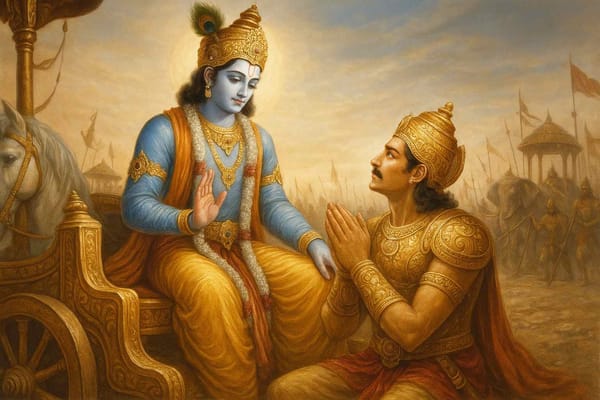
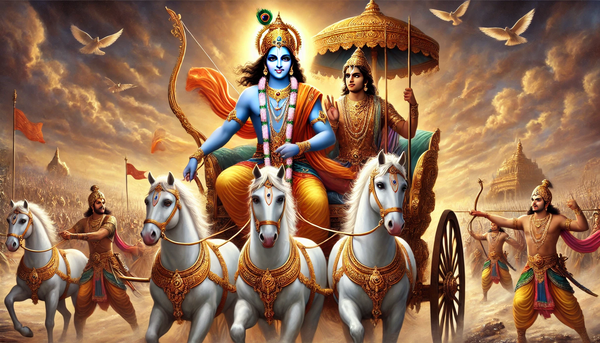
In the vast tapestry of the Mahabharata, Arjuna stands out not just as a formidable warrior but as an exemplar of unwavering focus and dedication. His journey, enriched by the teachings of the Bhagavad Gita, offers timeless lessons on concentration, discipline, and purpose. Let's delve into the qualities that made Arjuna the epitome of focus and how we can emulate them in our lives.
1. The Story of Arjun's Unparalleled Focus

Among the many awe-inspiring episodes of the Mahabharat, one particular incident shines a spotlight on Arjun’s extraordinary ability to concentrate — a trait that made him the finest student of Guru Dronacharya. This timeless tale not only illustrates Arjuna's razor-sharp focus but also offers a profound lesson on the nature of concentration and the qualities of a successful aspirant.
During one of their training sessions in Hastinapur, Guru Dronacharya devised a unique test to assess the level of focus among his students. He placed a wooden bird high on the branch of a tree and asked each of his disciples, one by one, to aim at the bird’s eye with their bow and arrow.
But before allowing them to shoot, Dronacharya asked each student, “Tell me, what do you see?”
The eldest, Yudhishthir, responded, “I see the bird, the tree, its branches, and the sky.” Dronacharya moved to the next student. Bhima replied, “I see the bird, and the branch on which it is sitting.”
Student after student gave similar answers, pointing out multiple objects in their field of vision. Each was asked to step aside.
Then came Arjuna's turn. Upon being asked what he saw, Arjuna replied with unshakable certainty, “I see only the eye of the bird.”
Guru Dronacharya smiled with satisfaction. “Shoot,” he commanded.
Arjuna released the arrow, which went straight and struck the bird precisely in the eye.
This moment defined Arjun’s mental discipline. His mind was completely absorbed in his goal, undistracted by the surrounding objects or people. He was not only physically aiming at the target but also mentally united with it — a state of ekāgratā, or one-pointed concentration.
Bhagavad Gita Insight:
Arjun’s unwavering focus mirrors the instruction given by Lord Krishna in the Bhagavad Gita:
"vyavasāyātmikā buddhir ekeha kuru-nandana
bahu-śākhā hy anantāś ca buddhayo 'vyavasāyinām"
— Bhagavad Gita 2.41
View verse
Translation:
"In this endeavor, there is a single-pointed determination. O descendent of the Kurus, the intelligence of those who are irresolute is many-branched."
Shree Krishna emphasizes that success on the spiritual path — and in life — requires focused, resolute intelligence. Arjuna displayed this quality not only in this episode but throughout his life.
Lesson:
Just like Arjuna, to achieve excellence in any field — be it academics, professional life, or spiritual growth — we must learn to silence distractions and focus solely on our goal. A distracted mind jumps from one object to another, whereas a focused mind channels energy into meaningful action. Arjuna’s discipline teaches us to cultivate vyavasāyātmikā buddhi — determined, single-pointed intellect.
Would you like me to expand the next section in a similar format with Bhagavad Gita verses and detailed spiritual lessons?
2. Embracing Single-Minded Devotion

Arjuna's unwavering devotion to Lord Krishna is exemplified in a poignant episode from the Puranas. After a long journey to Dwaraka, Arjuna, fatigued from handling the chariot, retired to the guest house to rest. Later, Mother Rukmini visited Krishna and inquired about Arjuna's well-being. Krishna suggested she see for herself. Upon approaching Arjuna, she observed that even in deep sleep, every pore of his body resonated with the chant "Krishna... Krishna..."
This incident underscores the depth of Arjuna's devotion, where his very being was immersed in the remembrance of Krishna, transcending conscious thought.
🕉️ Bhagavad Gita Insight:
This profound level of devotion aligns with Lord Krishna's teachings in the Bhagavad Gita:
"Engage your mind always in thinking of Me, become My devotee, offer obeisances to Me and worship Me. Being completely absorbed in Me, surely you will come to Me."
— Bhagavad Gita 9.34Madhu Chanda das
Arjuna's state exemplifies this instruction, where his mind and senses were perpetually engaged in Krishna consciousness, even during rest.
🎯 Lesson:
Arjuna's example teaches us that true devotion transcends conscious effort; it becomes an intrinsic part of our existence. By cultivating constant remembrance of the Divine, we can aspire to a state where our thoughts, words, and actions are harmoniously aligned with spiritual consciousness.
3. Overcoming Mental Restlessness

Even Arjuna faced moments of doubt and mental turmoil, especially on the battlefield of Kurukshetra. He confides in Krishna about the mind's restlessness:
"The mind is restless, turbulent, obstinate, and very strong, O Krishna. Controlling it is more difficult than controlling the wind."
— Bhagavad Gita 6.34
Krishna acknowledges this challenge but offers a solution:
"Undoubtedly, the mind is restless and difficult to restrain, but it is subdued by practice and detachment."
— Bhagavad Gita 6.35
Lesson: Regular practice and detachment are key to mastering the mind's fluctuations.
4. The Power of Meditation

Krishna introduces the concept of Dhyana Yoga, the path of meditation, as a means to attain inner peace and focus:
"When the mind, restrained from material activities, becomes still by the practice of yoga, then the yogi is said to have attained spiritual perfection."
— Bhagavad Gita 6.18
Lesson: Meditation is a powerful tool to calm the mind and enhance concentration.
5. Performing Duties Without Attachment – Arjuna's Transformation
Before the battle of Kurukshetra commenced, Arjuna was gripped by deep emotional turmoil. Seeing his own kin, revered elders, and beloved friends on both sides of the battlefield, he was overwhelmed with grief and confusion. His attachment to the outcome — the destruction of his relatives and the consequences of war — paralyzed him into inaction. He dropped his bow and declared:
“I will not fight.”
— Bhagavad Gita 2.9
Read Verse
Arjuna, the invincible warrior, now stood immobilized — not because he lacked skill or strength, but because he was too attached to the fruits of his actions. He feared the destruction of his family, the guilt of killing, and the grief of loss. His focus was entirely on the outcome rather than the righteousness of his duty (dharma).
The Turning Point: Learning the Principle of Nishkam Karma
Lord Krishna, acting as Arjuna’s charioteer and divine guide, introduced him to the revolutionary principle of Nishkam Karma — action without attachment to results.
“You have a right to perform your prescribed duties, but you are not entitled to the fruits of your actions. Never consider yourself the cause of the results of your activities, and never be attached to not doing your duty.”
— Bhagavad Gita 2.47
Read Verse
Krishna’s message was clear: One must act in alignment with dharma (duty), but without craving specific results. The outcome is in the hands of God, not the individual.
How Arjuna Applied This Teaching
After hearing the entire Bhagavad Gita, Arjuna experienced a massive internal shift. No longer was he weighed down by the emotional burden of results. He recognized that fighting the war was his Kshatriya dharma — a righteous obligation. He accepted that it was not his place to determine the result, but only to act rightly.
“My illusion is now gone. I have regained my memory by Your grace. I am now firm and free from doubt and am prepared to act according to Your instructions.”
— Bhagavad Gita 18.73
Read Verse
From that moment, Arjuna picked up his bow and fought valiantly, not for revenge or personal gain, but as an instrument of divine will, with detachment and clarity.
Psychological Depth: Freedom from Anxiety
Before receiving Krishna’s wisdom, Arjuna’s anxiety stemmed from an over-attachment to consequences — a mindset that afflicts many of us in daily life. The Bhagavad Gita offers a liberating shift: when we surrender the outcomes and focus on righteous action, our anxiety diminishes.
Krishna further reinforces this point:
“One who performs their duties without attachment, surrendering the results unto the Supreme God, is not affected by sinful action, as the lotus leaf is untouched by water.”
— Bhagavad Gita 5.10
Read Verse
Lesson from Arjuna’s Transformation
The story of Arjuna is a timeless mirror for all of us. When we obsess over results — success, failure, recognition — we become paralyzed, just like Arjuna. But when we shift our mindset to focus on the effort, the sincerity, and the righteousness of action, we become liberated.
This is not a call to indifference; rather, it is a call to empowered detachment — acting fully and sincerely, while surrendering the fruits to God.
Perform your duties diligently and sincerely, but leave the results to God. This attitude leads to peace, clarity, and effectiveness — as demonstrated by Arjuna after his transformation through Krishna's teachings in the Bhagavad Gita.
6. Cultivating Determination and Discipline
Arjuna's journey underscores the importance of discipline. Krishna advises:
"One must deliver oneself with the help of one's mind, and not degrade oneself. The mind is the friend of the conditioned soul, and his enemy as well."
— Bhagavad Gita 6.5
Lesson: Self-discipline transforms the mind into an ally, guiding one towards success.
7. The Role of Faith and Devotion -Arjuna’s Unshakable Trust in Krishna
A sharp intellect and disciplined practice may sharpen our focus, but without faith and devotion, even the strongest minds may waver during trials. One of the most powerful yet subtle teachings of the Bhagavad Gita is that unwavering faith in God fortifies our mind, clears distractions, and channels our focus like a divine compass pointing toward righteousness.
Lord Krishna promises in the Gita:
“But those who always worship Me with exclusive devotion, meditating on My transcendental form—to them I carry what they lack and preserve what they have.”
— Bhagavad Gita 9.22
Read Verse
This verse underscores a divine guarantee — when a devotee surrenders with full faith, Krishna becomes their protector and provider, guarding them from both spiritual and material loss.
Arjuna’s Peaceful Sleep Amidst a Death Vow
A striking example of this faith is found during the war of Kurukshetra when Bhisma Pitamah, the grandsire of the Kuru dynasty, made a fierce vow: “Tomorrow I will kill Arjuna unless Krishna breaks His vow of not taking up arms in battle.”
This was no empty threat. Bhisma was not only the most powerful warrior alive but also a knower of divine weapons (astra-vidya). Everyone in the camp was terrified for Arjuna’s life. The Pandavas held an urgent meeting that night, strategizing how to protect Arjuna.
And where was Arjuna?
He was fast asleep.
Unlike others, Arjuna slept peacefully without a trace of worry. Why? Because he had complete faith in Krishna. He knew that as long as Krishna was his charioteer, protector, and guide, no harm could ever befall him.
Even when the whole world feared Bhisma’s wrath, Arjuna’s mind was calm like a still lake — a state born not of ignorance but of deep spiritual maturity and devotion to Krishna.
As per the Bhagavatam (Śrīmad Bhāgavatam 1.9.37), Bhisma himself glorifies Arjuna’s fortune:
“Arjuna, whom Lord Sri Krishna favors and whose chariot He drives, has nothing to fear even in the midst of a hundred dangers.”
Bhisma, lying on the bed of arrows, confesses that it was Krishna’s protection and Arjuna’s devotion that saved him time and again.
The Moment When Krishna Breaks His Vow for His Devotee
The next day, the battle raged on. Bhisma unleashed a relentless attack, showering divine astras upon Arjuna. Krishna, watching Arjuna being cornered, was moved by divine rage. Breaking His own vow, Krishna leaped off the chariot, lifted a chariot wheel, and charged toward Bhisma like a divine storm.
Bhisma, with folded hands and tears in his eyes, welcomed his death, saying, “This is what I live for — to be slain by the Lord Himself!” But Krishna stopped short, sparing Bhisma, and Arjuna was saved.
This incident shows how Krishna protects His devotee even at the cost of His own vow, fulfilling His promise from Bhagavad Gita 9.22.
Lesson: Faith Sharpens Focus and Removes Fear
Arjuna’s peaceful sleep amidst a death threat reveals a great truth — devotion is the highest form of inner strength. It frees the mind from fear, anxiety, and overthinking — the biggest enemies of focus.
By trusting Krishna fully, Arjuna was able to remain mentally and emotionally stable, which allowed him to act decisively in battle. His clarity came not only from discipline but from the deep security of divine companionship.
Modern Parallel: Focus Through Faith
In modern life, we often face “mental battles” — deadlines, exams, pressure, competition, and uncertainty. We can learn from Arjuna to surrender the burden of outcomes to God and work with full intensity. As Krishna says:
“Therefore, surrendering all your works unto Me, with mind intent on Me, free from desire and selfishness, fight without inner agitation.”
— Bhagavad Gita 3.30
Read Verse
When we work with this mindset — with devotion and surrender — we remain focused and calm even in the face of difficulty.
Summary Lesson:
Devotion isn't escapism — it’s the deepest empowerment. Arjuna’s faith in Krishna removed all fear and kept his focus sharp even when death loomed. Like Arjuna, we too can learn to anchor our minds in faith, and let Krishna carry what we lack and preserve what we have.
8. Arjuna's Humility and Willingness to Learn

Despite his accomplishments, Arjuna remained humble and eager to learn. On the battlefield, instead of reacting impulsively, he sought Krishna's guidance:
"Now I am Your disciple, and a soul surrendered unto You. Please instruct me."
— Bhagavad Gita 2.7
Lesson: A focused mind is open to guidance and eager to learn and grow.
9. Emulating Arjuna in Modern Times
In today's world, distractions are abundant. Yet, by adopting Arjuna's qualities—single-minded focus, discipline, and devotion—we can navigate challenges effectively.
Ready to deepen your focus and devotion?
- Join JKYog Online Classes for Bhagavad Gita wisdom and practical tools → https://jkyog.org/online-classes/
- Join RKT Online Classes for Vedic learning and community → https://radhakrishnatemple.net/online-classes/
- Watch Swami Mukundananda’s Gita talks on YouTube → https://www.youtube.com/c/SwamiMukundananda
- Practice Roopdhyan Meditation for inner calm → https://jkyog.org/roopdhyan-meditation/
Conclusion
Arjuna's legacy in the Mahabharata and the Bhagavad Gita serves as a beacon for those seeking focus and purpose. By internalizing these teachings, we can cultivate a mind that's steady, purposeful, and aligned with our highest aspirations.
Frequently Asked Questions (FAQs)
Q1: How did Arjuna develop such unparalleled focus?
A: Through rigorous training under Guru Dronacharya, unwavering dedication, and the guidance of Lord Krishna, Arjuna honed his concentration.
Q2: Can the teachings of the Bhagavad Gita help improve modern-day focus?
A: Absolutely. The Gita's principles on detachment, discipline, and meditation are timeless tools for enhancing concentration.
Q3: What is the significance of performing duties without attachment?
A: It encourages individuals to focus on their responsibilities without being swayed by success or failure, leading to inner peace.
Q4: How does meditation aid in achieving focus?
A: Meditation calms the mind, reduces distractions, and fosters a deep sense of awareness, enhancing one's ability to concentrate.
Q5: Is it possible to attain Arjuna-like focus in today's distracted world?
A: Yes, by practicing the Gita's teachings, maintaining discipline, and cultivating devotion, one can achieve heightened focus even amidst modern distractions.
References
- Bhagavad Gita 2.41
- Bhagavad Gita 6.34
- Bhagavad Gita 6.35
- Bhagavad Gita 6.18
- Bhagavad Gita 2.47
- Bhagavad Gita 6.5
- Bhagavad Gita 9.22
- Bhagavad Gita 2.7
For further reading and exploration of the Bhagavad Gita's teachings, visit holy-bhagavad-gita.org.