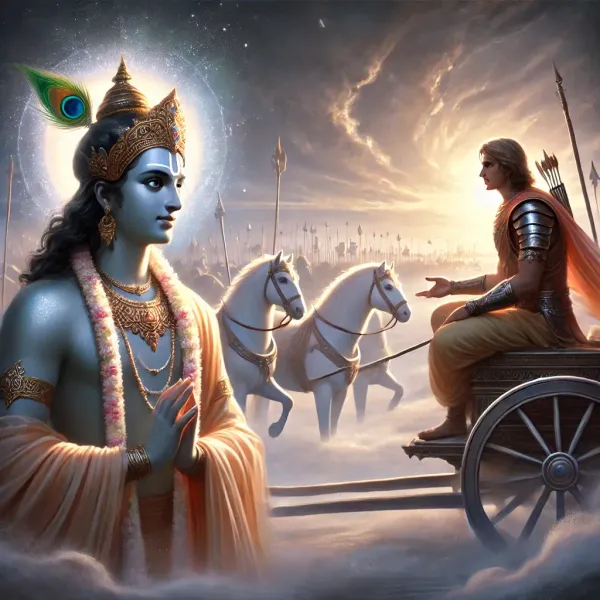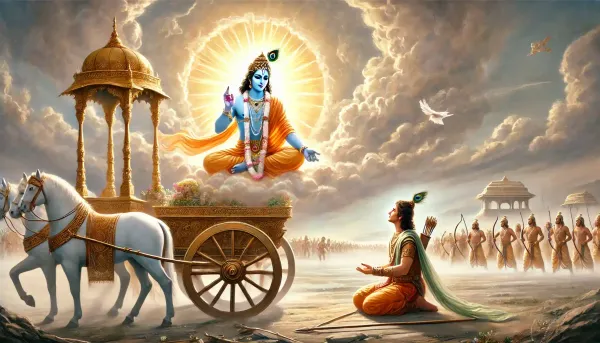
Every year, devotees around the world come together to honour the day when the sacred dialogue known as the Bhagavad Gītā was delivered to Arjuna on the battlefield of Kurukshetra, and to renew their own commitment to its timeless teachings. At the Radha Krishna Temple, a rich programme of events helps devotees immerse in this celebration, and yet the real spirit of the Gītā Jayanti lies not in grand external ceremonies alone but in the transforming turn of the heart. In that sense, the teachings of Swami Mukundananda provide invaluable guidance: it is our internal intent, more than the outward ritual, that determines the depth of our devotion.
BG 12.2: The Lord said: Those who fix their minds on Me and always engage in My devotion with steadfast faith, I consider them to be the best yogis.
In this blog we will examine:
- The significance of Gītā Jayanti
- The celebration at Radha Krishna Temple (what events to expect)
- How to participate if you can attend in person
- How to celebrate at home if you cannot attend
- How to integrate the key teachings of Swami Mukundananda into your observance
- Suggestions for everyday transformation beyond the day
1. Significance of Gita Jayanti
The Bhagavad Gītā is a 700‑verse sacred dialogue between Lord Krishna and Arjuna, set on the battlefield of Kurukshetra. It addresses the fundamental questions of duty (dharma), the nature of the self, action and detachment, devotion and knowledge.
Gītā Jayanti commemorates the day this divine scripture was spoken. The festival offers a chance to not just remember the text, but to bring its wisdom into our lives, via our thoughts and our actions, and align ourselves with its deeper meaning.
For devotees at the Radha Krishna Temple, this day is much more than a ritual, it is a call to awaken the spirit of the Gītā within: to allow Lord Krishna’s message to speak into our own personal “battlefields” of life.
2. The Celebration at Radha Krishna Temple
The Radha Krishna Temple offers a multi‑day programme of events around Gītā Jayanti:
- A Kids Workshop (stories, games, interactive sessions) designed to help children explore lessons from the Gītā (kindness, courage, focus, inner peace).
- A Kirtan & Bhagavad Gītā Recitation: e.g., chapters 12 and 15, a Shree Krishna Abhishek, cultural programmes, aarti, mahaprasad.
- A Satyanarayan Katha special evening.
- Kids Chanting / Bhajan Sandhya – devotional music and chanting by young children, uplifting the atmosphere of bhakti.
- An Online Interactive Session for those at home to engage, learn and connect virtually.
- A Kids Show: children render songs, skits, shlokas, stories based on the Gītā.
- A Pothi Yatra and Pothi Pooja: a procession and worship honouring the scripture itself, followed by maha‑mantra chanting and cultural programmes.
- A Bhagavad Gītā Parayan & Poornahuti: The complete recitation culminating in a ritual marking the culmination, followed by mahaprasad.
All these events follow a devotional theme: bringing the Gītā’s message into warmth, community, music, and shared remembrance.
It is important to note that while these external events are beautiful, it is the collective recitations, enlightening discourses, and heartfelt devotion that make the day meaningful.
3. How to Participate In Person
If you are able to attend the Radha Krishna Temple’s Gītā Jayanti programme, here are some tips to make the most of it, in the spirit of internal devotion:
Preparation
- Look at the details on the website: https://www.radhakrishnatemple.net/gita-jayanti/
- Register your details for attendance: https://www.radhakrishnatemple.net/gita-jayanti/#BGWS_Register_section
- Arrive early: respect the programme’s schedule (kids workshop, recitations, etc).
- Dress in clean, modest attire, reflecting the inner readiness for sacredness.
- Bring a copy of the Bhagavad Gītā (or use one provided by the temple) or access it online: https://www.holy-bhagavad-gita.org/en/
- Set a personal resolution: for example, to listen deeply, to try to see how a verse applies to my life.
During the Events
- In the chanting/recitation sessions: rather than simply hearing, aim to listen with the heart. When a verse is chanted, allow its meaning to resonate within you.
- During the kids’ programmes: recognise the innocence and enthusiasm: they remind us that devotion can be simple, heartfelt.
- In the Pothi Yatra and Pooja: participate consciously. Offer your mental “book” of life to the Lord, intending that your life be an offering, not merely your recitation.
- In the cultural programmes/music: allow your emotions to be stirred into devotion rather than mere entertainment. Let the music become a vehicle for your attention toward the Divine.
After the Events
- Partake in mahaprasad with gratitude, seeing it as prasāda (divine gift) rather than just free food.
- Spend a few minutes in silence, reflecting on one verse that stood out. Ask: “What does this mean for me next week?”
- Consider making a small service offering (volunteering at the temple, supporting their children’s programme, etc.). This aligns with the Gītā’s call to selfless action.
Key Attitude
Throughout these external practices keep in mind Swami Mukundananda’s teaching: True devotion lies in fixing the mind and intellect on God, not just external rituals.
Even the most beautiful aarti, procession or chanting will bear fruit only when your inner intent is aligned. In his words:

4. How to Celebrate at Home
If you cannot attend the festivities in person, you can still honour Gītā Jayanti in a powerful, meaningful way at home. Here is a suggested “home celebration plan” tailored to reflect the spirit of the Radha Krishna Temple events and Swami Mukundananda’s teachings.
Create a Sacred Space
- Choose a quiet corner of your home. Place your copy of the Bhagavad Gītā on a clean cloth. Add a small lamp or candle, perhaps a picture or memento of Lord Krishna or the temple.
- Before beginning, take a few deep breaths and set an inner intention: “Today I celebrate the Gītā not just by words, but by offering my heart.”
- Consider cleaning the space: symbolic of preparing the mind. (External cleanliness often reflects internal readiness.)
Kids/Family Workshop (if with family)
If you have children or family around, you might run a short interactive session:
- Pick a simple Gītā verse
- Discuss: What does this verse mean? How can we live it? Use a story or game: e.g., “If Arjuna was me today facing a challenge in school/work…”
- Invite each person to pick one sentence from the verse and express how they would feel it in everyday life.
Recitation and Reflection
- Choose one or more chapters. Sit quietly and recite aloud or read slowly.
- After each 5‑10 verses pause, and reflect on the question: “What is Shree Krishna asking of me here?”
- Write a short line in your journal: “My action this week inspired by this verse will be…”
Chanting / Bhajan Time
- Play a devotional song or chant that references Shree Krishna, the Gītā, the Word of God.
- As you listen/chant, focus inward: let the rhythm and melody carry the mind toward devotion, not just sound. Use this as a form of “inner sankalp” (resolution).
- Consider a short group chanting if with family or online participants (if possible) to emulate the community feel of the temple’s Bhajan Sandhya.
Offering & Intentional Service
- Offer something simple: A flower, water, a fruit, or simply your mental offering: “I offer my mind, intellect and heart to Shree Krishna.” Swami Mukundananda reminds us that the outer object is secondary; the internal emotion is what reaches the divine.
- Plan a small act of service: e.g., call/check a relative, share a kind word, volunteer for a short time. Link it to the verse you selected. This transforms the day from passive celebration into active living.

Silent Contemplation & Sankalpa
- Conclude your home celebration with five‑ten minutes of silent contemplation. Sit comfortably, breathe gently, and allow the verse, the day’s energy, the service you offered to settle.
- Make a sankalpa: “From this day onward, I will … (for example) read one verse of the Gītā each morning, and before action always ask: ‘Is this aligned with Shree Krishna’s will?’”
- Note it down; place it somewhere visible.
Mahaprasad at Home
- If you like, prepare or share a simple vegetarian meal or sweet with your family. Approach it as prasāda: divine gift. Offer a short gratitude prayer: “May this food nourish body and mind in the service of God.”
- As you eat, reflect: “My body is Shree Krishna’s; how will I use it this week for devotion?”
5. Integrating Swami Mukundananda’s Teachings

The external events of Gītā Jayanti and the home practices above are valuable, but they truly gain power when anchored in the deeper teaching emphasised by Swami Mukundananda reminds us repeatedly that devotion depends on internal intent, not mere external show. Here are key teaching points to infuse your celebration and beyond.
Key Principle: Mind and Intellect Matter More Than Ritual
Swami Mukundananda explains that rituals without the mind are like multiplying by zeros: they yield nothing. What matters is where the mind is engaged; what the heart is offering. Thus when you participate in any event (temple or home) ask: Is my mind with Shree Krishna?
Offering Your Mind and Intellect to God
Swami Mukundananda describes true devotion, which is not just rituals but aligning every thought with Shree Krishna’s will. When intellect surrenders to divine wisdom, the mind follows, leading to true peace and spiritual growth.
Therefore your sankalpa might be: “May every choice this week reflect devotion, not obligation.”
Avoiding Mechanical Rituals, Cultivating Genuine Bhakti
Many people without realizing it make their bhakti serve the ritual. In other words, bhakti becomes subservient to the ritual.This is a crucial caveat. In your celebration, avoid doing things because they are scheduled or to check a box. Aim to do things because you feel the call of the Gītā within you.
Living the Gītā in Action
Swami Mukundananda's writings on work, life and spirituality remind us that both the warrior (Arjuna) and the monk can reach the same goal, if their action is heart‑connected. Thus, after the celebration, ask: How will I bring Shree Krishna's wisdom into my Monday morning meeting, my child’s homework, my struggle with impatience?
6. Suggestions for Everyday Transformation
Celebrating Gītā Jayanti is wonderful—but the true victory is carrying its message forward. Here are some suggestions to embed the spirit deeper:
Daily Practice
- Read at least one verse of the Gītā each morning. Reflect on one actionable insight.
- Pause mid‑day and ask: Is my intent pure? Am I working for Shree Krishna, or merely for applause?
- Each evening, review: Where did I surrender to Shree Krishna? Where did I act on ego or fear?
Conclusion
Celebrating Bhagavad Gītā Jayanti at the Radha Krishna Temple offers a beautiful combination of community‑spirit, chanting, cultural programmes, recitation and devotion. Yet the true essence of the day, and the real spiritual harvest, lies within: in how our minds, hearts and lives align with the message of the Gītā.
Swami Mukundananda offers a timely reminder: external rituals are helpful when they serve an inner change. The leaf or flower we offer is minor; what matters is the devotion behind it.
Whether you participate in person at the Temple or celebrate at home, take the opportunity to turn inwards, set your intention afresh, and allow Lord Krishna’s counsel to become living, not just historical.
May this Gītā Jayanti be a profound start for you, one where you not only hear the Word but live it, offering your life as a sacred devotion.
Further Study of the Bhagavad Gita
- The Holy Bhagavad Gita with Swami Mukundananda's Commentary
- Swami Mukundananda's YouTube channel on the Holy Bhagavad Gita