Let us explore its meaning, significance, and how it can transform our daily life.When understood deeply, this doha is not just a prayer—it is a complete spiritual philosophy, especially when viewed through the lens of bhakti (devotion), seva (service), and surrender, as taught in the tradition of JKYog and expounded by Swami Mukundananda.The Hanuman Chalisa concludes with a deeply powerful and heartfelt prayer—the final doha, which encapsulates the entire spiritual essence of the text. While the preceding verses describe the glory, strength, and devotion of Hanuman, this closing verse brings everything inward; into the heart of the devotee.

Final Doha
पवन तनय संकट हरन, मंगल मूरति रूप।
राम लखन सीता सहित, हृदय बसहु सुर भूप॥
Pawan tanay sankat haran, mangal murti roop.
Meaning: O the son of wind, you are the destroyer of all sorrows. You are the embodiment of fortune and prosperity.
Ram Lakhan Sita sahit, hriday basahu sur bhoop.
Meaning: May you always dwell in my heart along with Lord Ram, Lakshman and Mother Sita.
Spiritual Significance
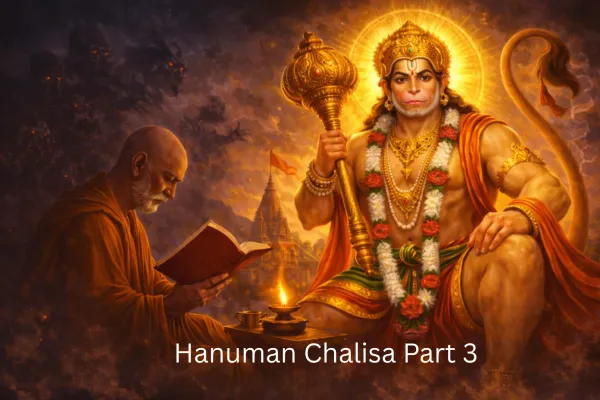
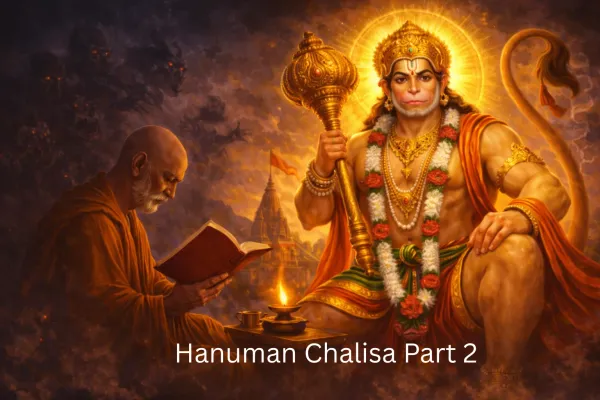
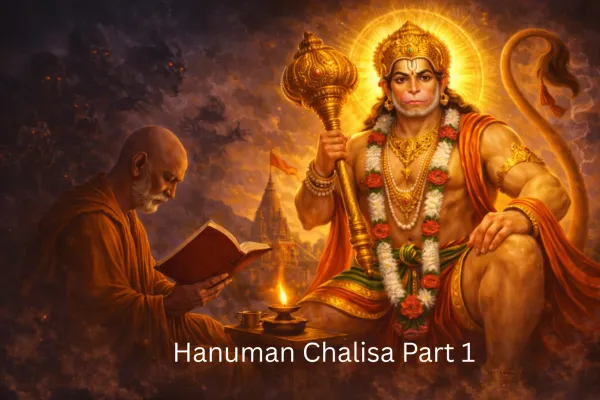
This concluding doha summarizes the central message of the Hanuman Chalisa. Hanuman is addressed as the son of the Wind God (Pavan Tanay) and the remover of troubles (Sankat Haran), emphasizing his protective and compassionate nature. He is also described as the embodiment of auspiciousness, symbolizing purity, strength, and divine grace.
The devotee prays for Hanuman to dwell in their heart along with Rama, Lakshmana, and Sita. Spiritually, this represents the desire for the heart to become a place filled with devotion, righteousness, compassion, and divine guidance. The verse also reflects the belief that remembering Hanuman brings protection from suffering and promotes spiritual well-being.
Reflection and Application in Daily Life
This doha encourages individuals to cultivate noble qualities within their hearts. When values such as courage, compassion, humility, and devotion guide one’s actions, life becomes more meaningful and harmonious. The presence of Hanuman symbolically represents strength and resilience, while the presence of Rama, Sita, and Lakshmana symbolizes righteousness, compassion, and loyalty.
In daily life, this verse can inspire people to create a positive inner environment by practicing kindness, patience, and faith. By focusing on these virtues, individuals can face life’s challenges with calmness and confidence while maintaining a compassionate and ethical outlook.
Entering the Meaning

The words are simple, but their depth is immense. Hanuman is addressed as Pavan Tanay, the son of the wind, and Sankat Haran, the remover of difficulties. He is described as the embodiment of auspiciousness itself: mangal murti.
Then comes the prayer: may you dwell in my heart, along with Rama, Sita, and Lakshmana.
At first glance, this seems like a devotional request. But when reflected upon deeply, it reveals an entire spiritual philosophy.
This is not just about divine presence; it is about inner transformation.
The Heart as a Sacred Space
Throughout life, we search for stability outside ourselves, in achievements, relationships, or circumstances. Yet the final doha gently redirects that search inward. It suggests that the true temple is not external, but within the heart.
When the devotee asks Hanuman to reside in the heart, it symbolizes a longing for strength that does not waver. When Rama is invited, it is a call for righteousness and truth to guide every action. When Sita is invoked, it is an aspiration for compassion and purity. When Lakshmana is included, it reflects a desire for discipline and unwavering service.
In the teachings of Swami Mukundananda, the mind is often described as a space that is constantly filled; with thoughts, desires, and impressions. The question is not whether the heart will be occupied, but by what.
This doha answers that question. It invites us to consciously fill the inner space with divine qualities.
Hanuman: The Embodiment of Devotion in Action

To understand the depth of this prayer, one must understand who Hanuman truly represents. He is not merely a figure of strength or heroism. He is the perfect example of selfless devotion expressed through service.
In every episode of the Ramayana, Hanuman acts not for personal gain, but for the joy of serving Rama. His strength is extraordinary, yet he remains humble. His wisdom is vast, yet he speaks only when necessary. His courage is unmatched, yet it is always guided by compassion.
This is the essence of bhakti as taught in the tradition of JKYog: devotion is not passive emotion; it is active, loving service.
Hanuman does not withdraw from the world. He engages fully, but with a heart aligned to a higher purpose. This is why he becomes the ideal devotee.
The Deeper Meaning of “Sankat Haran”
The phrase Sankat Haran is often understood as the remover of problems. People turn to Hanuman in times of difficulty, seeking relief from external challenges. While this is true at one level, the deeper meaning lies within.
The greatest challenges are not outside us, but are actually within the mind. Fear, doubt, anxiety, and attachment create far more suffering than circumstances themselves.
Through the lens of spiritual wisdom, Hanuman removes these inner obstacles. He represents the strength that allows us to face fear, the clarity that dissolves confusion, and the devotion that steadies the mind.
When these qualities awaken, problems may still exist, but they no longer disturb us in the same way. The transformation happens from within.
A Summary of the Hanuman Chalisa: The Path of Devotion and Service
To truly appreciate the final doha, it helps to reflect on the journey of the Hanuman Chalisa as a whole.
The Chalisa begins by glorifying Hanuman as an ocean of knowledge and virtue. It then unfolds his qualities: his strength, courage, humility, and unwavering devotion. Each verse reveals a different dimension of his character, but together they point toward a single truth: Hanuman is the ideal servant of the divine.
He is powerful, yet never proud. He is capable, yet never self-centered. He acts decisively, yet always with alignment to dharma.
As the verses progress, the focus subtly shifts. What begins as praise gradually becomes inspiration. The reader is no longer just admiring Hanuman, they are being invited to become like him.
The final doha completes this journey. It asks not, “Who is Hanuman?” but rather, “Can his qualities live within us?”
The Philosophy of Service in JKYog Teachings

In the teachings of Swami Mukundananda, service is not seen as a duty imposed from outside, but as an expression of love. When devotion deepens, service arises naturally.
This aligns perfectly with Hanuman’s life. He does not serve because he is instructed to do so. He serves because his heart is filled with love for Rama.
This distinction is important. Actions performed out of obligation often feel heavy. Actions performed out of devotion feel light, even joyful.
The final doha reflects this state. When divine presence fills the heart, actions become naturally aligned with higher values. There is less conflict, less hesitation, and more clarity.
Living the Doha: A Transformation of Daily Life
The beauty of this verse lies in its simplicity. It does not demand dramatic change or renunciation. Instead, it invites a subtle shift in awareness.
Imagine beginning the day with this prayer: not as a ritual, but as an intention. As the day unfolds, challenges arise, as they always do. But instead of reacting impulsively, there is a pause. A moment of remembrance.
“What would it mean to act with courage here?”
“What would it mean to act with compassion?”
“What would it mean to act with integrity?”
These questions gradually reshape behavior. Over time, they reshape character.
The presence of Hanuman in the heart becomes not a metaphor, but a lived experience, expressed through actions, decisions, and attitudes.
The Inner Battlefield
Much like the dialogue of the Bhagavad Gita takes place on a battlefield, the teachings of the Hanuman Chalisa address an inner struggle.
The real battle is not external. It is the constant movement of the mind—the pull between fear and courage, between selfishness and service, between confusion and clarity.
The final doha offers a solution that is both simple and profound: fill the heart with divine qualities, and the battle begins to resolve itself.
This is not an instant transformation. It is a gradual process, shaped by repeated remembrance and sincere effort.
The Power of Remembrance and Repetition
There is a quiet power in repeating this doha regularly. Not as a mechanical chant, but as a conscious reflection.
Each repetition plants a seed. Over time, these seeds begin to grow. The mind, which was once scattered, becomes more focused. Reactions become more thoughtful. Emotions become more balanced.
In the teachings of bhakti, this process is known as internalization. What begins as an external practice slowly becomes an internal reality.
Final Reflections
The final doha of the Hanuman Chalisa is not merely a closing verse. It is the essence of the entire text.
It reminds us that the goal of spiritual practice is not just knowledge, nor even devotion alone, but transformation. A transformation that begins in the heart and expresses itself in every aspect of life.
To invite Hanuman into the heart is to invite strength without ego.
To invite Rama is to invite truth without compromise.
To invite Sita is to invite compassion without condition.
To invite Lakshmana is to invite discipline without rigidity.
When these qualities come together, life itself becomes a path of devotion.
Call to Action
Take a quiet moment today and reflect on this doha. Read it slowly, allowing each word to settle within.
Rather than rushing through it, pause and ask what it means for your life right now. Where can you bring more courage? Where can you bring more compassion? Where can you act with greater sincerity?
Begin with one small change. Stay consistent. Let the transformation unfold naturally.
If this reflection resonated with you, share it with someone who may benefit from it, and continue exploring the deeper teachings of devotion and service.
FAQs
1. What is the deeper meaning of the final doha of the Hanuman Chalisa?
It represents a prayer for inner transformation, asking divine qualities to reside within the heart.
2. How does this doha relate to daily life?
It encourages living with courage, compassion, discipline, and devotion in everyday situations.
3. What does “Sankat Haran” truly signify?
It refers to the removal of inner obstacles such as fear, doubt, and confusion.
4. How do JKYog teachings interpret this verse?
They emphasize devotion expressed through selfless service and alignment with a higher purpose.
5. Why is Hanuman considered the ideal devotee?
Because he combines strength, humility, wisdom, and complete surrender in service to Lord Rama.