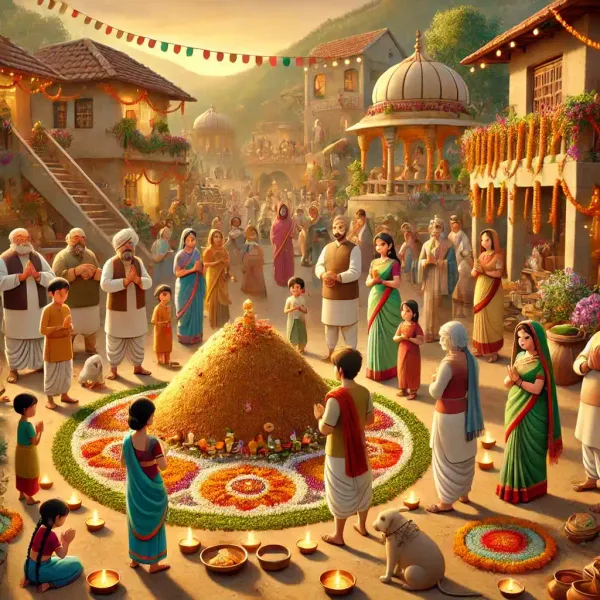
In the sacred land of Braj, Shree Krishna once again revealed the divine essence of Bhakti and devotion, challenging age-old traditions and setting an eternal example of pure love for God. Through the legendary Govardhan Leela, Shree Krishna did not merely lift a mountain; He lifted the veil of illusion that blinds us to the supremacy of God over His celestial servants. This profound episode is not just a tale of miraculous strength but a beacon of spiritual philosophy, taught in the most enchanting way by the Supreme Lord Himself.
The Tradition of Indra Puja in Braj
Braj, being an agrarian society, was naturally dependent on rain. The people traditionally worshipped Indra, the celestial god of rain, believing that his blessings ensured fertile crops and prosperity. Much like modern ministries have ministers for different departments, the celestial realm has deities managing aspects of the universe: Agni for fire, Vayu for wind, and Indra for rain. Even today, in places like Kathmandu, remnants of Indra worship exist.
During Shree Krishna’s childhood in Braj, elaborate preparations were underway for Indra’s annual puja. Curious, Shree Krishna questioned His parents, Nanda and Yashoda, about the rituals. Nanda Baba explained that they offered gratitude to Indra for rains that sustained their lives. Again, Shree Krishna questioned this. Why worship a deity for rain when it is our own actions, our karma, and devotion to the Supreme that truly matter? He proposed instead that they worship Govardhan Hill, the very source of their livelihood and joy.
Shree Krishna's Divine Intention

Shree Krishna, who knew His future role as the speaker of the Bhagavad Gita, realized that He must set the right spiritual precedent. In the Gita, He would later declare that only God is to be worshipped with exclusive devotion. Allowing the worship of celestial beings would confuse devotees and dilute the principle of Ananya Bhakti (exclusive devotion to the Supreme).
Determined to course-correct this tradition, Shree Krishna cleverly initiated a divine revolution.
A New Worship: Govardhan Hill

Shree Krishna first convinced His friends, the young cowherd boys, that Govardhan Hill deserved their reverence. After all, Govardhan nourished their cows with lush grass and gave them joy through its natural beauty. Krishna revealed that Govardhan was a manifestation of Lord Vishnu Himself, descended to enhance Krishna’s pastimes.
With the children on His side, Shree Krishna then addressed the village assembly. He eloquently explained that the rain, like all natural phenomena, ultimately flows from the Supreme Lord. The devatas (celestial gods) are merely administrators, not the source. Just as one should appeal directly to the king rather than a minister, Shree Krishna urged the Brajvasis to worship Govardhan Hill instead.
The villagers, won over by Shree Krishna’s sweet words and logic, agreed. Grand offerings were made, and the festival of Govardhan Puja was born.
Offering of Bhog and Indra's Rage

On the chosen day, the villagers joyously prepared a variety of food offerings. They laid the bhog (offerings) before Govardhan Hill with devotion. To their divine astonishment, Shree Krishna assumed a colossal form and accepted the offerings directly, revealing His Vishnu Swarup.
Indra, enraged by this defiance, commanded his most powerful storm cloud, Samvartaka, to unleash destruction upon Braj. Torrential rains fell relentlessly, threatening to drown the entire region.
The Miracle of Lifting Govardhan

In response, Shree Krishna calmly lifted the entire Govardhan Hill on the little finger of His left hand. He invited everyone to take shelter beneath it. For seven days and nights, Shree Krishna held the hill, shielding His devotees from Indra’s wrath.
Interestingly, Shree Krishna chose His little finger, the weakest part of the body, to highlight that the act was effortless for the Supreme Being. While onlookers saw a miraculous feat, Krishna’s friends, the cowherd boys, remained unimpressed by the Aishwarya (divine opulence). They thought Krishna was pretending and even offered their own sticks to help "hold" the mountain.
Their unwavering friendship (Sakhya Bhav) was so pure that even in the face of Shree Krishna’s divine display, they remained unaffected. To them, He was still just their beloved friend, their ‘Langotiya Yaar’. Such was their Sakhya bhava (devotional friendship): so pure, so unwavering, that even Shree Krishna marvelled at their love.
But little Shree Krishna smiled, lifted the entire Govardhan Hill on the tip of the smallest finger of his left hand, and held it aloft for seven days and nights: a divine umbrella for all.
Divine Emotions and Radharani’s Arrival
As Shree Krishna stood holding the hill, Radharani approached. Upon seeing Her, Shree Krishna experienced deep spiritual ecstasy: Ashta Sattvic Bhavs, including trembling and sweating. The mountain began to shake. Sensing the moment, Balaram intervened, reminding Shree Krishna of the gravity of the situation.
The villagers danced in joy beneath the shelter of the mountain, oblivious to the magnitude of what was unfolding above.
Indra’s Realization and Shree Krishna’s Grace

Eventually, Indra realized his grave mistake. Not only had he challenged the Lord of all lords, but he had also failed to see the divinity masked behind a cowherd boy’s charming smile.
Mounted on his white elephant, Airavata, he descended, withdrew the storm clouds, and offered his heartfelt apologies at Shree Krishna’s feet. Indra admitted his ignorance, having mistaken Shree Krishna for a mere child.
Shree Krishna, ever compassionate, forgave him. Indra's humiliation transformed into humility, marking the first step toward true devotion. He acknowledged that divine knowledge is only granted by God’s grace, not through intellect or status.
Shree Krishna forgave him, dried the land, and life in Braj returned to joyous normalcy. The lesson remained: Divine love, when pure and surrendered, is more powerful than ritualistic worship or ego-driven actions.
A Shift in Perception
However, the aftermath of this event brought an unexpected change in Braj. Until then, many villagers saw Shree Krishna as one of their own: a playful boy, a friend, or a son. But now, rumors spread that the King of Heaven had bowed before Shree Krishna. Some began to see Him as God.
This shift pained Shree Krishna. His friends, who once embraced Him with love and innocence, now looked at Him with reverence and distance. The familiarity and affection began to fade. Krishna wept.
When asked why He cried, Shree Krishna lamented, “They now think I am God. That sweetness, that feeling that I am theirs, is disappearing.”
The friends, unable to bear this, reaffirmed their belief. "What kind of God loses in games? Our parents must be mistaken." Once again, through His Yogmaya (divine illusion), Shree Krishna made them forget His divinity and restored the playful love.
The Deeper Message: Bhakti, Not Bureaucracy
This Leela imparts timeless wisdom: spiritual growth begins with surrender, humility, and exclusive devotion to the Supreme Lord. Celestial beings like Indra serve God and act under His command. Worship should be directed to the source, not the intermediaries.
As Swami Mukundananda eloquently explains, rituals devoid of love for God are empty. Dharma must blossom into devotion. Just as Farid, the Sufi saint, chose to beg from God rather than from a beggar king, we too must connect directly with the Divine.
Remember the Essence
The Govardhan Leela is not just a story of Shree Krishna’s strength. It is a living message to humanity: cultivate direct, loving devotion to God. Let go of externalities and bureaucratic worship. Embrace the simplicity of love, like the cowherd boys who cared not for miracles, but only for Shree Krishna.
In a world full of distractions and rituals, let us remember Shree Krishna’s warning: worship the source, not the servants. And in that pure surrender, find the joy of divine love.
Why These Leelas Matter Today
Shree Krishna’s leelas are not just stories. They are spiritual metaphors wrapped in the innocence of a child’s play. They remind us:
- That love binds the infinite.
- That God honors the devotion of the humble.
- That ego, even celestial, must bow to grace.
- That in every act of Shree Krishna’s life lies a lesson in surrender, love, and dharma.
This Janmashtami, may our hearts be filled with the butter-soft love of Shree Krishna. Whether as Damodar or Govardhan-Dhari, let us remember that he comes not to display power, but to dissolve our pride, awaken our devotion, and flood our lives with divine joy.
Exclusive surrender and devotion
In the Bhagavad Gita, one of Shree Krishna’s final messages to Arjun, is to surrender exclusively to Him. Let is delve deeper into this verse with the divine guidance of Swami Mukundananda’s transaltion.
BG 18.66: Abandon all varieties of dharmas and simply surrender unto Me alone. I shall liberate you from all sinful reactions; do not fear.
👉 Read Verse 18.66 with commentary

All along, Shree Krishna had been asking Arjun to do two things simultaneously—engage his mind in devotion, and engage his body in fulfilling his material duty as a warrior. He thus wanted Arjun not to give up his Kshatriya dharma, but to do devotion alongside with it. This is the principle of karm yog. Now, Shree Krishna reverses this teaching by saying that here is no need to fulfill even material dharma. Arjun can renounce all material duties and simply surrender to God. This is the principle of karm sanyās. Here, one may question that if we give up all our material dharmas will we not incur sin? Shree Krishna tells Arjun not to fear; he will absolve him from all sins, and liberate him from material existence.
To comprehend this instruction of Shree Krishna, we need to understand the term dharma. It comes from the root word dhṛi, which means dhāraṇ karane yogya, or “responsibilities, duties, thoughts, and actions that are appropriate for us.” There are actually two kinds of dharmas—material dharma and spiritual dharma. These two kinds of dharma are based upon two different understandings of the “self.” When we identify ourselves as the body, then our dharma is determined in accordance with our bodily designations, obligations, duties, and norms. Hence, serving the bodily parents, fulfilling the responsibilities to society, nation, etc. are all bodily dharma. This is also called apara dharma or material dharma. This includes the dharma as a Brahmin, Kshatriya, etc. However, when we identify ourselves as the soul, we have no material designations of varṇa (social class) and āśhram (status in life). The soul’s Father, Mother, Friend, Beloved, and resting place are all God. Hence our one and only dharma becomes loving devotional service to God. This is also called para dharma or spiritual dharma.
If one leaves the material dharma it is considered a sin due to dereliction of duty. But, if one leaves material dharma and takes the shelter of spiritual dharma, it is not a sin. The Śhrīmad Bhāgavatam states:
devarṣhi-bhūtāpta-nṛiṇāṁ pitṝīṇāṁ na kiṅkaro nāyam ṛiṇī cha rājan
sarvātmanā yaḥ śharaṇaṁ śharaṇyaṁ gato mukundaṁ parihṛitya kartam (11.5.41)[v37]
This verse explains that for those who do not surrender to God, there are five debts—to the celestial gods, to the sages, to the ancestors, to other humans, and to other living beings. The varṇāśhram system includes various procedures for releasing ourselves from these five kinds of debts. However, when we surrender to God, we are automatically released from all these debts, just as by watering the roots of a tree, all its branches, twigs, leaves, flowers, and fruit automatically get watered. Similarly, by fulfilling our duty to God, we automatically fulfill our duty to everyone. Hence, there is no sin in renouncing material dharma if we are properly situated in spiritual dharma. In fact, the ultimate goal is to engage completely and wholeheartedly in spiritual dharma.
The Śhrīmad Bhāgavatam states:
ājñāyaivaṁ guṇān doṣhān mayādiṣhṭān api svakān
dharmān santyajya yaḥ sarvān māṁ bhajeta sa tu sattamaḥ (11.11.32) [v38]
“I have given innumerable instructions regarding the performance of bodily dharma in the Vedas. But those who realize the shortcomings in these, and renounce all prescribed duties, to simply engage in my devotional service, I consider them to be the best sādhaks.”
In the Ramayan, we read how Lakshman renounced all material duties to accompany Lord Ram in the forest. He said:
guru pitu mātu na jānahu kāhū, kahahu subhāū nātha patiyāū
more sabahiñ eka tumha swāmī, dinabhandhu ura antarayamī [v39]
“O Lord, please believe me, I do not know any teacher, father, mother, etc. As far as I am concerned, you, the savior of the fallen and the knower of the heart, are my Master and my everything.”
Similarly, Prahlad said:
mātā nāsti pitā na ’sti na ’sti me swajano janaḥ [v40]
“I do not know any mother, father, or relative (God is everything to me).”
In the Bhagavad Gita, Shree Krishna gave Arjun sequentially higher instructions. Initially, he instructed Arjun to do karm, i.e. his material dharma as a warrior (verse 2.31). But material dharma does not result in God-realization; it leads to the celestial abodes, and once the pious merits are depleted one has to come back. Hence, Shree Krishna next instructed Arjun to do karm yog, i.e. his material dharma with the body and spiritual dharma with the mind. He asked Arjun to fight the war with the body and remember God with the mind (verse 8.7). This instruction of karm yog forms the major portion of the Bhagavad Gita.
Now in the very end, Shree Krishna instructs Arjun to practice karm sanyās, i.e. renounce all material dharma and simply adopt spiritual dharma, which is love for God. He should thus fight, not because it is his duty as a warrior, but because God wants him to do so.
Call to Action
Read the Bhagavad Gita with Swami Mukundananda’s commentary at
https://www.holy-bhagavad-gita.org/index/en/
Relish the leelas of Shree Krishna, as narrated by Swamiji, to further enhance your devotional sentiments. Subscribe at
https://www.youtube.com/@bhagavadgita4life


References
- Bhagavad Gita: The Song of God. Translation and Commentary by Swami Mukundananda.
- Śhrīmad Bhāgavatam (Bhāgavata Purāṇa), Canto 10. Translation by A. C. Bhaktivedanta Swami Prabhupāda, Bhaktivedanta Book Trust.
- Śhrīmad Bhāgavatam, Canto 11. Translation by A. C. Bhaktivedanta Swami Prabhupāda, Bhaktivedanta Book Trust.
- Tulsidas. Ramcharitmanas. Translation and Commentary. Verse reference to Lakshman’s renunciation.
- Nārada Bhakti Sūtra. Teachings on the supremacy of exclusive devotion (Ananya Bhakti).
FAQs
- What is the significance of the Govardhan Leela in Shree Krishna’s life?
The Govardhan Leela shows Shree Krishna teaching exclusive devotion (Ananya Bhakti) by lifting Govardhan Hill to protect Braj, emphasizing that God—not celestial beings—deserves our surrender. - Why did Shree Krishna stop the worship of Indra?
Shree Krishna aimed to end the tradition of worshipping demigods like Indra, guiding the villagers to focus on the Supreme Lord alone as the ultimate source of blessings. - What is the message behind Shree Krishna lifting Govardhan with His little finger?
Shree Krishna’s effortless act of lifting the mountain with His weakest finger demonstrated His divinity while also showcasing His humility and protective love for devotees. - How did Shree Krishna’s friends react during the Govardhan Leela?
Despite witnessing a divine miracle, Shree Krishna’s friends remained in pure Sakhya Bhav (friendly devotion), treating Him as their equal and offering sticks to “help” Him lift the mountain. - What spiritual lesson does the Govardhan Leela offer today?
It teaches us that true devotion lies in simplicity and love. Rituals and worship should not be ego-driven or bureaucratic but must be rooted in heartfelt surrender to God.