Introduction
Goda Devi Kalyanam, also known as Andal Kalyanam, is not merely the remembrance of a divine wedding; it is the celebration of a divine relationship. In the heart of this sacred festival stands Goda Devi (Andal), the saint-poetess whose love for the Lord was so pure and so single-pointed that it continues to awaken devotion in countless hearts even today. Her bhakti does not feel distant or theoretical; it feels intimate, like a soul turning fully towards God with trust, longing, and joy.

That is why this Kalyanam is more than an event on the calendar. It is an invitation to selfless bhakti, to love God not for what we can receive, but simply because the heart finds its highest purpose in pleasing Him. Andal’s devotion teaches that when love becomes sincere and self-giving, it naturally matures into surrender. And when surrender becomes steady, grace flows in ways we cannot manufacture by effort alone. In this spirit, devotees remember her divine union with the Lord, revered as the Supreme Vishnu and adored by many as Sri Krishna, through a celebration that feels both tender and triumphant.
The festival also carries the fragrance of Margazhi/Dhanurmas, the month of early-morning devotion and inner discipline. Andal’s Tiruppavai, thirty verses of devotion, has shaped how generations greet these sacred mornings, with humility, simplicity, and a heart eager to awaken for God. Goda Devi Kalyanam is celebrated in this devotional atmosphere, marking the culmination of the month’s quiet practices with a joyful expression of love.
Goda Devi Kalyanam is a festival that not only enlightens the mind but also touches the heart, serving as a reminder that true devotion lies in love rather than ritual or show.
Who is Goda Devi (Andal

Goda Devi—whom devotees lovingly call Andal—is not remembered only as a saint; she is remembered as a heart that could not stop loving the Lord. Her bhakti was not calm admiration from a distance. It was closed. It was yearning. It was the kind of love that makes the world feel incomplete unless God is nearby. In the Sri Vaishnava tradition, she is revered as the only female among the Alvars, yet what truly sets her apart is not a title—it is the tenderness and intensity with which she belonged to the Lord.
Andal’s devotion carries the flavor of a beloved calling out to her Beloved. She did not approach God as a concept to be understood, but as the Divine Person to be loved—fully, exclusively, and without hesitation. Her longing is pure—she seeks only the Lord, not recognition, comfort, or worldly success. This is why her bhakti is often described in the mood of bridal devotion—not as mere poetry, but as a spiritual reality where the soul feels, “I am meant for Him, and my heart will not rest until it reaches Him.”
Yet Andal’s longing was not fragile emotion. It had strength. It had discipline. True yearning does not make a devotee careless—it makes the devotee sincere. Andal’s love naturally shaped her life into worship, and it expressed itself through sacred song and steady remembrance. Her Tiruppavai—thirty verses sung and cherished through Margazhi/Dhanurmas—still carries that same feeling: the heart waking early, stepping out into the quiet dawn, and calling itself (and others) back to God with urgency and sweetness.
That is why Andal is so deeply tied to the atmosphere of Dhanurmas. This season is not only about rituals; it is about a particular inner mood—simplifying life, softening the heart, and turning longing into prayer. Andal’s voice becomes a companion in those mornings. Through her, devotees learn that bhakti is not dry correctness; it is love that breathes. Love that remembers. Love that waits. Love that dares to ask for nothing except nearness to the Lord.
And when devotees celebrate Goda Devi Kalyanam, they are not merely recalling a divine wedding as a historical or symbolic event. They are celebrating the truth that Andal’s longing did not end in disappointment. Her love reached its fulfillment. Her yearning found its answer. And for every devotee who feels the same ache for God—whether faint or fierce—Andal stands as a gentle assurance: selfless love is never wasted; it becomes the path by which the Lord draws the soul to Himself.
Andal’s life shows that bhakti is not a concept—it is belonging, where the heart rests in God alone.
Reference: Andal devi’s life at a glance
Andal means she who ruled or she who conquered through devotion that wins the Lord’s heart.
Goda Devi Goddhai translates into gift of the earth, signifies beauty.
Sri Vaishnava tradition only female among the Alvars often regarded as an incarnation of Bhudevi Mother Earth.
Soodi Kodutha Nachiyar, lovingly called because she first wore the garland meant for the Lord and then offered it to Him as an intimate sign of love.
Tiruppavai thirty verses and Nachiyar Tirumozhi are the two beautiful poems written in the love of the Lord. Rich in love and longing.
She personifies that single pointed bhakti culminates in the Lord’s grace and the spiritual union Kalyanam.
The Story Beats (Andal’s Love in Motion)

Andal’s story moves like a current of love, quiet at first, then irresistible. She is remembered as Goda Devi, the child whose heart seemed to recognize the Lord before the world had time to shape her desires. While others saw temple worship as routine, Andal experienced it as relationship. The Lord was not “somewhere above”; He was the One her heart leaned toward, the One she longed to please, and the One she could not forget even for a moment.
Andal’s story is also tenderly linked with Saint Periyalvar, who is remembered as finding the divine child under a Tulsai plant and raising her with loving care. In that home, devotion was not just taught, it was lived each day. It is as though Andal’s heart was nurtured from the beginning to recognize the Lord as her eternal Beloved.
As her devotion deepened, it did not remain hidden within her. Love always seeks expression. Andal expressed her bhakti through song, not as decoration, but as devotion. Her words were soaked in yearning, as though each verse was a garland made from the flowers of her own heart. This is why her Tiruppavai is cherished with such tenderness: it is not merely literature; it is devotion that still breathes. Even today, when devotees recite those verses in the sacred mornings of Margazhi/Dhanurmas, it feels as though Andal is walking with them,calling them gently, waking them lovingly, drawing them inward toward the Lord.
A striking beauty of Andal’s devotion is that it carries both sweetness and seriousness. She did not treat love for God as a passing emotion. Her yearning matured into resolve. The Margazhi mood—early mornings, purity, simplicity, and focused remembrance—reflects the kind of devotion Andal embodied: love that is willing to reorder life for God. In her vision, devotion is not only feeling; it is a sacred direction for the whole self.
Andal’s longing also carries a unique intimacy, the mood of a soul that sees the Lord as her eternal Beloved. This “bridal bhakti” is not about worldly romance; it is about total belonging. The devotee’s heart stops scattering itself among many attachments and begins to rest in one truth: “I am meant for Him.” In Andal, this longing becomes so complete that the distance between devotee and Lord feels unbearable—and yet that very ache becomes the flame of her surrender.
And then comes the culmination that devotees celebrate as Goda Devi Kalyanam / Andal Kalyanam—the divine wedding. This is not remembered merely as a ceremonial moment; it is remembered as the fulfillment of love. Andal’s yearning does not end in emptiness. Her devotion is answered by divine grace. The Kalyanam celebrates that sacred mystery: when love is selfless and unwavering, God does not remain far away. The Lord draws near. The separation dissolves. The longing finds its home.
That is why Andal’s story continues to soften hearts today. It communicates to all devotees, both beginners and experienced, that bhakti holds great significance. Even a single sincere longing for God carries power. If that longing is consistently nurtured, it becomes the way the Lord reveals Himself and embraces the soul.
Andal’s story teaches that yearning becomes a path when it is protected by steadiness and offered as love.
What is Goda Devi Kalyanam (Andal Kalyanam)

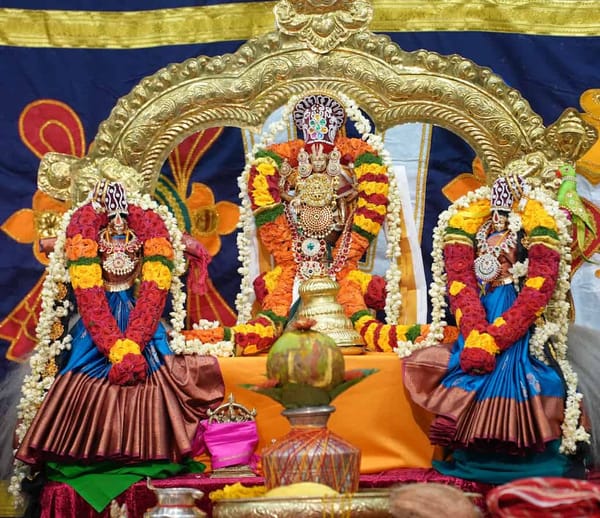
Goda Devi Kalyanam—also called Andal Kalyanam or Goda Kalyanotsavam—is the celebration of a love that reaches its fulfillment. On the outer level, it is remembered as the divine wedding of Andal with the Lord. But on the inner level, it is something even more tender: it is the day devotees honor the truth that pure longing for God is never left unanswered. Andal’s heart did not merely admire the Lord—it belonged to Him. And the Kalyanam marks that sacred culmination, where devotion matures into union.
The word kalyanam itself carries a fragrance of auspiciousness. It suggests joy, sanctity, and blessing—not only for one devotee, but for all who witness it. That is why temples celebrate it with such reverence: the divine wedding becomes a mirror held up to the human heart. It reminds us that bhakti is not a dry duty; it is a living relationship. The soul draws near to God through love and surrender, not force or display.
Devotees may describe the Lord in this festival with different beloved names—sometimes as Sri Ranganatha, sometimes devotionally as Sri Krishna—yet the essence is the same: Andal’s Beloved is the Supreme Lord Vishnu, the eternal refuge of the soul. What matters most is not which name is spoken, but the mood with which it is spoken—the mood Andal carried so naturally: “I want nothing from You, O Lord, except You.”
Andal Kalyanam is also deeply tied to the spiritual atmosphere of Margazhi/Dhanurmas, when devotees rise early and chant Andal’s Tiruppavai with the hope of awakening their own hearts. In many communities, the Kalyanam is celebrated as though the month-long devotion finally blossoms into a joyous offering—like a garland that has been patiently woven, flower by flower, until it is ready to be placed at the feet of the Lord.
Therefore, when devotees assemble for Goda Devi Kalyanam, their presence extends beyond simply attending a ceremonial event. They are stepping into a sacred reminder: the greatest celebration is not the grandeur outside, but the transformation within. If a heart can learn even a fraction of Andal’s selfless love—her sweetness, her steadiness, her yearning—then devotion stops being occasional and becomes natural. And that is the real blessing of this Kalyanam: it teaches the soul, gently and emphatically, that God can be loved—and God can be reached—through love alone.
Goda Devi Kalyanam celebrates the truth that selfless love ripens into divine closeness.
Meaning for Devotees Today (Andal’s Kalyanam as Inner Guidance)
It is easy to admire Andal from afar—her purity, her intensity, her unmistakable love. But the deeper purpose of Goda Devi Kalyanam is not simply to praise her; it is to let her devotion enter our own hearts. Andal’s life asks a gentle question: What do we truly want from God? Many people approach the Divine with a list of needs—relief from problems, success, protection, peace. These are natural, and God is compassionate. Yet Andal shows something rarer and more beautiful: to want God for God’s sake—to love Him not as a means, but as the very goal of life.
This is the heart of selfless bhakti. In selfless devotion, the ego slowly steps back. The devotee stops treating prayer as negotiation and begins to treat it as offering. The mind learns to say, “O Lord, I may not be perfect, but my love can be sincere. May my remembrance be pleasing to You. Let my actions become an offering. Let my heart belong to You.” Andal’s bhakti is powerful because it carries no hidden bargaining. It is simple, direct, and unguarded—like a child running toward the One she trusts most.
Goda Devi Kalyanam also teaches that devotion is not only emotion—it is direction. Longing becomes meaningful when it is protected through steadiness: waking the heart again and again, choosing purity over indulgence, choosing remembrance over distraction, choosing humility over self-display. Andal’s mood is deeply sweet, but it is never careless. Her love has backbone. And that is why her devotion transforms: it does not remain a passing feeling; it becomes a settled belonging.
For householders and busy modern lives, this message is especially comforting. Andal does not demand that everyone renounce the world; she shows how the world can be reordered around God. Even small changes—one sincere prayer before the day begins, one sacred verse remembered while cooking or driving, one act of service done quietly without craving appreciation—can slowly turn devotion from occasional to natural. In that sense, Goda Devi Kalyanam becomes a yearly reminder that bhakti is not meant to remain inside temples or books. It is meant to enter ordinary life and soften it from within.
Above all, this festival gives hope. Andal’s love did not end in separation. Her yearning was not ignored. The Kalyanam celebrates that divine assurance: when devotion becomes sincere and selfless, God responds—not always in the way the mind expects, but in the way the soul most needs. And this is the most practical meaning for devotees today: if we protect even a small spark of selfless love, it will gradually grow into a light that guides the whole life back to God.
The festival encourages seeking God sincerely and letting devotion guide everyday li
Swami Mukundananda’s Lens on Selfless Bhakti (The Andal Mirror)

Swami Mukundananda often emphasizes that the purest devotion is selfless love—bhakti that seeks nothing except to please God. When love is mixed with bargaining, it remains restless; it rises when things go our way and weakens when life becomes difficult. But when love becomes selfless, it gains quiet strength. It stops depending on external circumstances and begins to rest in a deeper joy: “My purpose is to love and serve the Lord.” This teaching resonates profoundly with Andal, because her entire life reflects devotion that is not transactional, but total.
In this light, Andal becomes a mirror for every seeker. She shows what happens when the heart’s deepest desire is not comfort, recognition, or even spiritual achievement, but simply nearness to God. Such bhakti is not passive emotion—it is an offering of the whole self. As love becomes increasingly selfless, the influence of the ego tends to diminish. As the influence of ego diminishes, devotion tends to become more genuine, straightforward, and consistent. Swamiji’s message here is both hopeful and practical: we do not need to force lofty states; we need to purify our intention—to ask, again, “Am I doing this for God’s pleasure, or for my own?”
Swamiji also highlights that selfless bhakti expresses itself not only in prayer, but in seva—loving service. When service is done for applause, it exhausts the heart. When it is done as an offering, it nourishes the heart. Andal’s mood teaches the same truth: love for God naturally wants to give. It wants to decorate, to sing, to serve, to surrender. In that sense, Goda Devi Kalyanam is not only a celebration of union; it is a celebration of the spirit that leads to union—service filled with love, love filled with surrender.
Finally, Swamiji often reminds devotees that divine love grows through consistency—a steady turning of the heart toward God each day. Andal’s Tiruppavai, recited through Margazhi mornings, reflects this beautifully: devotion returning repeatedly like a faithful rhythm, until remembrance becomes natural. Selfless bhakti is not built in dramatic moments; it is built in small daily offerings—quiet prayers, sincere chanting, humble service, and the decision to please God even when the mind would rather seek comfort.
If Andal is the festival’s living example, Swami Mukundananda’s lens helps translate that example into our own life: make devotion selfless, make service an offering, and make remembrance steady. In this way, Goda Devi Kalyanam becomes not just something we attend, but something we carry—an invitation to love God with a heart that asks for nothing, yet receives everything.
Selfless bhakti grows when intention is purified—to please God, not to gain from God.
Dhanurmas/Margazhi and the Tiruppavai Connection

Goda Devi Kalyanam carries the fragrance of Margazhi/Dhanurmas, the sacred season when devotion feels easier and the heart feels more willing to awaken for God. This month is cherished for its early mornings—when the world is quiet, the mind is less distracted, and remembrance becomes tender. In many homes and temples, the day begins before sunrise, as though the soul is learning to place God first again.
Andal embodies the spirit of Margazhi through her Tiruppavai, thirty verses that devotees both recite and practice. They hold the sweetness of longing and the seriousness of discipline together. Each verse feels like a gentle call: wake up, rise above comfort, gather your heart, and turn toward the Lord with love. Through Tiruppavai, Andal teaches that devotion is not a single moment of inspiration; it is a daily returning.
There is also something deeply communal in the Tiruppavai spirit. Andal’s voice does not only speak to the individual heart; it draws others along, as if devotion becomes stronger when it is shared. The season itself begins to feel like a collective journey—many hearts waking early, many mouths chanting, many lives simplifying. Even those who cannot do every detail feel the pull of the mood: let this month make me more sincere.
In that light, Goda Devi Kalyanam feels like the flowering of the month’s practice. The discipline of Margazhi does not end in dryness; it ripens into joy. The quiet dawn offerings gather strength day after day, and then, like a garland finally completed, the devotion is celebrated as Kalyanam—love reaching fulfillment. This is why devotees experience the festival not as a separate event, but as the culmination of a sacred rhythm.
Most importantly, the connection reminds us that the essence of Dhanurmas is not perfection, but direction. Even if one can only wake a little earlier, chant one verse, offer one sincere prayer, or choose one act of purity, that small sincerity matters. Andal’s Tiruppavai and the Margazhi mood together whisper the same truth: God is pleased not by display, but by the heart that keeps turning back—again and again—until remembrance becomes natural.
Dhanurmas and Tiruppavai teach the power of daily returning—again and again—until remembrance becomes natural.
Devotional Mood more important than date 2026
It is natural for devotees to ask, “On which exact day is Goda Devi Kalyanam in 2026?” And it is also natural to feel a little confused when different temples list different dates. Remember: devotion stays constant, even if the calendar changes. Goda Devi Kalyanam is closely associated with the concluding mood of Margazhi/Dhanurmas—the season of Tiruppavai recitation and early-morning worship. Traditionally, the anchor takes place around the sacred Bhogi/Pongal period.
At the same time, temples serve living communities. Many organize the public celebration on a nearby convenient day—often a weekend—so families can participate fully, children can attend, and the congregation can celebrate together without rushing. This is why you may see one temple observe it on a weekday closer to the traditional anchor, while another celebrates it on the following weekend. The intention is not to change the festival’s meaning, but to open the doors wider for collective devotion.
So the simplest way to hold this clarity is:
• Keep the spiritual anchor in your heart—this Kalyanam belongs to the Margazhi/Dhanurmas culmination mood.
• Follow the temple’s posted schedule for the community celebration you will attend.
Focus on Andal’s mood of longing and sincere devotion, rather than getting caught up in date-specific questions.
And perhaps this, too, is a quiet teaching hidden inside the “date question.” Devotion is not meant to become anxiety. When the heart is sincere, any day offered with Andal’s mood becomes sacred. The calendar guides us, but bhakti is what carries us
2026 Date Clarity (Quick Guide)
Spiritual anchor: Goda Devi Kalyanam is closely associated with the concluding mood of Margazhi/Dhanurmas and Tiruppavai recitation—often near the Bhogi/Pongal window.
Why different temples show different dates: Temples may schedule the public community celebration on a nearby weekend so families and the wider congregation can participate fully.
How to hold it peacefully:
• Keep the spiritual anchor in your heart—this Kalyanam belongs to the Margazhi/Dhanurmas culmination mood.
• Follow the temple’s posted schedule for the celebration you will attend.
• Stay centered on Andal’s mood of longing and sincere devotion, not date-anxiety.
Gentle reminder: The calendar guides us, but bhakti carries us.
Rituals and Celebration Elements Commonly Experienced by Devotees

Goda Devi Kalyanam is celebrated with the tenderness of a wedding and the reverence of worship. Temples create an atmosphere where devotion feels personal again—where the mind naturally quiets, and the heart begins to participate, not merely observe. Even for someone attending for the first time, the feeling is unmistakable: this is not entertainment; it is darshan-filled celebration, where love is offered to the Lord and received as grace.
Most celebrations include a sacred sequence of prayers, chanting, and offerings, culminating in the Kalyanam itself. Devotees may witness beautiful alankaram, hear the Lord’s names sung with joy, and feel the collective upliftment that comes when many hearts gather with one intention. The outward form may differ from temple to temple, but the inner thread remains the same: Andal’s mood of pure love is honored, and the Lord is welcomed as the divine Beloved who accepts that love.
There is also a special sweetness in how community devotion expresses itself on this day. Families come together, children watch with curiosity, elders feel the pull of tradition, and everyone receives the blessing of participating in something auspicious. Often, devotees also take part through seva or offerings—not as obligation, but as a way to say, “Let my hands also serve this love.” When service is done with humility, it becomes its own form of prayer.
Finally, the celebration usually concludes with prasadam, which devotees receive not as food alone, but as the Lord’s kindness made tangible. That final moment—hands extended, heart softened—often carries the real takeaway of the day: devotion is meant to be simple. Come with sincerity. Listen with attention. Offer what you can. Receive grace with gratitude. And carry a little of Andal’s sweetness back into daily life.
Radha Krishna Temple Dallas (2026 Celebration)
For devotees in the Dallas area, it is a special blessing to celebrate Goda Devi Kalyanam together in the atmosphere of temple devotion and community prayer. The Radha Krishna Temple Dallas has an official listing for the Shri Goda–Ranganatha Kalyanam in 2026, inviting devotees to participate in this sacred occasion as a congregation.
According to the temple’s posted schedule, the celebration is planned for Sunday, January 18, 2026, from 9:00 AM to 12:30 PM.
If you are attending, it helps to come with a simple inner intention: to sit in Andal’s mood for a few hours—listening, remembering, and offering your heart through the collective prayers.
Since temple schedules can sometimes include program-flow details or small updates, it is always best to refer to the temple’s event listing as you get closer to the date.
Whether you participate fully from beginning to end or join for part of the program, the essence remains the same: come with sincerity, and allow the celebration to awaken that sweet longing for God that Andal embodied so perfectly.
Conclusion
Goda Devi Kalyanam leaves the heart with a rare softness. It reminds us that the highest devotion is not complicated—it is love that is sincere, love that is selfless, love that keeps turning toward God even when the mind is pulled in many directions. Andal’s life shines like a gentle assurance: yearning for the Lord is not weakness; it is spiritual strength. Pure love leads to surrender. And when surrender becomes steady, grace quietly carries the soul closer than it ever imagined.
This is also why the festival feels so complete. Through Margazhi/Dhanurmas mornings and the spirit of Tiruppavai, devotion is nurtured day by day—until it blossoms into the joy of Kalyanam. Outwardly, we celebrate a divine wedding; inwardly, we celebrate the soul’s possibility: that God can be approached not only with fear or formality, but with tenderness and belonging.
If we want to take Andal’s gift into daily life, we do not need grand gestures. We only need one sincere step. Choose one small offering that you can protect—an earlier morning prayer, a few minutes of chanting, one verse remembered, one act of service done quietly, one intention repeated through the day: “Let this please You, my Lord.” That simple selfless turn of the heart is where devotion begins to become real.
May Goda Devi’s love awakens that same sweetness within us. And may the Lord—who accepted Andal’s yearning—also accept our imperfect but sincere devotion, and draw us closer to Him, step by step, until remembrance becomes natural and love becomes our home.
Takeaways:
- Goda Devi Kalyanam turns worship into celebration—where devotion feels personal, tender, and alive.
- The outer ceremony may vary, but the inner thread remains the same: Andal’s pure love is honored, and grace is received.
- Kalyanam is not something we merely watch—it is something we participate in through attention, chanting, and heartfelt offering.
- When seva is done quietly as an offering, it becomes a form of prayer and deepens the sweetness of the day.
- The joy of community devotion is itself a blessing—many hearts gathering in one intention lifts each individual heart.
- Prasadam becomes the festival’s final teaching: devotion is simple—offer sincerely, receive gratefully, and carry the sweetness home.
Call to Actions:
1.To deepen the spirit of selfless bhakti, listen to Swami Mukundananda’s discourses on pure devotion—especially the teachings on the gopis’ selfless love, which beautifully echoes Andal’s mood. Then bring that inspiration into action: attend Goda Devi Kalyanam at your local temple, participate in seva, and let your daily remembrance become steadier and sweeter.
2.Come and receive the blessings of Goda Devi Kalyanam with a prayerful heart. If you are in the Dallas area, join the celebration at Radha Krishna Temple Dallas and participate with devotion—through darshan, chanting, and seva.
Frequently Asked Questions:
1) What is Goda Devi Kalyanam (Andal Kalyanam)?
It celebrates Andal’s divine union with the Lord and reminds devotees that selfless bhakti ripens into grace and closeness.
2) Who is Goda Devi (Andal), and why is her bhakti revered?
Andal is the saint-poetess of single-pointed longing for God. She is cherished for her pure, intimate, “bridal bhakti” that seeks only the Lord.
3) Why is it linked to Margazhi/Dhanurmas and Tiruppavai?
Margazhi/Dhanurmas is a season of early-morning devotion. Andal’s Tiruppavai (30 verses) shapes this month, and the Kalyanam is often seen as its joyful culmination.
4) Why do temples list different dates in 2026?
The festival is spiritually anchored to the end-of-Dhanurmas/Bhogi–Pongal window, but temples may celebrate on a nearby weekend for community participation.
5) How is Goda Devi Kalyanam typically celebrated?
Usually with prayers, chanting, offerings, the Kalyanam ceremony, and prasadam—with devotees participating through darshan, recitation, and seva.
6) How can I practice Andal’s bhakti at home?
Choose one simple offering for a week: earlier prayer, a few lines of Tiruppavai, or quiet seva—and keep one intention: “Let this please You, my Lord.”
Reference Gallery (Resources & Citations)
Radha Krishna Temple Dallas Goda Devi Kalyanam Videos
Video 1 Kalyanam Live Official temple page
https://www.radhakrishnatemple.net/Kalyanam-Live
Video 2 YouTube highlights Glimpses
https://www.youtube.com/watch?v=wYe-XMb2lKI
Video 3 YouTube full program recording
https://www.youtube.com/watch?v=edf79IcbYGM
Swami Mukundananda Selfless Bhakti and Gopis Pure Love
Video 1 Gopis selfless love for Krishna
https://www.youtube.com/watch?v=IMchlqbJ0Ks
Video 2 Gopi Geet Explained
https://www.youtube.com/watch?v=rmUiaTgCPyA
Video 3 How selfless love enslaves God
https://www.youtube.com/watch?v=XY9VHXTqodk
Official site pages if you prefer non YouTube links
https://swamimukundananda.org/en/videos/gopis-love-for-shree-krishna-thatll-melt-your-heart-the-gopi-geet-explained-shreemad-bhagavatam-3949/
https://swamimukundananda.org/en/videos/how-selfless-love-enslaves-god-shreemad-bhagavatam-2949/
Temple Event Reference Dallas 2026
Shri Goda Ranganatha Kalyanam Sunday January 18 2026 9 00 AM to 12 30 PM
Use the official RK Temple events listing for the latest updates