📅 Diwali 2025 – Festival Days & Their Spiritual Meaning
Let’s begin with a clear, beautiful overview of the 5 days of Diwali — not just in terms of the calendar, but also their inner symbolism, as inspired by the Ramayana and Swamiji’s teachings.
| 🗓️ Date | 🪔 Day | 🌸 Festival Name | 🕉️ Spiritual Significance |
|---|---|---|---|
| Oct 17, 2025 (Fri) | Day 1 | Dhanteras | A day to honor Dhanvantari, the divine healer. Begin the cleansing of not just homes but hearts. Let light enter through health, simplicity, and gratitude. |
| Oct 18, 2025 (Sat) | Day 2 | Naraka Chaturdashi / Choti Diwali | Symbolizes the destruction of darkness — both demonic (Narakasura) and internal (ego, anger). |
| Oct 19, 2025 (Sun) | Day 3 | Main Diwali (Deepavali) | The day Lord Ram returned to Ayodhya. Lamps lit in every home — but more importantly, every heart. |
| Oct 20, 2025 (Mon) | Day 4 | Govardhan Puja / Annakut | Krishna lifts Govardhan Hill — an invitation to surrender our ego and take refuge in divine protection. |
| Oct 21, 2025 (Tue) | Day 5 | Bhai Dooj | A celebration of sacred sibling bonds, reminding us of divine family ties like Lakshman–Urmila, Ram–Bharat. |
🎉 Join the grand Diwali Mahotsav at Radha Krishna Temple of Dallas »
Enlighten your celebration with spiritual kirtans, dance, divine satsangs, fireworks & prasad. Families across the world welcome.

📜 Table of Contents
🌌 Part 1: A Return Beyond Time
- 🌌 Ayodhya in Waiting — A Nation in Darkness
- 🕯️ What Diwali Really Celebrates
- 🎭 Why Ram Had to Leave: The Divine Drama Begins
- 🐍 Manthara: The Shadow That Set the Light in Motion
- ✨ Reflection: The Mantharas in Our Own Lives
- 📖 From Ramayana to Your Life
- 🎭 The Real Reason Ram Had to Go
- 🧭 What This Means for You
🪔 Part 2: The Devotees Who Lit the Inner Lamps
🌟 Part 3: Let Ayodhya Rise Within You
- 🕯️ Lighting the Inner Ayodhya
- 📖 Bhagavad Gita Speaks to Diwali
- 🧘♀️ How to Celebrate Diwali in a Spiritually Fulfilling Way
- 🛕 Join a Grand Celebration: Radha Krishna Temple of Dallas
- 📺 Call to Action: Stay Inspired Year-Round
- ❓ Diwali FAQs
- 🧡 Closing Reflection: Let Your Soul Become Ayodhya
- 📚 References & Links
Part 1: A Return Beyond Time
Inspired by the Teachings of Swami Mukundananda
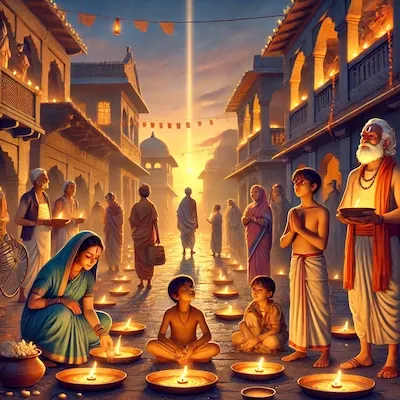
"Ayodhya Awaits: A City Lit by Longing, Not Lamps"
🌌 Ayodhya in Waiting — A Nation in Darkness
"After 14 years, the Lord of your life has come back. The lamp is being lit not just outside — but inside your soul."
— Swami Mukundananda
Let us time-travel to the banks of the river Sarayu, in Treta Yuga.
It’s twilight.
The kingdom of Ayodhya waits — breath held, hearts stilled.
Every home has cleaned its courtyard. Every doorway is lined with deepaks.
But beneath the golden glow lies a longing… a yearning that words cannot contain.
For 14 years, Ayodhya had lived with the absence — not of a king, but of its divine soul.
Lord Ram was not just a prince of Ayodhya.
He was their beloved, their reason to breathe, their light.
On this night, He returns.
🕯️ What Diwali Really Celebrates
When most people think of Diwali, they think of:
- Lights and fireworks
- New clothes
- Sweets and celebrations
- Lakshmi Puja
But if we stop there, we miss the soul of the celebration.
Swami Mukundananda beautifully reveals:
“We decorate our homes with diyas. But the real Diwali is when we decorate our inner world with light — the light of divine remembrance.”
The true Diwali occurred when Ayodhya became Ayodhya again — not a city of palaces, but a city of love for Lord Ram.
The residents of Ayodhya weren’t celebrating wealth.
They were celebrating the return of meaning.
Of hope.
Of dharma.
Of God.
🎭 Why Ram Had to Leave: The Divine Drama Begins
Now comes the paradox.
If we love Ram so much… why did He leave?
Why was He banished to the forest for 14 years?
Why did the Lord of Light plunge His devotees into darkness?
Swamiji answers this with stunning clarity:
“We all want celebration. But we forget — it is the dark nights that prepare us for the bright dawns.”
Let’s unfold this together.
🐍 Manthara: The Shadow That Set the Light in Motion
"Manthara is not dead. She's still alive. Sometimes… within us."
Manthara — a hunchbacked maid — twisted Kaikeyi’s mind.
Kaikeyi, once a mother of love, demanded Ram’s exile.
King Dashrath’s heart shattered.
Ram left.
And we ask:
“Why did God allow this to happen?”
Swamiji explains:
- Without Manthara, there would be no Ramayana.
- No forest exile.
- No meeting with Shabari.
- No building of Ram Setu.
- No battle with Ravan.
- No Deepavali.
Manthara is the necessary trigger in God’s divine play.
✨ Reflection: The Mantharas in Our Own Lives
Every one of us has a Manthara.
That one person who:
- Constantly criticizes us
- Blocks our progress
- Sows division and doubt
- Tests our patience, love, and dharma
Swamiji says: “We pray, ‘O Lord, remove this Manthara from my life!’ But in truth, God placed them there… for our purification.”
These adversities, like chisels, sculpt us.
They make us:
- Humble
- Spiritually alert
- Emotionally refined
- Devoted beyond comfort
📖 From Ramayana to Your Life
Imagine if the Ramayana were written without the exile.
Ram would have been king.
Everything would be perfect.
But…
There would be no depth, no transformation, no inner revelation.
Swamiji shares:
“If there was no Vanvas, there would be no Diwali. The greatest joys are born from our greatest tests.”
That’s not just philosophy — it’s your story.
Your exile.
Your heartbreak.
Your setbacks.
These are not detours.
They are the very path to your soul’s reunion with divine love.
🎭 The Real Reason Ram Had to Go
Let’s explore a divine secret Swamiji shared during the 2023 Diwali Mahotsav:
When Dashrath wanted to coronate Ram, he asked Guru Vasishtha for an auspicious date.
“What better muhurat can there be,” the sage said, “than Ram himself taking the throne?”
But Dashrath delayed it by one day.
That one day… was enough for fate to slip in.
Manthara struck. Kaikeyi demanded.
Ram was exiled.
Swamiji connects this to our own procrastination:
“We hear we should do sadhana. We say, ‘Yes, Swamiji, we’ll begin… but not today — tomorrow.’
And like Dashrath, that one day’s delay… changes everything.”
🧭 What This Means for You
Don’t delay your inner coronation.
Ram is ready to return — not to Ayodhya, but to your heart.
Light the lamp.
Clear the path.
Don’t wait.
💡 Divine Whisper:
“Every challenge in your life is writing your own Ramayana.
Will you turn your pain into purification?”
Part 2: The Devotees Who Lit the Inner Lamps
Inspired by the Teachings of Swami Mukundananda
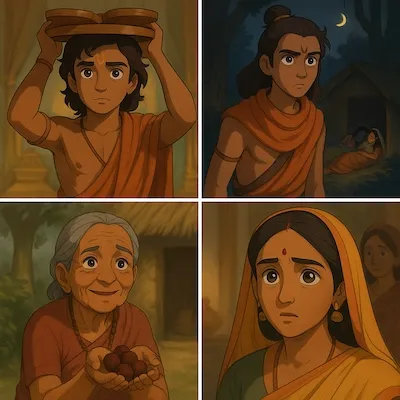
"Bharat renounced the throne, Lakshman gave up sleep, Shabari waited with love, and Kaushalya bore silent pain. Four unsung hearts, one divine devotion."
📌 In Part 1, we witnessed the stage being set: Lord Ram’s exile, Ayodhya’s longing, the orchestration of adversity through Manthara — and Swamiji’s revelation that without exile, there would be no Diwali.
Now in Part 2, we explore the lives of those who lit inner Deepavalis in the forest, in sacrifice, in separation — and emerged with devotion so luminous, it rivals the lamps of Ayodhya.
👑 Bharat: The Monarch Who Refused the Throne
“Bharat ruled the kingdom… but from the ground, not the palace. He ruled on Ram’s command, not his own ambition.”
When Bharat returned from Kaikeyi's Desh and learned of Ram’s exile, he was devastated. But what’s remarkable is his reaction:
- He did not celebrate his new position.
- He did not blame Kaikeyi.
- He saw only dharma and devotion.
Swamiji explains this divine integrity:
“Bharat said: ‘My father had no right to give the kingdom to me — it belonged to Ram. I reject it unless Ram himself commands me.’”
🩵 The Journey to Chitrakoot
Bharat walked barefoot — with a massive entourage — all the way to the forest.
He begged Ram to return. He pleaded. He wept.
But Ram stood firm. “We must honor our father’s word.”
Bharat then did something extraordinary.
He placed Ram’s padukas (sandals) on the throne and vowed:
- To rule as a servant, not a sovereign.
- To live in Nandigram, not the palace.
- To sleep on the floor, wear bark clothes, and eat simply — until Ram returned.
✨ Reflection: Bharat’s Inner Diwali
Bharat teaches us:
- Power is not real authority; surrender is.
- Love does not seek control — it seeks obedience to dharma.
- The real throne is not in a palace — it’s in the heart that worships God.
“Let Ram’s sandals sit on your heart’s throne.
Become a ruler by becoming a servant.”
🪶 Lakshman: Sleepless in Service
Lakshman, upon hearing of Ram’s exile, didn’t wait for instruction.
He declared:
“If Ram leaves, I follow. If he doesn’t allow me, I will surrender my life to the Saryu river.”
🔥 The Vow of Wakefulness
For 14 years, Lakshman:
- Did not sleep.
- Guarded Ram and Sita.
- Lived like a yogi.
And yet… he never once complained.
“Lakshman’s seva was not duty. It was bhakti in action.”
— Swamiji
💔 And What of Urmila?
His wife? Urmila?
She silently accepted her role — a queen without her husband, left behind in the palace.
But Urmila’s sacrifice is not lesser. It’s greater.
She vowed:
“If Lakshman does not sleep, then I shall not light a lamp in my room.”
14 years. In solitude. Without complaint.
This is the strength of divine feminine energy — silent, steady, and spiritually supreme.
👸 Kaushalya: A Mother’s Roar of Love
Kaushalya, Ram’s mother, stood strong like a mountain — but inside, her heart wept.
When she learned of Lakshman’s injury in battle, she told Ram:
“If anything happens to Lakshman, do not return to Ayodhya.”
This was not just motherly emotion — it was spiritual oneness.
Kaushalya saw Lakshman not as her daughter-in-law’s husband, but as her own son.
Swamiji says:
“Such bonds — formed not by blood, but by bhakti — are deeper than the ocean.”
🧓 Shabari: Devotion Without Expectation
Perhaps the most touching Leela is that of Shabari — the old tribal woman who waited decades in the forest for Ram.
Her guru had promised, “One day, Lord Ram will visit you.”
So what did she do?
Every day:
- She swept the path.
- Decorated her hut.
- Plucked sweet berries.
- Waited with full faith.
One day… He came.
And Shabari offered the berries — one by one — first tasting them to ensure they were sweet.
Ram accepted them. Gladly.
“Devotion, not perfection, pleases the Lord.”
🕯️ A Light in the Forest: The Real Deepavali
Let us pause and reflect.
Where was the real Deepavali?
- In Ayodhya with golden lamps?
- Or in Shabari’s hut with hand-picked berries?
- In Nandigram, where Bharat lit the lamp of renunciation?
- In the forest, where Lakshman guarded Ram?
- In Urmila’s silent chamber, dark for 14 years?
“Deepavali is not a day. It is the state of your inner lamp.”
💎 The Sculptor and the Wood: Swamiji’s Divine Metaphor
Swamiji shares a parable:
The wood went to the sculptor and said, “Make me beautiful.”
The sculptor agreed and began chiseling.
The wood cried, “Stop! It hurts!”
But the sculptor whispered, “If you want to become divine, you must endure the chisel.”
In time, the wood became a murti (deity) — worshipped by thousands.
- Adversity is not punishment. It is God’s tool.
- Every hardship is a sculptor’s stroke.
- Ram’s exile was not a tragedy — it was the sculpting of the soul.
Swamiji reminds:
“Our prayer should not be: ‘God, make me comfortable.’
It should be: ‘God, make me beautiful from within.’”
🧘 Kunti’s Prayer & The Gita Connection
Swamiji beautifully connects this with Kunti’s prayer to Krishna:
“O Lord, give me more suffering… for in pain, I remember You most.”
This sounds shocking. But it is deeply profound.
When life is easy, we forget.
When life is shaken, we awaken.
📖 Bhagavad Gita 2.15 says:
“O Arjun, the wise who remain unaffected by joy and sorrow, whom these cannot disturb, they alone are fit for liberation.”
🔗 Read Verse »
💡 Divine Whisper:
“Comfort breeds forgetfulness.
Suffering awakens remembrance.
Every exile is a disguised invitation — to come closer to God.”
Part 3: Let Ayodhya Rise Within You
Inspired by the Teachings of Swami Mukundananda
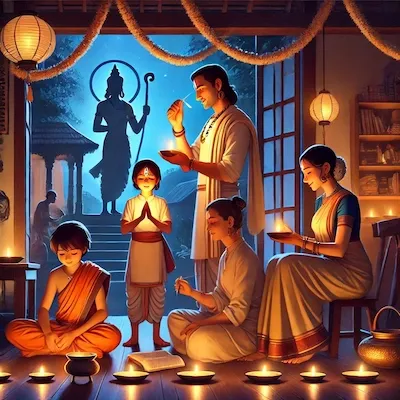
"Let Ayodhya Rise Within: In Every Home Where Devotion Dwells"
📌 In Part 1, we walked through Ayodhya’s longing and the divine orchestration of Ram’s exile. In Part 2, we met Bharat, Lakshman, Urmila, Shabari — and explored how Deepavali truly ignites within.
Now, in Part 3, we bring these teachings home — to your life, your practice, and your celebration this Diwali.
🕯️ Lighting the Inner Ayodhya
“We’ve cleaned our homes. But have we cleaned our hearts?”
— Swami Mukundananda
In today’s world, Diwali is a burst of shopping, décor, gifts, and noise. But in the silence of the heart lies a question:
Have I invited Lord Ram to return within me?
Swamiji encourages us to ask:
- Have I dethroned ego and made space for God?
- Have I welcomed dharma over desire?
- Have I let go of the Kaikeyis and Mantharas of my mind?
💡 Spiritual Deepavali is not about external firecrackers. It’s the explosion of divine light within your consciousness.
📖 Bhagavad Gita Speaks to Diwali
📜 Gita Verse 10.11:
“To show special mercy to them, I, dwelling in their hearts, destroy with the shining lamp of knowledge the darkness born of ignorance.”
🔗 Read on Holy-Bhagavad-Gita.org »
This verse is the very definition of Diwali.
God lights the lamp within you — only if you’re willing to offer the oil of surrender.
🧘♀️ How to Celebrate Diwali in a Spiritually Fulfilling Way
- Wake Before Sunrise
Begin with silence, breath, and reflection. Let your day start with light. - Offer Gratitude
Thank the Divine for both joys and challenges. Each has shaped your soul. - Light a Diya at Your Home Altar
Let it symbolize your intention to live in light — not just for a day, but every day. - Chant the Divine Name
“Shri Ram Jai Ram Jai Jai Ram” — just one mala can flood your being with bhakti. - Read or Listen to Ram Katha
Swamiji’s lectures are a well of nectar. Let Ramayana become your mirror. - Fast From Negativity
Avoid gossip, ego-talk, and anger. Let it be a true spiritual fast. - Give Selflessly
Serve your family, temple, or strangers. Diwali is about giving, not just gifting. - Forgive & Let Go
Release your Mantharas. Embrace your Bharats. Begin again.- Decorate With Intention
Each diya, each rangoli should be an offering — not an obligation.
- Decorate With Intention
- Invite Others Into Devotion
Whether by sharing prasadam, wisdom, or a kind word — let your Diwali uplift someone else’s.
🛕 Join a Grand Celebration: Radha Krishna Temple of Dallas
🎉 Looking to experience the essence of Diwali with family, community, and spiritual upliftment?
You are warmly invited to the Diwali Mahotsav at Radha Krishna Temple of Dallas:
🌸 What to Expect:
- Soulful kirtans
- Ram Katha & Gita wisdom from Swamiji & senior speakers
- Exquisite aarti & darshan
- Grand fireworks & Annakut
- Family-friendly cultural programs
- Delicious sattvic prasad
📍 Location: Radha Krishna Temple of Dallas
Come celebrate Diwali the way Ayodhya did — in joy, in light, in devotion.
📺 Call to Action: Stay Inspired Year-Round
This Diwali, don’t let the flame die out.
Let Swamiji’s daily teachings be your lamp — illuminating the path of:
- Self-purification
- Devotional service
- Bhagavad Gita understanding
- Divine love
👉 Subscribe to Swami Mukundananda’s YouTube Channel »
And receive Ram Katha, Bhagavad Gita discourses, Q&A, and guided meditations — directly from a living spiritual master.
❓ Diwali FAQs
What is the real meaning of Diwali?
Diwali marks Lord Ram’s return to Ayodhya after 14 years of exile. Spiritually, it represents the return of divine light to the soul after the darkness of ego, forgetfulness, and suffering.
How do Swami Mukundananda's teachings change the way we celebrate Diwali?
Swamiji reveals Diwali as an inner celebration — lighting the lamp of knowledge, letting go of attachments, and remembering that the real Ayodhya is within us.
What is the significance of the 5 days of Diwali?
Each day has spiritual meaning — from Dhanteras (health and gratitude) to Govardhan Puja (surrender to God). All point toward inner purification.
How can families celebrate Diwali spiritually?
- Attend temple celebrations
- Chant together as a family
- Share Ramayana stories with children
- Listen to Swamiji’s Diwali playlists on YouTube
- Avoid wasteful or ego-driven rituals — focus on love and light
Where can I celebrate Diwali with a spiritual community?
Join the Radha Krishna Temple of Dallas. Events are open to all, in-person or virtually, and designed to uplift your Diwali into devotion.
🧡 Closing Reflection: Let Your Soul Become Ayodhya
“Do not wait for Lord Ram to descend into your world.
Build Ayodhya in your soul — and He shall return.”
This Diwali, may your lights shine not just on your doorstep…
…but in the dark corners of your being.
May your love resemble Bharat’s.
May your seva reflect Lakshman’s.
May your patience mirror Urmila’s.
May your faith imitate Shabari’s.
And may your every breath chant the name of Lord Ram.
📚 References & Links
- Swami Mukundananda's Diwali Mahotsav Satsang (2023)
- Swamiji’s YouTube Channel »
- Bhagavad Gita – Verse Source
- Radha Krishna Temple of Dallas – Diwali 2025
- Ramcharitmanas by Tulsidas (devotional reference)
🪔 May the Divine Light of Diwali fill your life with the fragrance of bhakti, the colors of dharma, and the brightness of eternal joy.
Jai Shri Ram!
Happy Deepavali 2025!