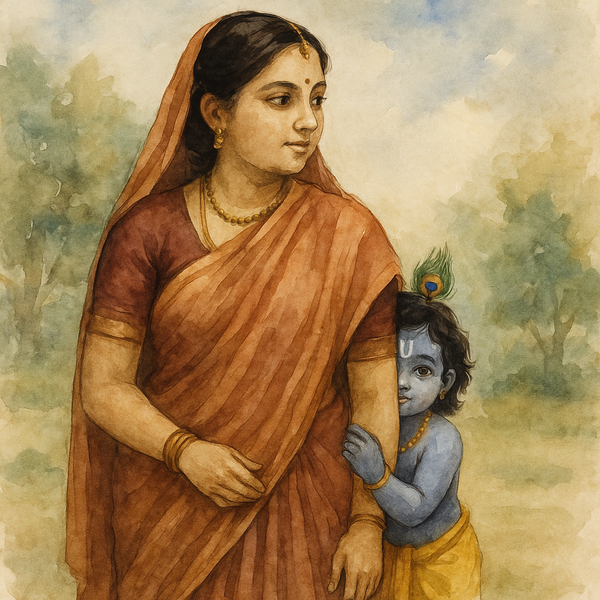
The Bhagavad Gita, a timeless spiritual guide, offers profound insights into navigating life's challenges. Its teachings, delivered by Lord Krishna to Arjuna on the battlefield of Kurukshetra, provide wisdom on making decisions rooted in righteousness and clarity. Let's explore key verses from the Gita, each accompanied by stories from the Mahabharata or Puranas, to understand how these teachings can guide us through difficult times.
1. Perform Your Duty Without Attachment to Results

Bhagavad Gita 2.47
“You have a right to perform your prescribed duties, but you are not entitled to the fruits of your actions.”
Read the verse
Story of King Rantideva: A Symbol of Selfless Duty Without Attachment
King Rantideva was a noble and righteous king, celebrated for his unwavering devotion to God and his compassion for all beings. He believed in serving others as a form of worship and accepted suffering joyfully if it pleased the Lord.
The Test of True Selflessness
Once, after fasting for 48 days, King Rantideva and his family finally prepared to eat a simple meal. Just as he was about to take his first bite, a hungry Brahmin arrived at his door. Without hesitation, the king offered him a portion of the food. The Brahmin left, grateful.
As the king again prepared to eat, a Shudra (lower caste man) came, pleading for food. Rantideva gave him another portion.
Then came a foreigner with his dogs, asking for food. Rantideva fed both the man and the dogs with whatever little remained.
Now, all the food was gone, and King Rantideva hadn’t eaten a single morsel.
Revelation
At that moment, Brahma, Vishnu, and Mahesh appeared before him. They had taken the forms of the guests to test his devotion and detachment. Rantideva passed the test, having performed his dharma of hospitality and compassion without any attachment to results — not even the result of breaking his fast.
Moral and Connection to Gita 2.47:
King Rantideva never acted for personal gain or comfort. His actions were guided by selfless devotion and duty, not by expectation of reward — perfectly embodying:
“You have a right to perform your prescribed duties, but you are not entitled to the fruits of your actions.” – Bhagavad Gita 2.47
His life teaches that when we perform our duties with sincerity and offer the results to God, we remain free from bondage and anxiety, growing in spiritual stature.
2. Make Decisions with a Steady Mind
Bhagavad Gita 2.70
“A person who is not disturbed by the incessant flow of desires—that enter like rivers into the ocean, which is ever being filled but is always still—can alone achieve peace.”
Read the verse
King Ambarisha’s Test of Equanimity

King Ambarisha was a great devotee of Lord Vishnu. Though he was a wealthy king with access to all comforts and pleasures, his mind remained undisturbed by desires. He ruled justly, but his heart was fully surrendered to the Lord.
Once, he undertook the Dvadasi vrata, a spiritual fast that required breaking the fast at a precise time. Just before that moment, the powerful sage Durvasa visited the palace. As per etiquette, the king welcomed him and offered food. However, Durvasa said he would bathe and return.
Time passed and the auspicious moment to break the fast was slipping away. If the king broke his fast without feeding the sage first, it would be disrespectful. But if he didn’t break it at the exact time, he would violate the religious vow.
King Ambarisha calmly consulted learned sages and decided to sip a drop of water, which was considered both a way to break the fast and still respectful to his guest.
When Durvasa returned and learned that the king had sipped water before feeding him, he became furious. In his anger, he created a fiery demon to destroy the king.
But King Ambarisha remained steady, calm, and surrendered to God, showing no sign of fear or retaliation. Lord Vishnu immediately sent His Sudarshana Chakra, which destroyed the demon and pursued Durvasa. The sage ran to Lord Brahma, Lord Shiva, and finally Lord Vishnu, but none could help. Vishnu declared:
“I am bound by the love of My devotees. You must go back to King Ambarisha and beg for his forgiveness.”
Humbled, Durvasa returned and fell at the king’s feet. Despite being wronged, King Ambarisha forgave him instantly, showing no ego, no pride—only divine equanimity.
Lesson:
Like the ocean receiving rivers without overflowing, King Ambarisha received anger, disrespect, and threat—but his mind remained calm, anchored in devotion and righteousness. He made the right decision without panic, illustrating the essence of Gita 2.70: a steady mind leads to true peace.
3. Align Actions with Righteousness (Dharma)
Bhagavad Gita 3.19
“Therefore, always perform your duty efficiently and without attachment to the results, because by doing work without attachment, one attains the Supreme.”
Read the verse
Story of Sant Eknath’s Journey to the Godavari

Sant Eknath Maharaj (1533–1599), a revered saint-poet of Maharashtra and a great proponent of Bhakti and Karma Yoga, lived a life fully aligned with dharma and detachment.
Once, Eknath Maharaj undertook a pilgrimage to Kashi (Varanasi) and brought back holy Ganga water for abhishek (ritual bathing) of the deity Rukmini in his hometown Paithan. He carried it with great care across a long and arduous journey by foot.
Just as he was nearing Paithan, he saw a thirsty and dying donkey on the roadside. Despite being mocked by some onlookers and knowing he had carried the water for a sacred offering, he poured the Ganga water into the donkey’s mouth, saving its life.
Eknath explained, “If I can’t see God in this suffering creature, what use is my pilgrimage or ritual?”
Lesson:
Sant Eknath Maharaj’s action teaches that true dharma lies in compassion, and God resides in all beings. Performing duty with sincerity and without concern for praise or outcome leads to inner purity and spiritual growth, just as Lord Krishna advises in Bhagavad Gita 3.19.
4. Control Desires and Anger
Bhagavad Gita 3.37
“It is lust only, Arjuna, which is born of contact with the mode of passion and later transformed into wrath; and it is the all-devouring sinful enemy of this world.”
Read the verse
Story: The Fall of Karna – The Consequences of Uncontrolled Desire and Anger

Scriptural Source: Mahabharata, Adi Parva (Book of the Beginning)
One of the most tragic figures in the Mahabharata is Karna, who embodies the devastating effects of uncontrolled desire and anger. Though Karna is admired for his loyalty, bravery, and generosity, his inability to control his desires and anger led to his downfall and ultimate demise.
Karna was born to Kunti before her marriage to King Pandu, and was abandoned at birth, raised by a charioteer and his wife. Due to his humble beginnings, Karna’s desire to prove his worth and gain recognition led him to align with Duryodhana, the main antagonist of the Mahabharata, and become his close ally.
Karna’s desire for recognition and power was fueled by his growing resentment of the Pandavas, particularly Arjuna, who was the person he most wanted to surpass. When Karna was publicly humiliated by Drona and others at the royal court for his lower status, his anger boiled over. He desired to show that he was as capable as any prince, even though he wasn’t born into royalty. This desire for respect led him to take a rash oath: “I will defeat Arjuna in battle, no matter what.”
But as the war of Kurukshetra progressed, Karna’s desires became more intense, and his anger grew at the thought of being continually overshadowed by Arjuna. He became obsessed with the idea of defeating Arjuna and proving his superiority, which clouded his judgment. This obsession became his undoing.
The most telling moment came when Karna was faced with a crucial decision during the battle. When he was in a vulnerable position, his chariot wheel got stuck in the mud. At this critical moment, Karna’s anger and desire for victory led him to refuse help from his enemies, even though it would have been a fair and honorable act to do so. Arjuna, following the advice of Lord Krishna, used this opportunity to shoot a fatal arrow, killing Karna.
Despite Karna’s greatness, his uncontrolled anger and desire for power led him to make choices that caused his tragic death. His refusal to follow a righteous path, and his inability to let go of his resentment towards Arjuna and the Pandavas, consumed him.
5. Embrace Change and the Eternal Nature of the Soul
Bhagavad Gita 2.22
“As a person sheds worn-out garments and wears new ones, likewise, at the time of death, the soul casts off its worn-out body and enters a new one.”
Read the verse
Story: The Rebirth of King Jalandhara
King Jalandhara, after being defeated by Lord Shiva, was reborn due to his past deeds and devotion. His soul's journey illustrates the Gita's teaching on the eternal nature of the soul and the cycle of birth and rebirth.
Lesson:
Understanding the impermanence of life and the soul's continuity helps in making decisions without fear of change or loss.
6. Surrender to the Divine Will

Bhagavad Gita 18.66
“Abandon all varieties of dharma and just surrender unto Me alone. I will deliver you from all sinful reactions; do not fear.”
Read the verse
Story: Draupadi's Surrender
During her disrobing in the Kaurava court, Draupadi, after exhausting all efforts, surrendered completely to Lord Krishna. Her unwavering faith led to divine intervention, protecting her honor.
Lesson:
Draupadi's surrender to Krishna in her darkest hour is a profound lesson in the power of surrender to the Divine will. When we are faced with overwhelming challenges, instead of clinging to our limited abilities, we can surrender ourselves to the higher power and trust that the Divine will provide a way. This teaching from the Bhagavad Gita encourages us to abandon all attachments, seek refuge in the Divine, and be assured that the Lord will take care of us, just as He did for Draupadi.
7. Maintain Equanimity in Success and Failure
Bhagavad Gita 2.38
“Treating alike pleasure and pain, gain and loss, victory and defeat, engage in battle for the sake of duty; thus, you shall not incur sin.”
Read the verse
Shri Ram’s Equanimity: The Day of the Coronation

The day Shri Ram was to be coronated as the king of Ayodhya, joy and celebration filled the air. The entire kingdom was eager to see their beloved prince ascend to the throne. But fate had other plans. In a sudden and unexpected twist, Queen Kaikeyi, driven by the desire to fulfill an old promise, asked King Dasharath to crown her son, Bharata, instead of Ram and to exile Shri Ram for fourteen years.
Despite the shock and heartache of the situation, Shri Ram’s response was one of complete composure. With profound respect and reverence for his father’s words, and without a trace of anger or bitterness, Shri Ram accepted the exile without questioning it. Even though this was the day he had waited for his whole life—the day he was to be crowned king—Shri Ram's devotion to dharma and his sense of duty to his father and his kingdom remained unwavering.
Ram’s equanimity in this moment teaches us an invaluable lesson. He could have protested, felt betrayed, or reacted in anger. But instead, he chose to embrace the circumstances with grace, fully aware that his life was a greater part of a divine plan. His ability to remain steadfast and composed, even in the face of personal loss, is a reflection of his unwavering commitment to righteousness and duty.
Lesson:
Shri Ram’s response to such an unfair situation shows that true strength lies in remaining balanced and composed, regardless of external circumstances. When we face challenges or setbacks, our ability to maintain calmness, act with integrity, and trust in the larger purpose helps us rise above adversity. This inner strength and equanimity allow us to make decisions grounded in dharma and fairness, just as Shri Ram did.
8. Understand the Nature of Action and Inaction
Bhagavad Gita 4.18
“One who sees inaction in action, and action in inaction, is intelligent among men; he is a yogi and engaged in all actions.”
Read the verse
Story: Sage Vasistha's Wisdom
Sage Vasistha taught that true action is performed without attachment, and inaction is not merely abstaining from work but being free from desire. His teachings emphasize the subtle understanding of karma.
Lesson:
Recognizing the deeper essence of actions leads to more conscious and deliberate decision-making.
9. Seek Knowledge and Wisdom
Bhagavad Gita 4.34
“Learn the truth by approaching a spiritual master. Inquire from him submissively and render service unto him. The self-realized souls can impart knowledge unto you because they have seen the truth.”
Read the verse
Story: Nachiketa's Quest for Knowledge
In the Katha Upanishad, young Nachiketa approaches Yama, the god of death, seeking knowledge about the soul. His humility and determination lead him to profound wisdom about life and beyond.
Lesson:
Seeking guidance from the wise and being open to learning enhances our ability to make informed decisions.
10. Act According to Your Nature

Bhagavad Gita 3.33
“Even a wise man acts according to his own nature, for everyone follows his nature. What can repression accomplish?”
Read the verse
Story: Arjuna's Return to Battle
Initially reluctant to fight, Arjuna is reminded by Krishna of his Kshatriya duty. Recognizing his inherent nature as a warrior, he returns to battle, fulfilling his role in the cosmic order.
Lesson:
Understanding and embracing our true nature leads to authentic and effective decision-making.
FAQs
Q1: How can the Bhagavad Gita help in modern decision-making?
The Gita provides timeless principles like duty, detachment, and discernment, which are applicable in personal and professional life today.
Q2: Is the Gita relevant only to spiritual seekers?
No, its teachings on ethics, leadership, and self-management are valuable to all individuals, regardless of spiritual inclination.
Q3: How does one practice detachment in daily life?
By focusing on actions rather than outcomes and accepting results with equanimity, as advised in the Gita.
Q4: Can the Gita's teachings be applied in business decisions?
Yes, principles like ethical action, responsibility, and balanced judgment are crucial in business contexts.
Q5: Where can I read the Bhagavad Gita online?
You can access the Bhagavad Gita with translations and commentaries at [holy-bhagavad-gita.org]
References:
- Perform Your Duty Without Attachment to Results
Bhagavad Gita 2.47
Read the verse here - Make Decisions with a Steady Mind
Bhagavad Gita 2.70
Read the verse here - Align Actions with Righteousness (Dharma)
Bhagavad Gita 3.19
Read the verse here - Control Desires and Anger
Bhagavad Gita 3.37
Read the verse here - Embrace Change and the Eternal Nature of the Soul
Bhagavad Gita 2.22
Read the verse here - Surrender to the Divine Will
Bhagavad Gita 18.66
Read the verse here - Maintain Equanimity in Success and Failure
Bhagavad Gita 2.38
Read the verse here - Understand the Nature of Action and Inaction
Bhagavad Gita 4.18
Read the verse here - Seek Knowledge and Wisdom
Bhagavad Gita 4.34
Read the verse here - Act According to Your Nature
Bhagavad Gita 3.33
Read the verse here