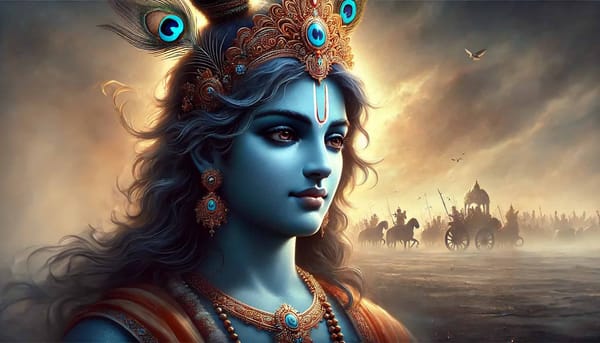
Chapter 2 of the Bhagavad Gita, titled Sankhya Yog or the Yoga of Knowledge, serves as the philosophical bedrock of the entire scripture. In this chapter, Shri Krishna imparts profound insights to the despondent Arjuna, addressing the nature of the self, the impermanence of the body, the essence of duty, and the path to spiritual wisdom. This discourse not only alleviates Arjuna's inner turmoil but also offers guidance for individuals navigating the complexities of life.
1. Arjuna's Despair and the Quest for Guidance
At the onset of the chapter, Arjuna is engulfed in sorrow and confusion, overwhelmed by the prospect of battling his own kin. He turns to Shri Krishna for counsel, expressing his inability to discern the righteous path.
To highlight the theme "Arjuna's Despair and the Quest for Guidance" from Bhagavad Gita 2.7, we can draw a powerful parallel from the Ramayana—the moment when Vibhishana, the brother of Ravana, faces a moral crisis and seeks guidance from Shri Rama.
Story from the Ramayana: Vibhishana Seeks Refuge in Shri Rama

In the grand narrative of the Ramayana, Vibhishana, the righteous brother of the demon king Ravana, finds himself in a moral dilemma. As Ravana stubbornly refuses to return Sita to Shri Rama, despite repeated counsel from his ministers and well-wishers, Vibhishana grows increasingly troubled.
Though born in a demon clan, Vibhishana is deeply dharmic by nature. He repeatedly warns Ravana that abducting Sita, a married woman, and refusing to return her, is adharma (unrighteous). He cites scriptural truths and pleads with Ravana to follow the path of righteousness and prevent doom from befalling their kingdom.
However, blinded by ego and rage, Ravana insults and banishes Vibhishana from his court. Now exiled, Vibhishana is torn between loyalty to his kingdom and loyalty to dharma.
Realizing that standing by Ravana would be supporting adharma, Vibhishana takes a courageous decision—he leaves Lanka and seeks shelter at the feet of Shri Rama.
Dialogue of Transformation
When Vibhishana arrives at Rama’s camp, Rama’s advisors, including Sugriva, express skepticism. They fear he might be a spy. But Shri Rama, with deep insight and compassion, declares:
"Sakrid eva prapanno yah tavasmiti ca yacate |
Abhayam sarvada tasmai dadamy etad vratam mama||"
(Valmiki Ramayana, Yuddha Kanda, Sarga 18)
"Whoever comes to Me but once, seeking refuge and declaring ‘I am Yours,’ I shall grant him protection always. This is My vow."
Rama accepts Vibhishana with open arms and crowns him as the future king of Lanka even before the battle begins.
Parallel with Arjuna’s Surrender – Gita 2.7
Like Vibhishana, Arjuna is torn—between svadharma (his personal duty as a warrior) and his emotional attachment to his family. Overwhelmed by grief and confusion, he puts down his bow, refusing to fight.
But in this crisis, instead of acting impulsively, Arjuna turns to Krishna. He acknowledges:
"Karpanya doshopahata svabhavah prcchami tvam dharma sammudha cetah |
Yat shreyah syan nishchitam bruhi tan me shishyah te aham shadhi mam tvam prapannam ||"
Bhagavad Gita 2.7
“Now I am confused about my duty and have lost all composure because of weakness. In this condition, I am asking You to tell me clearly what is best for me. Now I am Your disciple, and a soul surrendered unto You. Please instruct me.”
Just as Vibhishana surrenders to Shri Rama, seeking guidance in a moment of inner turmoil, Arjuna surrenders to Shri Krishna, the Supreme Teacher. Both display humility, wisdom, and the courage to admit their inner conflict and submit to divine counsel.
Lesson: The First Step to Spiritual Growth Is Surrender
Whether it is Vibhishana before Rama or Arjuna before Krishna, both stories highlight a fundamental truth of spiritual life: we must first acknowledge our own confusion and limitations before true knowledge can dawn.
❝Surrender is not weakness. It is the courage to open one’s heart to divine wisdom.❞
In everyday life, we often encounter moments of conflict—between emotional attachments and what is right, between fear and responsibility. Like Arjuna and Vibhishana, choosing to seek help, reflect, and surrender to dharma is the first major step on the path to transformation.
Lesson: Recognizing one's limitations and seeking guidance is the first step towards spiritual awakening.
2. The Eternal Nature of the Soul
Shri Krishna elucidates the distinction between the physical body and the immortal soul (Atman), emphasizing the soul's indestructible and eternal nature.
Bhagavad Gita 2.20: "For the soul, there is neither birth nor death at any time. It has not come into being, does not come into being, and will not come into being. It is unborn, eternal, ever-existing, and primeval. It is not slain when the body is slain."
Story from the Puranas: Nachiketa and Yama (Katha Upanishad)

A shining illustration of the immortality of the soul comes from the Katha Upanishad, in the story of the young seeker Nachiketa, who questioned Yama, the god of death, about what happens after death.
Nachiketa was the son of a pious sage, Vājashravas, who once performed a yajña and offered old, unproductive cows as charity. Seeing this hypocrisy, young Nachiketa questioned his father and was angrily sent to Yama’s abode.
At Yama’s door, Nachiketa waited for three days without food or water. Impressed by his patience and sincerity, Yama offered him three boons. For the third boon, Nachiketa asked the most profound question:
“What happens after death? Does the soul continue to exist, or does it perish?”
Yama, initially reluctant, finally answered, revealing the nature of the ātman (soul):
na jāyate mriyate vā vipaschit nāyaṁ kutaścin na babhūva kaścit
Katha Upanishad 1.2.18
“The wise soul is never born, nor does it die. It does not come from anywhere, nor did it become anyone.”
Yama described the soul as eternal, unborn, imperishable, and unchanging—exactly what Krishna teaches in the Bhagavad Gita.
Connection with Arjuna’s Dilemma
Arjuna’s sorrow is rooted in the fear of killing his loved ones. Krishna gently removes this fear by revealing a higher truth: you are not killing anyone; the soul cannot be slain.
Just as Nachiketa rises above the fear of death through divine knowledge, Arjuna too begins his journey from grief to wisdom through the understanding of the soul's immortality.
Lesson: Understanding the Soul Removes Fear of Death
We often fear loss—of people, situations, status, and ultimately, life itself. But as Krishna reveals, the soul is untouched by death. Recognizing this truth dissolves fear and anchors us in divine strength.
❝We are not human beings having a spiritual experience. We are spiritual beings having a human experience.❞ — Teilhard de Chardin
When we see ourselves as the eternal soul, not the perishable body, we live with greater purpose, courage, and clarity.
3. Embracing Duty Without Attachment
Krishna advises Arjuna to perform his prescribed duties without attachment to the outcomes, a principle known as Karm Yoga.
Karmany evadhikaras te ma phaleshu kadachana |
Ma karma-phala-hetur bhur ma te sango 'stv akarmani ||
— Bhagavad Gita 2.47
"You have a right to perform your prescribed duties, but you are not entitled to the fruits of your actions. Never consider yourself the cause of the results of your activities, and never be attached to not doing your duty."
Story from the Mahabharata: King Janaka’s Exemplary Karm Yoga

One of the greatest examples of selfless action is King Janaka, the father of Sita. Though he ruled over a vast kingdom with countless responsibilities, he remained internally detached—performing every act as an offering to the Divine.
Despite being a king, Janaka lived like a sage. He managed affairs of the state with complete commitment but without personal attachment. In fact, Lord Krishna mentions him specifically:
"Janaka-ādayaḥ karmaṇaḥ eva hi saṁsiddhim āsthitāḥ"
— Bhagavad Gita 3.20
“King Janaka and others attained perfection through action alone.”
Once, when a messenger brought news that the palace had caught fire while Janaka was deep in a spiritual discourse, he calmly replied,
“If my palace is burning, let it burn. My mind is not on it.”
This was not negligence, but supreme inner stability—a detachment born of the wisdom that nothing in this material world is permanent.
Connection with Arjuna’s Crisis
Like Arjuna, who hesitated to act out of attachment and desire to avoid conflict, we too often refrain from doing our duty due to fear, emotional bias, or expectation of rewards. Krishna reminds Arjuna that true spirituality lies in action without selfish desire.
King Janaka demonstrates how one can live in the world, act with full responsibility, and yet stay untouched within.
Lesson: Action with Detachment Is the Path to Inner Peace
Spiritual life does not demand we escape the world—it asks us to act in the world with a higher purpose. Karma Yoga is not renunciation of work, but renunciation of attachment to its results.
❝Work as worship. Act with devotion, and let go of the outcome. That is true freedom.❞
When we stop obsessing over success or failure and instead focus on doing our best as service to God, we find peace amidst all challenges.
4. The Equanimity of a Wise Person
Krishna describes the qualities of a Sthita-Prajna, a person of steady wisdom who remains unaffected by pleasure and pain.
Bhagavad Gita 2.56: "One who is not disturbed in mind even amidst the threefold miseries or elated when there is happiness, and who is free from attachment, fear, and anger, is called a sage of steady mind."
Certainly! The story of Maharaj Janaka testing Shukadeva Maharaj is a powerful example of spiritual detachment and equanimity, showcasing the profound wisdom described in Bhagavad Gita Chapter 2.56. This test of detachment can be found in the Srimad Bhagavatam, where Maharaj Janaka, known for his deep wisdom and spiritual equanimity, challenges Shukadeva to demonstrate his true detachment from worldly attachments.
The Story of Maharaj Janaka Testing Shukadeva Maharaj

Background: Maharaj Janaka, the king of Mithila, was not only a wise ruler but also a true yogi who embodied the teachings of detachment and self-realization. He had risen above the dualities of the material world and attained the state of Sthita-Prajna, as described in the Bhagavad Gita. Despite his royal status and responsibilities, Janaka was free from attachment to his wealth, kingdom, and even family.
In the Srimad Bhagavatam, it is mentioned that Vedavyasa, the great sage and compiler of the Vedas, wanted to verify the true nature of Shukadeva Maharaj's detachment. Shukadeva Maharaj was known for his renunciation and deep spiritual wisdom, yet Vedavyasa, seeking to further test the true depth of Shukadeva's detachment, sent him to Janaka for a personal assessment.
The Test of Shukadeva Maharaj
Shukadeva Maharaj, a young ascetic, was sent by Vedavyasa to meet King Janaka. The sage's task was to observe whether Shukadeva was indeed as detached from the material world as he appeared. To assess this, Maharaj Janaka decided to give Shukadeva a practical test to verify whether his renunciation was truly complete.
When Shukadeva Maharaj arrived at the court of Maharaj Janaka, the king welcomed him with great respect, offering him a seat and food. Janaka, wishing to understand the depth of Shukadeva's detachment, devised a subtle test.
He ordered a grand feast to be prepared, with abundant delicacies and luxury, and invited Shukadeva to partake. The grandeur of the setting, filled with all kinds of rich food, music, and opulence, was intended to tempt Shukadeva and test whether he would be swayed by the material pleasures of the world.
As Shukadeva sat down to the feast, the grandeur of the palace and the luxurious offerings seemed to be a challenge to his deep spiritual discipline. The lavish surroundings might have led many to indulge in the pleasures of the senses. However, Shukadeva Maharaj remained calm and composed, unaffected by the opulence around him. He continued to focus on his inner self, without the slightest hint of attachment or desire for the worldly pleasures offered.
Shukadeva Maharaj's Response
Maharaj Janaka, observing Shukadeva's steadfastness, then asked him a critical question: "O great sage, you have lived in complete detachment from the material world, but when you come into such a royal palace, does your mind not waver, even slightly, towards the comforts and pleasures of this world?"
Shukadeva Maharaj, undisturbed by the surroundings, responded with profound wisdom, explaining that true renunciation is not about physically leaving the world but about relinquishing the attachment to the objects and pleasures of the world in the mind. He expressed that the wise do not allow themselves to be attached to material possessions, no matter how luxurious they may be. In the same way that the lotus remains untouched by water, a true renunciant remains unaffected by the allure of worldly pleasures.
Shukadeva continued: "I am a detached soul because I have renounced attachment in my mind. The pleasures of the world do not touch me because I am focused on the imperishable truth, the eternal soul. The material body and its senses may come into contact with the world, but the soul remains untouched."
The Spiritual Lesson from This Test
This story highlights the essence of what Lord Krishna describes in the Bhagavad Gita (2.56) when he talks about the qualities of a Sthita-Prajna, one who remains unaffected by both pleasure and pain, and is free from attachment, fear, and anger. Shukadeva Maharaj demonstrated this very ideal in his response to Maharaj Janaka's test.
Bhagavad Gita 2.56:
"One who is not disturbed in mind even amidst the threefold miseries or elated when there is happiness, and who is free from attachment, fear, and anger, is called a sage of steady mind."
This verse encapsulates Shukadeva Maharaj's attitude as he sat amidst the grandeur of Janaka's palace yet remained untouched by it, demonstrating a mind that had attained steadiness through detachment.
Lessons from the Story of Janaka and Shukadeva
- Equanimity in the Face of Temptation:
Just as Shukadeva was not swayed by the pleasures of the royal feast, we too can practice detachment by training our minds to remain steady and focused on our spiritual goal, irrespective of the distractions that life throws at us. This is the essence of a Sthita-Prajna, one who is unaffected by external circumstances. - The Importance of Inner Detachment:
Maharaj Janaka's test of Shukadeva reveals that true detachment is not about renouncing the material world outwardly but about cultivating inner detachment. The outward environment can be filled with distractions, but it is the inner resolve that matters. In the same way, Bhagavad Gita teaches us that it is not the physical renunciation of worldly things but the detachment in the heart that is most important. - Self-Control and Focus on the Divine:
Shukadeva's response to Janaka’s test also emphasizes the importance of controlling the mind and senses. The Bhagavad Gita teaches that true wisdom is when one can maintain control over the senses and stay focused on the eternal truth. By doing so, one becomes free from attachment and aversion, leading to a steady, unshakable mind. - Wisdom in the Face of Wealth:
Maharaj Janaka himself was a perfect example of this wisdom. He ruled a kingdom yet remained free from attachment to its wealth and power. His ability to maintain detachment while still fulfilling his worldly duties as a king showcases how a wise person can live in the world but not be affected by it. This is similar to the wisdom imparted by Krishna in the Gita where one is advised to act in the world without getting entangled in the results of their actions.
The Upanishadic Insight
The Katha Upanishad reinforces this teaching, explaining that the true nature of a yogi is one who has mastered the mind and senses, remaining calm and unaffected by the world. This insight aligns perfectly with the qualities of a Sthita-Prajna, as described in the Bhagavad Gita and demonstrated in the lives of great saints like Maharaj Janaka and Shukadeva.
“When the five senses are stilled, the mind is stilled, and the intellect is stilled, that is called the highest state.” (Katha Upanishad 2.3.3)
This verse from the Upanishads reflects the state that both Shukadeva and Janaka embodied: the highest state of wisdom where the mind is steady and undisturbed by external influences.
Through this example, we learn that true detachment is not an outward renunciation but an inward transformation—one where we become unaffected by the dualities of pleasure and pain, success and failure, wealth and poverty. By following the path of steady wisdom and cultivating inner tranquility, we can achieve the same peace and wisdom that Shukadeva and Janaka embodied.
5. Transcending the Modes of Nature
In the rich spiritual tapestry of the Bhagavad Gita, Lord Krishna introduces a profound framework that explains human behavior, personality, and the path to ultimate freedom—the theory of the three Gunas. These are Sattva (goodness), Rajas (passion), and Tamas (ignorance)—subtle qualities that shape every thought, emotion, and action.
However, the goal of spiritual evolution is not merely to become Sattvic. It is to ultimately transcend all three Gunas and realize the eternal Self—free from nature’s fluctuations. This blog explores how each Guna binds the soul, how to rise above them, and the steps to liberation.
1. Sattva – The Guna of Goodness and Wisdom

What is Sattva?
Sattva represents purity, light, harmony, and truth. It promotes clarity, inner peace, and spiritual wisdom.
“O Arjuna, Sattva being pure, is illuminating and free from disease. It binds one through attachment to happiness and knowledge.”
— Bhagavad Gita 14.6
Read Verse
How Sattva Binds:
Despite its uplifting nature, Sattva still binds the soul—through attachment to peace, joy, and knowledge itself. One might feel virtuous and serene, yet still be entangled in ego: “I am wise,” “I am peaceful,” “I am better than others.”
The sense of superiority in goodness can subtly reinforce ego, hindering surrender to the Divine.
2. Rajas – The Guna of Passion and Activity

What is Rajas?
Rajas is the force of desire, restlessness, ambition, and action. It fuels our worldly pursuits and external achievements.
“Rajas is of the nature of passion, born of craving and attachment. It binds the embodied being through attachment to action and its fruits.”
— Bhagavad Gita 14.7
Read Verse
How Rajas Binds:
Rajas creates a constant hunger for more—more success, more praise, more pleasure. It binds us to the outcomes of our actions, causing anxiety, fear of failure, and dissatisfaction even in success.
In this state, the mind is always agitated, making it difficult to reflect or connect with the deeper Self.
3. Tamas – The Guna of Ignorance and Inertia

What is Tamas?
Tamas is the force of darkness, ignorance, laziness, confusion, and delusion. It veils wisdom and leads to negligence and destruction.
“Know that Tamas arises from ignorance and deludes all living beings. It binds the soul through carelessness, indolence, and sleep.”
— Bhagavad Gita 14.8
Read Verse
How Tamas Binds:
Tamas keeps the soul in a state of spiritual slumber. Under its grip, one avoids responsibilities, resists growth, and remains entangled in unawareness and self-doubt. It’s the heaviest of the three, pulling the soul away from light.
The Cycle of Gunas: Why Transcending Them is Vital
Most of us live in a constant tug-of-war between these three Gunas. One day we’re driven (Rajas), another day lethargic (Tamas), and occasionally, we experience serenity (Sattva). But even Sattva is a golden cage.
True liberation (moksha) comes when we rise above all three, realizing that we are not these qualities—but the eternal soul (Atman), untouched by nature’s fluctuations.
“When the embodied being rises above these three modes, he becomes free from birth, death, old age, and suffering, and attains immortality.”
— Bhagavad Gita 14.20
Read Verse
6. The Path to Liberation
Krishna concludes the chapter by highlighting the importance of self-knowledge and disciplined action as the path to liberation (Moksha).
Bhagavad Gita 2.72: "That is the way of the spiritual and godly life, after attaining which a man is not bewildered. Being so situated even at the hour of death, one can enter into the kingdom of God."
Lesson: Consistent practice of self-discipline and devotion leads to eternal peace and liberation.
Example from the Life of Indian Saints: Saint Tukaram, a 17th-century Marathi saint, exemplified this path through his unwavering devotion and poetic expressions of love for the Divine, ultimately attaining liberation.
Conclusion
Chapter 2 of the Bhagavad Gita serves as a comprehensive guide to understanding the nature of the self, the importance of duty, and the path to spiritual wisdom. By internalizing these teachings, individuals can navigate life's challenges with clarity, purpose, and inner peace.
Key Takeaways:
- Self-Realization: Recognize the eternal nature of the soul beyond the physical body.
- Duty Over Outcome: Focus on performing one's duties without attachment to results.
- Equanimity: Cultivate a balanced mind, unaffected by pleasure or pain.
- Transcendence: Rise above material modes to attain spiritual wisdom.
- Liberation: Consistent practice and devotion lead to ultimate freedom and peace.
Ready to Dive Deeper into Bhagavad Gita Chapter 2?
Transform your life by learning the timeless wisdom of Sankhya Yog (Chapter 2) through JKYog’s Online Bhagavad Gita Classes offered by the Radha Krishna Temple of Dallas.
🎓 Learn directly from authentic commentaries by Swami Mukundananda
📺 Subscribe to Swami Mukundananda’s YouTube Channel for insightful video discourses
📘 Read the Holy Bhagavad Gita Commentary by Swami Mukundananda – Free and online with verse-by-verse explanations
👉 Discover your true self. Live with clarity, courage, and compassion—just like Arjuna.
🔗 Register now at www.radhakrishnatemple.net and begin your journey to spiritual mastery!
FAQs based on Bhagavad Gita Chapter 2
1. What is Sankhya Yoga in Bhagavad Gita Chapter 2?
Answer: Sankhya Yoga, explained in Chapter 2 of the Bhagavad Gita, is the path of knowledge that teaches the distinction between the eternal soul (Atman) and the temporary body, guiding seekers toward spiritual wisdom.
2. What lesson does Arjuna learn in Chapter 2 of the Bhagavad Gita?
Answer: Arjuna learns that the soul is immortal, and one must perform one’s duties with detachment, focusing on righteous action rather than the fear of consequences.
3. What does Krishna say about the soul in Chapter 2?
Answer: Krishna explains that the soul is eternal, unborn, and indestructible; it is neither killed when the body dies nor affected by physical changes (Gita 2.20).
4. What is the meaning of ‘Karmanye Vadhikaraste’ in Bhagavad Gita 2.47?
Answer: This verse teaches the principle of Karma Yoga—focus on your duty without attachment to the results, and do not let success or failure affect your motivation.
5. What are the qualities of a spiritually wise person in Chapter 2?
Answer: A spiritually wise person (Sthita-Prajna) remains calm in success and failure, is free from anger and desire, and is unaffected by worldly pleasures and sorrows (Gita 2.56–2.72).
References
Bhagavad Gita Verses
- Arjuna surrenders to Krishna – Bhagavad Gita 2.7 Read Verse
- The soul is eternal – Bhagavad Gita 2.20 Read Verse
- Perform duty without attachment – Bhagavad Gita 2.47 Read Verse
- Sage of steady mind (Sthita-Prajna) – Bhagavad Gita 2.56 Read Verse
- Sattva binds by attachment to happiness and knowledge – Bhagavad Gita 14.6 Read Verse
- Rajas binds by desire and attachment to action – Bhagavad Gita 14.7 Read Verse
- Tamas binds by ignorance and inertia – Bhagavad Gita 14.8 Read Verse
- Transcending the three Gunas leads to liberation – Bhagavad Gita 14.20 Read Verse
- Path of spiritual life leads to moksha – Bhagavad Gita 2.72 Read Verse
- King Janaka attained perfection through action – Bhagavad Gita 3.20 Read Verse
- Devotion to God transcends the Gunas – Bhagavad Gita 14.26 Read Verse
Scriptural and Puranic References
- Vibhishana surrenders to Rama – Valmiki Ramayana, Yuddha Kanda 18.33 Read
- Nachiketa learns about the soul from Yama – Katha Upanishad 1.2.18 Read
- Shukadeva Maharaj’s detachment tested by Janaka – Srimad Bhagavatam (Canto 11) Read
- Mastery of senses leads to the highest state – Katha Upanishad 2.3.3 Read
Saints and Role Models
- Saint Tukaram attained liberation through devotion – Tukaram – Wikipedia
- King Janaka exemplifies detached action – Janaka – WisdomLib