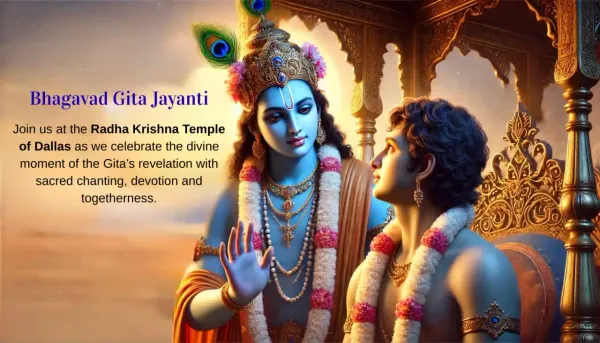
Bhagavad Gita Chapter 13 is one of the most profound philosophical chapters, revealing the distinction between the Kshetra (the body or the field) and the Kshetrajna (the knower of the body — the soul). Lord Krishna illuminates the eternal truth of self-awareness, knowledge, and the imperishable soul through this discourse to Arjun.
📜 Total verses: 35
🔗 Read the full chapter here: Bhagavad Gita Chapter 13
Understanding Kshetra and Kshetrajna – Body vs. Soul

Verse 13.1–2
“This body, O Arjun, is called the field (Kṣhetra), and one who knows this field is called the knower of the field (Kṣhetrajña) by the sages.”
🔗 BG 13.2
Lord Krishna distinguishes between the physical body (Kshetra) and the conscious soul (Kshetrajna). The soul is the perceiver and experiencer, while the body is the medium of experience.
🌺 Story from the Ramayan:
In the Ramayan, Jatayu, the vulture king, demonstrated this truth. When Ravana abducted Sita, Jatayu valiantly fought him, despite his old age. Mortally wounded, he waited for Shree Ram and narrated the event before dying. Ram performed his final rites personally.
🕊 Lesson: Jatayu knew he was not the body but the soul, a servant of God. His sacrifice was rooted in Kshetrajna-awareness — living for dharma, not bodily preservation.
The True Knowledge – What It Means to Be Wise
Verse 13.8–12
Lord Krishna lists 20 qualities of true knowledge, such as humility, non-violence, celibacy, and seeking the Absolute.
“Knowledge means to see the distinction between the soul and body and understand the pursuit of the Supreme.”
🧘 Patanjali Yog Sutra Insight:
The Yog Sutras emphasize Viveka Khyati — the discrimination between Purusha (soul) and Prakriti (nature). This aligns with Gita’s teaching of knowledge as inner clarity.
🌿 Story from the Puranas:

King Rantideva, in the Bhagavatam, had all material opulence but practiced humility and charity. Once, as he prepared to eat after fasting, a series of guests — a Brahmin, a Shudra, a hunter, and a beggar — came one after the other. Rantideva gave everything away, declaring:
“I do not desire from the Supreme Lord liberation or pleasure — I only desire that I may feel the suffering of all beings and remove their distress.”
🕊 Lesson: Real knowledge is service with humility, not intellectual pride.
The Role of the Supreme – God is the Knower of All Fields
Verse 13.3
“O Arjun, understand that I am also the knower of the field in all fields.”
🔗 BG 13.3
Here, Lord Krishna reveals that He is the Supreme Knower in every body — Paramatma, the Super-Soul.
🕉️ Upanishadic Reference:
The Katha Upanishad speaks of two birds on the same tree: one eats the fruit (soul), the other only watches (Supersoul). This image symbolizes the individual soul and God residing in the same body.
🌸 Story from the Mahabharat:

When Duryodhana was dying on the battlefield, he asked Krishna mockingly, “Where was your Dharma when Bhishma and Dronacharya fell?” Krishna replied, “It was always present, but you did not acknowledge Me as the Lord within.”
🕊 Lesson: God is the witness of all actions. When we recognize His presence within, we align with dharma.
The Nature of the Field – Elements and Qualities
Verse 13.5–6
Krishna explains that the body is composed of the five elements (earth, water, fire, air, ether), ego, mind, intellect, and the ten senses.
🔗 BG 13.5
📖 Vedic Insight:
The Taittiriya Upanishad details five sheaths of the body: Annamaya (physical), Pranamaya (energy), Manomaya (mind), Vijnanamaya (intellect), and Anandamaya (bliss) koshas — all part of Kshetra.
🌺 Story from the Ramayan:
When Hanuman leapt to Lanka, he was stopped by the serpent Surasa. He expanded his form to escape. She matched his size. Then Hanuman instantly shrank and flew into her mouth and out — escaping with intelligence.
🕊 Lesson: The body is changeable and temporary. True power lies in the intellect and soul — not just physical strength.
The Threefold Influences – Satva, Rajas, and Tamas
Verse 13.22
“The soul, seated in the body, experiences the three modes of nature—goodness, passion, and ignorance...”
🔗 BG 13.22
The soul identifies with the body and suffers due to Prakriti’s modes.
🌿 Mahabharat Insight:
Karna, though virtuous, let Rajas (passion) and Tamas (loyalty to evil) overpower his Satva. Despite knowing the truth, he chose Duryodhana out of attachment and fear of dishonor.
🕊 Lesson: The Gita asks us to transcend these modes by remembering our true self and aligning with Satva (purity).
Who Truly Sees – Vision of Unity
Verse 13.27–28
“One who sees the Supreme Lord equally present in all living beings truly sees.”
🔗 BG 13.27
🔗 BG 13.28
This is the vision of an enlightened soul — seeing all beings as equal, and God in all.
🌸 Saint’s Story:
Sant Tukaram was once beaten by those who disliked his devotional singing. He calmly said, “They only hit my body, not me. God is in them too.” His unwavering equanimity shocked everyone.
🌺 Ramayan Story:
When Bharat met Shree Ram in Chitrakoot, he wept bitterly and asked Ram to return to Ayodhya. Ram said, “Your love is selfless. You see Me in truth.” Bharat didn’t see the kingdom — he only saw God in his brother.
🕊 Lesson: Real vision is not external — it’s the ability to perceive divinity in all.
Imperishable Spirit and Perishable Body
Verse 13.31
“Those with the vision of truth see that the soul is eternal and not destroyed even when the body is destroyed.”
🔗 BG 13.31
This truth gives fearlessness — the soul neither kills nor can be killed.
📚 Upanishadic Quote:
“Na hanyate hanyamāne śarīre” – It is not slain when the body is slain
(Mundaka & Katha Upanishads)
🌺 Story from the Puranas:
In the Markandeya Purana, Sage Markandeya was destined to die at 16. On his birthday, Yama came to claim him, but Markandeya clung to a Shivling and chanted. Lord Shiva appeared and drove Yama away.
🕊 Lesson: The soul is immortal. Those who take shelter in God transcend death and fear.
Jnana – True Knowledge is the Means to Liberation
Verse 13.24
“Some perceive the soul through meditation, others through knowledge, and others through action...”
🔗 BG 13.24
Bhakti, Jnana, and Karma — all can lead to realization if offered to God.
🌼 Saint's Example:
Swami Vivekananda emphasized all paths leading to the same Truth. He said, “Each soul is potentially divine. The goal is to manifest this divinity.”
🌿 Ramayan Story:
Shabari, an old tribal woman, reached the Supreme by simple devotion — tasting fruits before offering to Ram. Her actions were pure bhakti.
🕊 Lesson: God is not reached by intellect alone but through devotion, humility, and surrender.
Summary: Who is Truly Liberated?
The soul, though bound by nature (Kshetra), is not touched by it — just like the lotus leaf remains untouched by water. This chapter urges us to become aware of our real identity, not to suppress the world, but to transcend it by understanding it.
“He who understands this knowledge, his actions do not bind him.”
🔗 BG 13.23
Final Reflections
- You are not the body. Realize your identity as a soul.
- God is within. Feel His presence in yourself and all beings.
- Knowledge must lead to devotion. Intellectual understanding must mature into surrender.
- Suffering is due to ignorance. Freedom lies in right vision.
Suggested Further Reading
- Patanjali Yog Sutras – for inner discrimination
- Upanishads – for the soul’s immortality
- Lives of saints like Tukaram, Eknath, and Ramakrishna – for bhakti in action
- Ramayan and Mahabharat – for dharmic dilemmas and soul awakenings
Conclusion
The 13th chapter of the Bhagavad Gita is a mirror held to the soul. It gently but firmly asks us: Who are you? Are you merely this body — or are you something far more sacred, luminous, and free?
Once this understanding dawns, our entire life becomes an offering. We stop clinging to pleasure and pain and start living with purpose, detachment, and grace. The soul blossoms when it realizes its Source — and that Source is none other than the Supreme Lord.
Call to Action
Want to deepen your Kshetra Kshetrajna Vibhag Yog?
📿 Join daily online Bhagavad Gita classes by JKYog: jkyog.org/online-classes
📲 Download the Free “Bhagavad Gita Krishna Bhakti” App:
Access daily verses, audio explanations, guided meditations, and more spiritual resources for your journey.
📺 Subscribe to Swami Mukundananda’s YouTube Channel:
Watch powerful spiritual discourses and find inspiration for your soul’s journey.
FAQs
1. What is the meaning of Kshetra and Kshetrajna in the Bhagavad Gita?
In Chapter 13 of the Bhagavad Gita, Kshetra refers to the body or field of activity, and Kshetrajna refers to the knower of that field — the individual soul. Lord Krishna explains that understanding the distinction between the body and the soul is the beginning of true knowledge.
2. What are the key teachings of Bhagavad Gita Chapter 13?
Bhagavad Gita Chapter 13 teaches the difference between the body and the soul, the nature of true knowledge, the role of God as the Supreme Knower, and how realizing this leads to liberation. It emphasizes discrimination, self-realization, and seeing the Divine in all beings.
3. How is Bhagavad Gita Chapter 13 relevant to daily life?
This chapter encourages inner reflection and helps one detach from bodily identity. By recognizing oneself as the soul, one becomes less affected by external events and more focused on spiritual growth. It promotes humility, self-awareness, and devotion to God.
4. What is the relationship between Kshetra, Kshetrajna, and Paramatma?
Kshetra is the physical body, Kshetrajna is the soul within the body, and Paramatma is the Supreme Soul who resides in all bodies. Lord Krishna explains that He is the ultimate knower in every body, witnessing all actions without attachment.
5. Which verses in Bhagavad Gita Chapter 13 explain the soul’s immortality?
Verses 13.31 and 13.22 highlight that the soul is eternal and remains unaffected even when the body perishes. The soul’s realization of its immortal nature leads to liberation.
References
📖 Bhagavad Gita Chapter 13 – Verse References
Additional Scriptural and Commentary Sources
- Vedanta Vision – Chapter 13 Summary
🔗 https://vedantavision.org/bhagavad-gita-chapter-13-summary/ - Pragmatic Gita – Verse-by-verse guide
🔗 https://pragmaticgita.com/kshetra-and-kshetrajna-vibhaga-yoga-1-to-7/ - Advaita Vedanta Commentary on Chapter 13
🔗 https://www.advaita-vedanta.co.uk/index.php/7-content/bhagavad-gita/81-bhagavad-gita-commentary-chapter-13 - Wikipedia Article – Kshetrajna
🔗 https://en.wikipedia.org/wiki/Kshetrajna
Related Yogic and Philosophical Texts
- Patanjali Yoga Sutra 2.20–2.23 (on Purusha & Prakriti)
🔗 https://www.yogasutra.net/yoga-sutra-2-20.htm
🔗 https://www.yogasutra.net/yoga-sutra-2-23.htm - Katha Upanishad – On the self beyond the body
🔗 https://www.swami-krishnananda.org/katha/katha_1-2.html - Brihadaranyaka Upanishad 3.7 (The Inner Controller)
🔗 https://www.swami-krishnananda.org/brdup/brhad_III-07.html