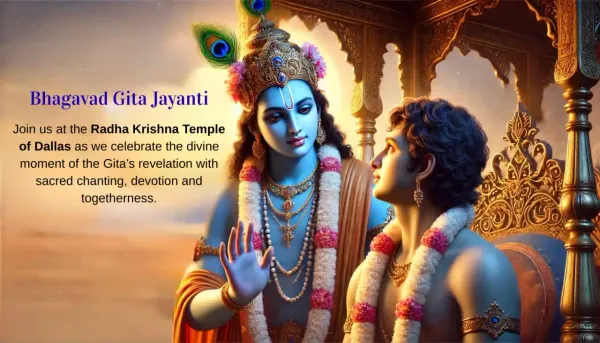
Yoga through Beholding the Cosmic Form of God
Chapter 11 of the Bhagavad Gita, titled Vishwarup Darshan Yog, is one of the most awe-inspiring revelations in the entire scripture. After patiently absorbing the teachings of Karma Yog, Bhakti Yog, and Jnana Yog, Arjun requests Krishna for a direct vision of His divine form. What follows is not just a divine spectacle, but a transformational experience that elevates Arjun’s understanding of who Krishna truly is — the Supreme Being encompassing all of creation.
“If You think that I am able to behold Your cosmic form, O my Lord, O Master of all mystic power, then kindly reveal Yourself to me.”
— Bhagavad Gita 11.4
Let us explore this profound chapter by interweaving stories from the Puranas and Itihasas, quotes from the Upanishads and Vedas, and insights from saints and yogic scriptures.
Arjun’s Request and Divine Curiosity

In Bhagavad Gita 11.3, Arjun, the great warrior and disciple of Lord Krishna, makes a humble yet profound request. He acknowledges the truth of all that Krishna has spoken so far — about His supreme divinity, His role as the sustainer and destroyer of the universe, and His manifestations through countless forms. But now, Arjun desires something more than intellectual understanding. He longs for a direct, experiential vision of Krishna's infinite nature.
“O Supreme Lord, You have graciously described Your own glories, which transcend the three worlds. I now wish to see this form of Yours as the Cosmic Being.”
— Bhagavad Gita 11.3
Until this point in the Gita, Arjun had received knowledge through words — about Krishna’s divine manifestations (Vibhutis), the imperishable Self, and the essence of dharma. However, the inner yearning of a sincere seeker drives him to go beyond conceptual belief to experiential realization. Arjun’s heart is moved not by doubt, but by divine curiosity — a sacred desire to witness the Supreme Reality with his own eyes.
This moment reflects a critical turning point in the dialogue:
- Faith transforms into longing.
- Knowledge blossoms into vision.
- The student seeks to directly perceive the Truth spoken by the teacher.
Arjun is not skeptical. He trusts Krishna completely — "I believe everything You have said." But he craves to see that glory for himself. This yearning is not borne out of arrogance or challenge, but out of deep reverence and spiritual thirst. It is a beautiful expression of bhakti (devotion) and jnana (wisdom) converging.
Through this request, Arjun becomes the medium for a divine revelation that benefits not just him, but all of humanity. His heartfelt plea leads to one of the most exalted spiritual visions in the entire scripture — the Vishwarupa Darshan, or the revelation of the universal form of God.
Arjun’s divine curiosity teaches us that spiritual progress is not merely about accepting truth passively, but about actively aspiring to experience the divine with the eyes of both faith and vision.
Upanishadic Echo:
The Katha Upanishad (2.3.9) mentions:
“The Self is not attained by instruction, nor by intellect, nor by much learning. He is attained only by the one whom He chooses.”
Lesson:
True spiritual growth begins when belief transforms into a deep longing for personal experience of the Divine.
Arjun shows us that it’s not enough to intellectually understand God’s greatness — the heart must yearn to behold and realize it. His humble request reflects the mindset of a true seeker: respectful, faithful, and yet passionately curious to go beyond words into vision.
Just as Arjun asked, “May I see You as You truly are,” we too can cultivate a similar yearning in our spiritual journey — to move beyond second-hand knowledge and enter into direct communion with the Divine.
Spiritual takeaway: Don’t settle for blind faith or mere ritual. Aspire for direct realization. Ask sincerely, and the Divine will reveal Himself in ways your heart can understand.
Krishna Grants Divine Vision
To fulfill Arjun’s request, Krishna blesses him with divine eyes:
“But you cannot see My cosmic form with your current eyes. Therefore, I give you divine vision.”
— Bhagavad Gita 11.8
Story Reference: Sage Durvasa and Ambarish

When Sage Durvasa tried to attack King Ambarish with a demon, he saw the Sudarshan Chakra manifest and follow him across all lokas. This cosmic weapon was not merely a tool of war — it was a symbol of the Lord's omnipresence, as later revealed to Durvasa by Lord Vishnu Himself.
Patanjali Yog Sutra Link:
In Sutra 3.36, Patanjali notes that through samyama (deep meditation), one gains divine sight (divya chakshu), a power to perceive subtle realities beyond normal perception.
Lesson:
Even seeing God requires divine grace. Spiritual perception is not gained by force — it is bestowed.
The Vishwarup is Revealed
What Arjun sees is indescribable — a form with infinite heads, arms, eyes, encompassing the sun, moon, fire, and all beings.
“Behold My opulences, hundreds of thousands of divine forms of various colors and shapes.”
— Bhagavad Gita 11.5
“Behold the entire universe, moving and non-moving, existing in one place in My body.”
— Bhagavad Gita 11.7
Puranic Connection: Vishnu’s Trivikrama Form

In the Vamana Avatar, Lord Vishnu took a gigantic form as Trivikrama, covering the earth and heavens in two steps. King Bali realized this was no ordinary Brahmin — but the Supreme Lord in His universal form.
Vedic Parallel:
The Rigveda 10.90, Purusha Suktam, describes the cosmic person whose “one-quarter is all creation, and three-quarters remain beyond.”
Lesson:
The universe is not outside of God — it is contained within Him. Everything we see is part of the divine body.
Arjun’s Overwhelming Experience
Arjun is astonished, thrilled, yet terrified. He sees all the warriors of both sides entering Krishna’s blazing mouths.
“I see all people rushing with full speed into Your mouths, as moths dash into a blazing fire.”
— Bhagavad Gita 11.29
Mahabharat Reference: Bhishma’s Understanding
Bhishma, lying on the bed of arrows, tells Yudhishthir that whatever is happening in the war is Krishna’s divine plan. Even he, a great warrior and scholar, bowed to this cosmic unfolding.
Saintly Insight:

Swami Vivekananda once said, “The moment I realize I am nothing, that is when I become everything.” The vision of the cosmic form humbles even the greatest ego.
Lesson:
Seeing the Divine’s grandeur shatters the ego. One realizes their smallness in the vast plan of the universe.
Krishna’s Role as Time – The Destroyer
Arjun is especially shocked when Krishna declares:
“I am time, the great destroyer of the world, and I have come here to destroy all people.”
— Bhagavad Gita 11.32
Ramayan Connection: Lord Ram and Ravana

Lord Ram gave Ravana multiple chances to return Sita and surrender. But when Ravana refused, time (Kala) manifested through Ram’s arrows. The Lord is gentle, but when evil persists, He becomes the destroyer.
Upanishadic Wisdom:
In the Brihadaranyaka Upanishad (1.2.1), time is said to be the first manifestation of the Divine:
“In the beginning, this universe was nothing but the Self in the form of Purusha. He created time, and from time arose the entire cosmos.”
Lesson:
Time is not neutral — it is divine. Those who align with dharma move with time; those who oppose it are crushed by it.
Be an Instrument – Krishna’s Invitation
Krishna assures Arjun that the war’s outcome is already decided. He need only play his part:
“Therefore, arise and attain honor! Conquer your enemies and enjoy a prosperous kingdom. They are already put to death by My arrangement; you, O Arjun, are merely an instrument.”
— Bhagavad Gita 11.33
Ramayan Story: Hanuman in Lanka
When Hanuman set Lanka ablaze, he did so not as a monkey but as the Lord’s instrument. He surrendered his ego and simply acted as a tool of divine will.
Yog Sutra Correlation:
Patanjali describes in Sutra 2.45:
“By total surrender to Ishwara, samadhi is attained.”
Here, the ego dissolves and the seeker becomes a pure channel.
Lesson:
Spiritual action is not about success or failure — it is about surrendering the doer-ship and becoming a divine instrument.
Arjun’s Praise and Apology
Overwhelmed, Arjun folds his hands and praises Krishna, recalling past instances where he addressed Him casually. Now, realizing Krishna’s cosmic stature, he seeks forgiveness.
“Thinking of You as my friend, I presumptuously addressed You as ‘O Krishna,’ ‘O Yadav,’ ‘O my dear friend,’ and so on. I beg forgiveness for all such indiscretions.”
— Bhagavad Gita 11.41
Mahabharat Episode: Duryodhan’s Disrespect
In contrast, Duryodhan mocked Krishna and refused to accept His divinity. When Krishna revealed His Vishwaroop in Hastinapur’s court, the blind king Dhritarashtra gained momentary vision and saw Krishna’s glory — but Duryodhan remained blind in ego.
Insight from Saints:
Saint Tulsidas in Ramcharitmanas says,
“Janma koti lagi raghunatha, charan preet nahi jehi” – Even after millions of births, one cannot love the Lord’s feet unless graced by Him.
Lesson:
Familiarity with God must not breed casualness. Humility and reverence are keys to receiving grace.
The Lord’s Return to Gentle Form

Seeing Arjun trembling in fear, Krishna reassures him and returns to His human-like form:
“Do not be afraid or bewildered on seeing My dreadful form. With a peaceful mind, now behold the form you are familiar with.”
— Bhagavad Gita 11.49
Story: Krishna’s Role as a Charioteer
Krishna’s return to His sweet, human form — the compassionate charioteer — reminds Arjun that the Infinite is also Intimate. The Lord is not just the Creator of galaxies, but the one who guides our daily journey with love.
Vedic Principle:
The Isha Upanishad declares:
“He moves and He moves not; He is far and He is near; He is within all and also outside all.” (Verse 5)
Lesson:
The Supreme is both terrifyingly vast and tenderly close. To the ego He appears formidable, but to the surrendered heart, He is deeply personal.
Conclusion: The Essence of Vishwarup Darshan Yog
Bhagavad Gita Chapter 11 gives us a powerful reminder — that God is not just a kind figure we pray to in temples. He is time, space, life, death, and the very fabric of reality. Yet, He is also our friend, guide, and charioteer.
Those who see Him in all and surrender to His will experience peace amidst the storm.
“With unwavering devotion, one can behold this form of Mine, truly know Me, and enter into union with Me.”
— Bhagavad Gita 11.54
🪔 Key Lessons from Chapter 11
- Divine vision is a gift, not an entitlement.
- God is all-pervading — the world is His form.
- Time is divine and must be respected.
- Be an instrument, not the controller.
- Ego must bow to realize God.
- True surrender brings divine intimacy.
🧘♀️ Join the Path
Want to learn more about the Bhagavad Gita?
🎓 Join Online Gita Classes with JKYog and the Radha Krishna Temple of Dallas:
Study the Gita systematically and apply its teachings to experience a spiritually fulfilling life.
📲 Download the Free “Bhagavad Gita Krishna Bhakti” App:
Access daily verses, audio explanations, guided meditations, and more spiritual resources for your journey.
🎥 Subscribe to Swami Mukundananda’s YouTube Channel for in-depth discourses.
FAQs on Vishwarup Darshan Yog
Q1: What is the Vishwarup Darshan in Bhagavad Gita Chapter 11?
It is the revelation of Krishna’s cosmic form showing that all of creation is within Him.
Q2: What is the significance of “I am Time” in BG 11.32?
It signifies Krishna’s identity as the divine force behind creation and destruction.
Q3: Why did Krishna give Arjun divine vision?
Because the cosmic form cannot be seen with material eyes — it requires divine grace.
Q4: What does BG 11.33 mean by being an instrument?
It teaches surrender — letting go of ego and becoming a vehicle of divine will.
Q5: What is the key message of Vishwarup Darshan Yog?
That the Lord is both immanent and transcendent, and true devotion leads to this realization.
Reference
All Bhagavad Gita verse references can be linked to:
Source: holy-bhagavad-gita.org
- Bhagavad Gita 11.3: https://www.holy-bhagavad-gita.org/chapter/11/verse/3
- Bhagavad Gita 11.4: https://www.holy-bhagavad-gita.org/chapter/11/verse/4
- Bhagavad Gita 11.5: https://www.holy-bhagavad-gita.org/chapter/11/verse/5
- Bhagavad Gita 11.7: https://www.holy-bhagavad-gita.org/chapter/11/verse/7
- Bhagavad Gita 11.8: https://www.holy-bhagavad-gita.org/chapter/11/verse/8
- Bhagavad Gita 11.29: https://www.holy-bhagavad-gita.org/chapter/11/verse/29
- Bhagavad Gita 11.32: https://www.holy-bhagavad-gita.org/chapter/11/verse/32
- Bhagavad Gita 11.33: https://www.holy-bhagavad-gita.org/chapter/11/verse/33
- Bhagavad Gita 11.41: https://www.holy-bhagavad-gita.org/chapter/11/verse/41
- Bhagavad Gita 11.49: https://www.holy-bhagavad-gita.org/chapter/11/verse/49
📜 Upanishads and Vedas
- Katha Upanishad 2.3.9 (on divine realization):
https://www.swami-krishnananda.org/katha/katha_2-3.html - Brihadaranyaka Upanishad 1.2.1 (on time as divine):
https://www.advaita-vision.org/brhadaranyaka-upanishad-1-2-1/ - Isha Upanishad Verse 5 (on omnipresence):
https://www.holy-bhagavad-gita.org/upanishads/isha-upanishad/verse-5 - Rigveda 10.90 - Purusha Sukta (on cosmic being):
https://www.sacred-texts.com/hin/rigveda/rv10090.htm
📚 Patanjali Yog Sutras
- Sutra 3.36 (divine sight):
https://www.yogasutra.net/yoga-sutra-3-36.htm - Sutra 2.45 (surrender to Ishwara):
https://www.yogasutra.net/yoga-sutra-2-45.htm